Can You Beat Roulette? How to Win at Roulette
Individual roulette sessions can win by chance. A persistent advantage requires something beyond a staking pattern, such as different outcome probabilities or favorable terms.

For independent uniform spins and standard payouts, changing bets from past results does not remove the house edgemathHouse edgeThe casino’s expected net gain expressed as a fraction of the stake, under specified probabilities and payouts.Read full definition →. Physical prediction and wheel bias concern different models and require separate evidence.
Why systems fail
Each standard single-zerowheelZeroThe 0 outcome, conventionally shown in green. Ordinary color, parity, high/low, dozen and column bets do not include it.Read full definition → bet has conditional expected return −1/37 of its stake when outcomes are independent and uniform. Summing over a bounded session gives expected lossmathExpected lossThe probability-weighted average net loss under a stated model. With a constant edge, it equals edge times expected total stakes.Read full definition → equal to expected turnovermoneyTurnoverThe sum of amounts wagered over a session or period, including money wagered again after a return. Also called handle or action.Read full definition → divided by 37. A past-result staking rule cannot change that. Unbounded stopping schemes require additional conditions, and special zero rules or promotions must be analyzed separately.
What has worked
Wheel bias concerns unequal pocketequipmentPocketA compartment on the rotor in which the ball can settle. The number of pockets depends on the wheel.Read full definition → probabilities. Physical prediction uses measurements of ballequipmentBallThe small ball that settles in a numbered pocket to determine a physical roulette result.Read full definition → and rotorequipmentRotorThe rotating part of a physical roulette wheel, carrying the numbered pockets.Read full definition → motion. “Dealer signature” is a separate claim that a dealer’s release permits useful predictions; a staking formula alone establishes none of these. Historical reports need to distinguish measured advantage, reported winnings and chance.
Bethell’s later account describes Jagger recording wheel results, betting favored numbers and facing casino countermeasures.
A contemporary report describes Wells’ large winnings and his claim of a private system. It does not establish a repeatable advantage.
Thorp and Shannon test a wearable roulette computer. Thorp’s later account describes useful predictions but repeated wiring failures.
The Eudaemons develop wearable roulette computers. Farmer’s retrospective account reports an advantage, small stakes and persistent hardware problems.
García-Pelayo describes collecting results to identify wheel bias. A 2004 Spanish Supreme Court judgment rejects the casino’s appeal over the family’s exclusion.
Reports describe a £1.3 million Ritz win. The players were not prosecuted and kept the winnings; their exact method remains disputed.
Small and Tse publish laboratory work on physical prediction. Their manual-timing trial predicts the target half-wheel in 13 of 22 trials, corresponding to a sample return near +18%; this small trial does not establish a reliable casino profit rate.
Why a laboratory result is not a casino guarantee
Maintenance and betting cutoffs can reduce opportunities for physical prediction, but it is too strong to say every modern wheel is unbiased or every possible advantage is detected immediately. Laboratory evidence also does not establish a usable advantage at a particular casino. Legal restrictions are jurisdiction-specific: Nevada’s NRS 465.075 prohibits specified advantage devices and software, subject to the statute’s terms and approval exception.
How to beat roulette, in principle only: what it would require
If a pocket’s true probabilitymathProbabilityA measure of how likely an event is, from zero to one. Percentages express the same scale from 0% to 100%.Read full definition → were 1/33 and its net payoutmoneyPayoutThe amount paid on a winning wager. Check whether the quoted figure is net profit or total return including the stake.Read full definition → 35:1, expected return would be 36/33 − 1 = 3/33, about +9.09% of the stake. The difficult step is establishing that probability prospectively. Required data depend on the effect size, chosen error rates, repeated testing and how many pockets were searched. There is no universal 10,000-spin threshold, and a changing wheel can invalidate an estimate.

The honest answer
A simulator can illustrate a precisely defined model, but a few simulated sessions do not prove a system profitable or unprofitable. Under the independent standard model, the expected-value calculation rules out a staking advantage. Claims about a physical wheel require independent evidence. If you choose to play, use an affordable spending limit and check the actual payout and zero rules.
Questions
No staking strategy guarantees consistent profit on independent standard spins. A winning session does not establish an advantage.
Yes, physical imperfections are possible. Whether a particular wheel has a stable, exploitable bias is an empirical question; neither its age nor its licensing status settles it.
Rules vary by jurisdiction. Nevada NRS 465.075 restricts advantage devices and software; this does not establish the law everywhere. An app’s marketing claim also does not establish that it works.
Comic relief
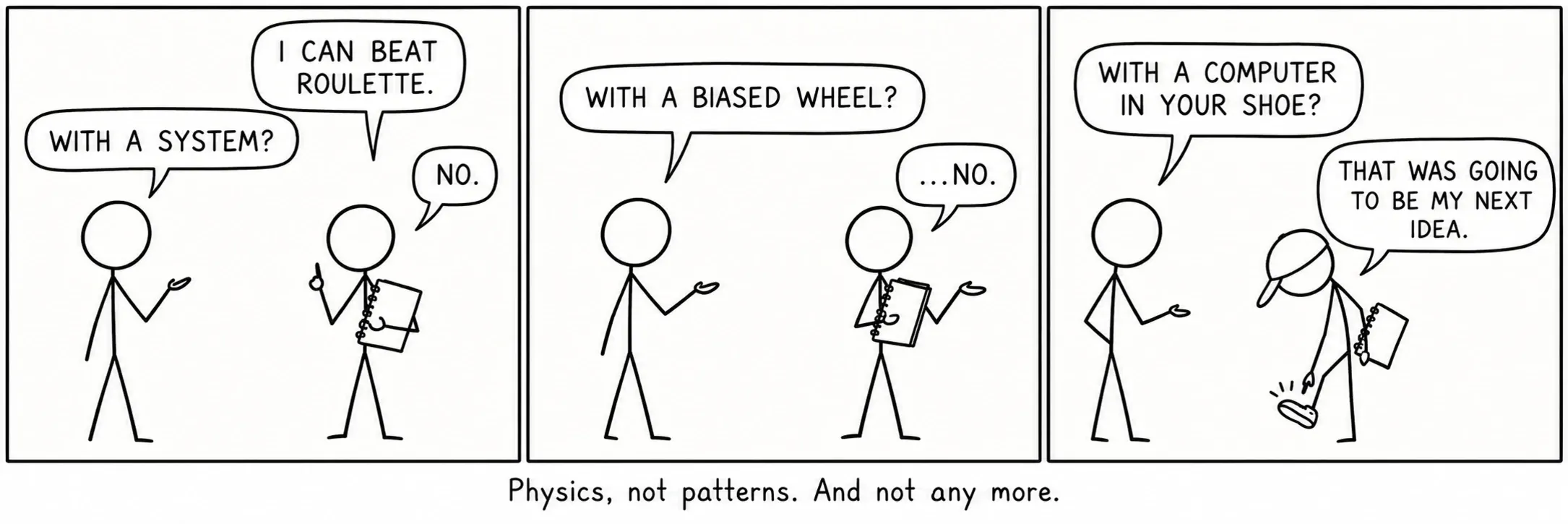
A staking pattern is not evidence of an advantage.
Sources
- RouletteDoc. Roulette strategies overview.
- Roulette77. Roulette strategies overview.
- Thorp, E. O. “Optimal gambling systems for favorable games.”
- Thorp, E. O. Elementary Probability.
- Doob, J. L. “Note on probability.”
- Halmos, P. R. “Invariants of certain stochastic transformations: the mathematical theory of gambling systems.”
- Bass, T. A. The Eudaemonic Pie.
- Small, M. & Tse, C. K. “Predicting the outcome of roulette.”
- Barnhart, R. T. Beating the Wheel.
- Chellel, K. “The Gambler Who Beat Roulette.”
- Nevada Legislature. NRS 465.075: advantage devices and software.
- Daily Telegraph, 9 November 1891 — report reproduced by Robin Quinn