Inside vs Outside Bets in Roulette
Inside vs outside bets in roulette: two families of bets, one house edgemathHouse edgeThe casino’s expected net gain expressed as a fraction of the stake, under specified probabilities and payouts.Read full definition →.

Inside bets cover one to six numbers and pay 5:1 to 35:1. Outside bets cover twelve or eighteen numbers and pay 2:1 or 1:1.
What are inside bets in roulette?
Straight upbetStraight upA wager on one number, ordinarily paying a profit of 35 to 1.Read full definition →, splitbetSplitA wager on two numbers sharing an allowed layout boundary, ordinarily paying 17 to 1.Read full definition →, streetbetStreetA bet on one row of three layout numbers, ordinarily paying 11 to 1.Read full definition →, cornerbetCornerFour numbers sharing a layout intersection, ordinarily paying 8 to 1.Read full definition → and six linebetSix lineA bet on six numbers in two adjacent layout rows, ordinarily paying 5 to 1.Read full definition → all live inside the number grid. They win rarely and pay a lot. A straight up wins one spin in 37 on average and pays 35 to 1; a six line covers 6 of 37 pocketsequipmentPocketA compartment on the rotor in which the ball can settle. The number of pockets depends on the wheel.Read full definition →, wins about 16.22% of spins on average and pays 5 to 1. Some tables apply the inside minimum to the combined stake; others impose different limits. Check before assuming five $1 chipsmoneyChipA token used to place a wager, with a printed or assigned value. Also called a check in some casino terminology.Read full definition → satisfy a $5 minimum.
The experience is streaky. A straight-up player can go 70 spins without a hit (probabilitymathProbabilityA measure of how likely an event is, from zero to one. Percentages express the same scale from 0% to 100%.Read full definition → about 15%) and then collect $350 on a $10 chip. If all 70 fixed $10 bets are made, expected lossmathExpected lossThe probability-weighted average net loss under a stated model. With a constant edge, it equals edge times expected total stakes.Read full definition → is about $18.92. The possible net results range from −$700 with no hits to +$24,500 with 70 hits; the upper extreme is extraordinarily unlikely.
What are outside bets in roulette?
DozensbetDozenA bet on 1–12, 13–24 or 25–36, ordinarily paying 2 to 1.Read full definition →, columnsbetColumnTwelve numbers in one vertical layout column, ordinarily paying 2 to 1.Read full definition →, redbetRedAn even-money wager on the 18 red numbers. French: rouge.Read full definition →, blackbetBlackAn even-money bet on the 18 black numbers. French: noir.Read full definition →, odd, even, high and low sit in the boxes around the grid. They win often and pay little: 2 to 1 for dozens and columns; 1 to 1 for red, black, odd, even, high and low. Each outside betbetOutside betA bet in the areas surrounding the numbered grid, including dozens, columns and the six even-money options.Read full definition → commonly has its own minimum; check the table rules. Each red bet changes the balance by one stake. Over a fixed number of spins, expected loss is 2.70% of turnovermoneyTurnoverThe sum of amounts wagered over a session or period, including money wagered again after a return. Also called handle or action.Read full definition →, but actual losses can be much larger.
What changes, what does not
The spread of outcomes changes completely between the two families. The average does not. Under standard single-zerowheelZeroThe 0 outcome, conventionally shown in green. Ordinary color, parity, high/low, dozen and column bets do not include it.Read full definition → rules, both have expected loss of 1/37 of the amount wagered. Actual results need not equal that average. The table below shows the same $10, 100-spin session under both; the expected result is identical and the typical range is six times wider for the straight up.
| $10 × 100 spins | straight up | red |
|---|---|---|
| expected result | −$27 | −$27 |
| standard deviation | $584 | $100 |
| mean ±1σ (not guaranteed) | −$611 to +$557 | −$127 to +$73 |
| p(session in profit) | 50.94% | 35.53% |
| p(no win at all) | 6.5% | ≈ 0% |
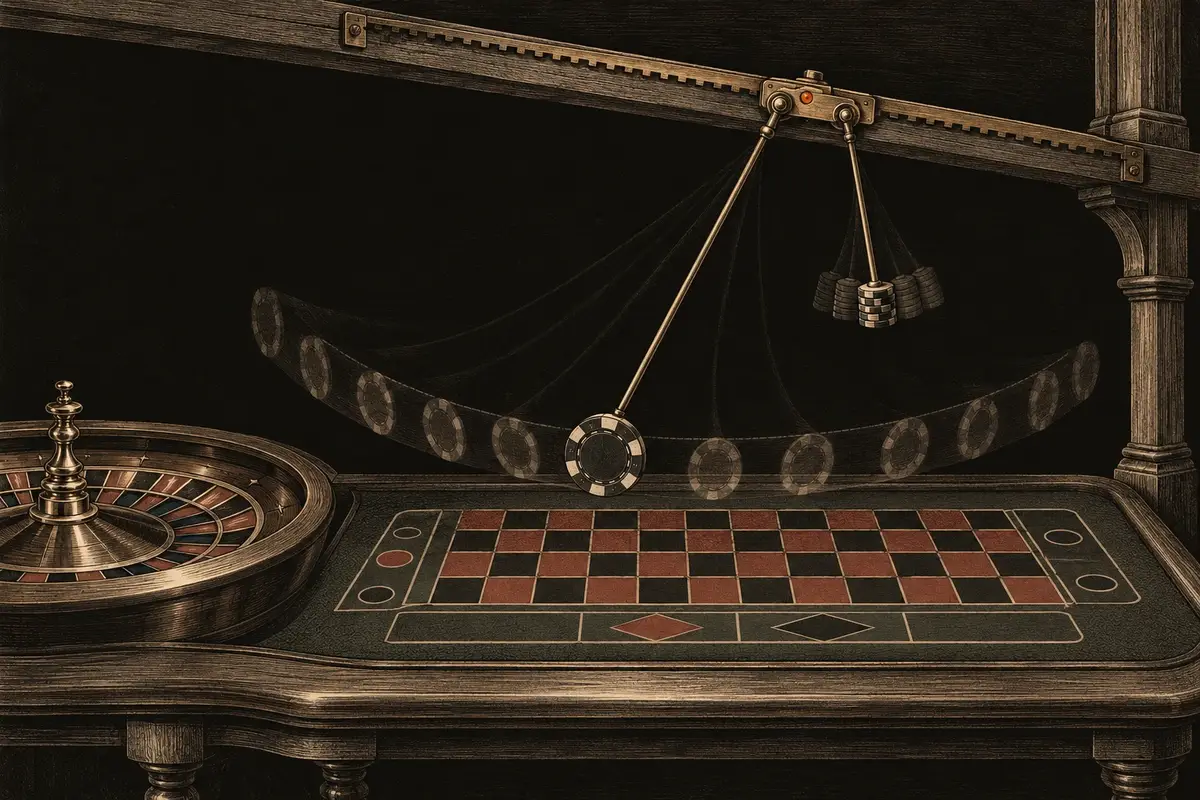
Choosing how to bet on roulette: by experience, not by edge
A smaller fixed stake on an even-money betbetEven-money betA bet paying a profit equal to the stake, such as red/black, odd/even or high/low.Read full definition → reduces the cash movement on each spin, but does not guarantee a long session. If you want the chance of a big win and accept a high chance of losing the whole budget, inside betsbetInside betA wager placed on or between the numbered layout cells, such as a straight up, split, street, corner or six line.Read full definition → deliver that. Neither is smarter. Expected loss depends on expected turnover and the actual payoutmoneyPayoutThe amount paid on a winning wager. Check whether the quoted figure is net profit or total return including the stake.Read full definition → rules.
- p10 −$420
- p25 −$280
- median −$120
- p75 +$20
- p90 +$140
Mixing families
Many players mix roulette inside and outside bets: a few straight ups for the lottery ticket and red for the ride. Because expected valuesmathExpected valueThe sum of each possible net result multiplied by its probability. It can be positive, zero or negative.Read full definition → add, the mix has an expected loss of 2.70% of the total while its variancemathVarianceThe expected squared distance of a result from its expected value. It measures dispersion in squared units.Read full definition → depends on the stake weights and how the bets overlap. The Bet Builder shows coverage, net results on covered pockets and expected loss for the supported combinations. It does not display variance.
- p10 −$500
- p25 −$500
- median −$500
- p75 +$40
- p90 +$1,480
Questions
Even-money outside bets are simpler to follow and have smaller swings per unitmoneyUnitA base amount used to express stakes or results.Read full definition → than a straight-up bet. Keep the stake within your budget; no bet guarantees a particular session length.
Under standard single-zero rules, the expected casino profit per dollar is the same. The cash amount wagered, number of spins and payout exposure matter more than the inside/outside label.
Check the posted limits or ask the dealer. Tables can apply separate minimums to inside bets and individual outside bets.
Fun with Math
Try these yourself first. Each solution is folded; open it when you are ready.
You put $10 on redbetRedAn even-money wager on the 18 red numbers. French: rouge.Read full definition → and $1 on 17, which is blackbetBlackAn even-money bet on the 18 black numbers. French: noir.Read full definition →, for one spin of a European wheel. List what can happen and what the pair of bets costs on average. Then do the same for $10 on red and $10 on black.
Show the solution
Answer Red: +$9. The 17: +$25. Any other number: −$11. On average −$11/37, about 30¢, which is 2.70% of the $11 staked. Red and black together lose $20 on the zerowheelZeroThe 0 outcome, conventionally shown in green. Ordinary color, parity, high/low, dozen and column bets do not include it.Read full definition → and nothing otherwise: −$20/37, 2.70% of $20.
Red comes up 18 times in 37: the $10 wins $10 and the $1 on 17 is lost, +$9. The 17 comes up once: the red bet loses $10 and the $1 wins $35, +$25. The other 17 black numbers and the zero, 18 pocketsequipmentPocketA compartment on the rotor in which the ball can settle. The number of pockets depends on the wheel.Read full definition → in all: both bets lose, −$11.
Average: (18 × 9 + 25 − 18 × 11)/37 = (162 + 25 − 198)/37 = −11/37.
Each bet keeps its own price when it is combined with another: the $10 on red costs 10/37 on average, the $1 on 17 costs 1/37, and together 11/37. Mixing bets changes how the results are spread, not what they cost. Red and black together make every result but the zero a wash and still pay 2.70% of everything staked, all of it on the zero. On a uniform double-zero wheel, the same standard bets each have an edge of 2/38, or 5.26%.
Comic relief
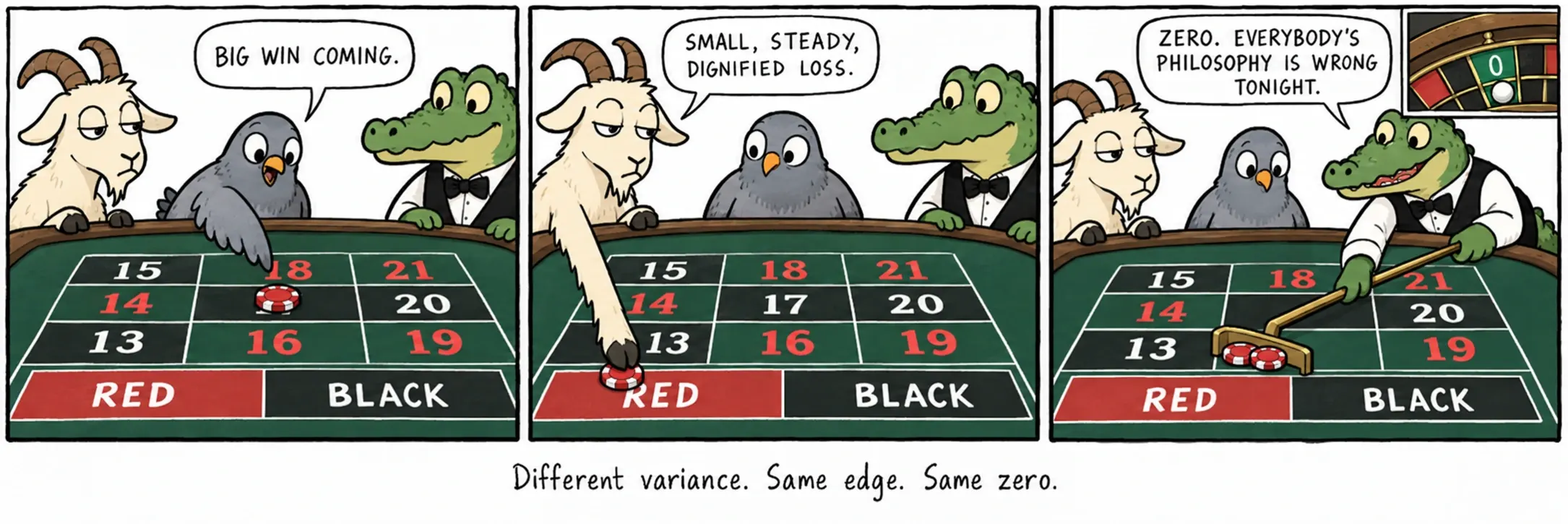
Standard single-zero bets: different swings, same house edge.
Sources
- Ethier, S. N. The Doctrine of Chances: Probabilistic Aspects of Gambling.
- Epstein, R. A. The Theory of Gambling and Statistical Logic, 2nd ed.