Famous Roulette Players
The people who beat the wheel, and how long it lasted.
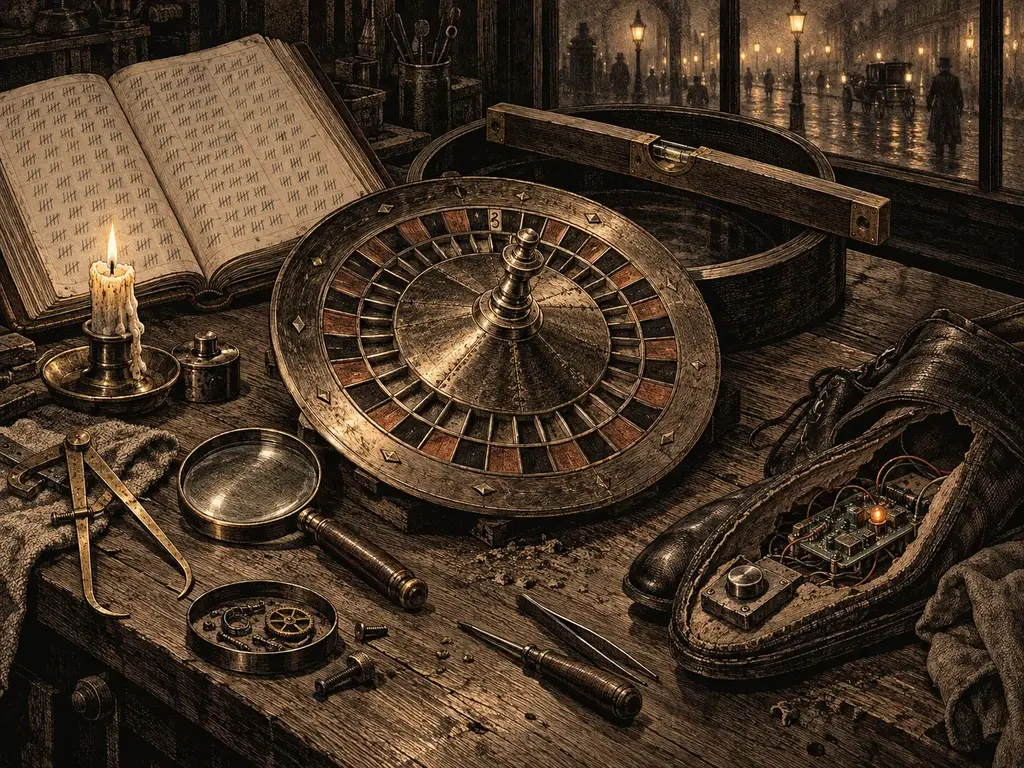
The documented winners exploited physics, not patterns: Jagger’s biased wheellabBiased wheelA wheel whose physical defects make some pockets more likely than 1/37. Rare, detectable only with thousands of recorded spins.Read full → (around 1880), Hibbs and Walford in Reno (1947), the Eudaemons’ hidden computers (1978), the García-Pelayo family’s bias records (1990s). The famous “system” winners, like Charles Wells, were lucky.
Joseph Jagger (1830–1892)
A textile businessman from Shelf, near Bradford, whose Manchester firm had failed in 1860. Around 1880 he went to Monte Carlo, had the wheels recorded, and bet the numbers that came up too often. The earliest account, Victor Bethell’s book of 1901, says he won £120,000, lost £40,000 of it back and left with about £80,000, some two million francs, and that the casino first moved its wheels from table to table each night and then ordered new ones with movable partitions. No newspaper of the time reported the win, and the casino’s papers for those years are gone. His biographer Anne Fletcher (2018), his great-great-great-niece, dates the first visit to 1880 or 1881, not the 1873 or 1875 of older retellings. The six hired clerks are Bethell’s; the list of nine numbers and the scratch he is supposed to have cut into a wheel first appear in 1951, and nothing supports them. When he died in 1892 his estate was modest. The Joseph Jagger page goes through the evidence.
Charles Wells (1841–1922)
A fraudster and inventor who arrived at Monte Carlo in 1891 with money raised for a fake invention and broke the bank several times in a few days, winning about £40,000 with an astonishing run. He claimed an infallible system and never explained it. He became “The Man Who Broke the Bank at Monte Carlo” in a music-hall song, lost part of the money back that winter, and spent much of the rest of his life in prison for fraud. Whatever his system was, his result was luck.
Hibbs and Walford (1947)
In 1947 two University of Chicago students, Albert Hibbs, who was finishing a master’s degree in mathematics, and Roy Walford, a medical student, spent a vacation in Reno recording spins. They were looking for wheels on which some numbers came up more often than 1 in 38 allows, found some, bet them, and moved on to Las Vegas. Life magazine told the story in December 1947 under the headline “How to Win $6,500”; later accounts, including Hibbs’s own, give larger totals, and Thorp, writing in 1998, dated it to 1949–50. The money paid for a 40-foot sailboat and more than a year in the Caribbean. Hibbs went on to the Jet Propulsion Laboratory, where he became its best-known public voice, and Walford became a researcher on ageing. Theirs is the first well-documented American win from wheel bias, and it is what Thorp had in mind in 1955 when he decided that well-made wheels would have to be beaten by physics instead.
Norman Leigh (1966)
In the summer of 1966 Norman Leigh, an Englishman who wrote that his father had been ruined at roulette, took a team of twelve to the Casino Municipal in Nice. By his own account they played the reverse LabouchèrestrategyLabouchèreCancellation system: write a line of numbers, bet the sum of the two ends, cross them off after a win, add the lost stake after a loss.Read full → on all six even chances at two tables, won heavily over several nights, and were stopped when the casino closed the tables and barred them from French casinos. His book, Thirteen Against the Bank (1976), is the only full witness, and its sums cannot be checked. The system cannot explain them: reverse Labouchère costs 1.35% of turnovermoneyTurnoverThe total amount wagered over a session or period, counting re-bet winnings. Also: handle, action.Read full → with la partageruleLa partageFrench rule: when zero hits, half of an even-money stake is returned. Halves the house edge on those bets to 1.35%.Read full → and wins only in the occasional session where a line runs up to the maximum (see Labouchère). Twelve players on six chances over several nights play many sessions, a few of them were bound to be large wins, and the casino closing the game kept the luck from evening out.
Thorp and Shannon (1961)
Edward Thorp, who went on to beat blackjack with card counting, and Claude Shannon, founder of information theory, built the first wearable computer: a cigarette-pack-sized device that timed the ballequipmentBallThe small ball launched along the track against the rotor. Modern balls are ivorine or Teflon, 18–21 mm.Read full → and rotorequipmentRotorThe spinning part of the wheel that carries the pockets.Read full → and sent a tone to an earpiece naming an octant of the wheel. It worked in Shannon’s basement on a bought wheel and intermittently in Las Vegas, where wires broke and the earpiece was visible. They stopped for practical reasons; Thorp announced the system in 1966 and described it in full in 1979 and 1984 (see Advantage Play).
The Eudaemons (1976–1981)
A group of physics graduate students at Santa Cruz built small digital computers to wear in a casino: one player timed the wheel with toe switches, the computer predicted a sectorwheelSectorA contiguous arc of pockets on the wheel, as distinct from a group on the layout.Read full →, and a second player received the prediction by vibration and bet it. In 1977 and 1978 the computer was strapped under the arm; a later version, built into the sole of a shoe, went to Las Vegas in November 1981 and was beaten by the electrical noise of the casinos. Their tests promised an edge of 44%, and their first long session at a real table gave about 25%. The hardware rarely worked for long: loose wires, electric shocks and once a burn from overheated wiring ended many sessions. They won a few thousand dollars at dime and quarter stakes, spent about $15,000 and left a good book. The Eudaemons page tells the story.
Jagger · bias · had the wheels recorded and bet the numbers that ran ahead. The casino moved its wheels, then replaced them.
Wells · luck · a long run and a system he never explained. Lost part of it back that winter.
Hibbs & Walford · bias · recorded spins in Reno and Las Vegas. Life told the story; they bought a boat.
Thorp & Shannon · timing · first wearable computer. Hardware too fragile for the floor.
Jarecki · bias · up to a month of records per wheel, mostly at Sanremo. Over $1.2 million by many accounts; barred, then readmitted.
Eudaemons · timing · hidden computers in Nevada. Edge real, electronics unreliable.
García-Pelayo · bias · 5,000 recorded spins per wheel near Madrid. Barred; the courts overturned the ban.
Ritz team · prediction · £1.3m in two nights. Press reported a laser; none was produced. Money kept.
Richard Jarecki (1931–2018)
A German-born American doctor who, with his wife Carol and a few helpers, recorded single-zerowheelZeroThe single green pocket that no even-money, dozen or column bet covers; the source of the house edge. Also: single zero, 0.Read full → wheels in European casinos in the 1960s and early 1970s, above all at Sanremo, and bet the numbers that came up too often. By Carol Jarecki’s account one wheel could take more than 10,000 spins and as long as a month. The New York Times obituary says that by many accounts he won more than $1.2 million; the figure was never audited. He told reporters that a computer at the University of London had cracked the game, which the Times and the roulette historian Russell Barnhart describe as a cover for plain observation. Sanremo asked him to stay away in January 1969, barred him as a professional gambler in February and readmitted him within days, moved its tables about, and in the end replaced some two dozen wheels. He went back to the United States in 1973 or 1974. The Richard Jarecki page has the details.
Gonzalo García-Pelayo (born 1947)
A Spanish record producer and film director who, with his children and nephews, recorded about 5,000 spins per wheel at Casino Gran Madrid, outside the city, from late 1991, and bet the pocketsequipmentPocketOne of the 37 numbered compartments on the rotor. Also: slot, cup.Read full → that ran ahead. By his own figures the best pocket won once in 28 spins and the advantage was about 6%; he puts the winnings at 200 to 250 million pesetas across several casinos. The casino barred the family, the government overruled the ban, and the casino’s appeals failed, the last of them in the Supreme Court in June 2004. The court said the players had used ingenuity and a computer and nothing more, and that a casino’s lawful answer is to move its wheels, exchange their parts or build them better. The Gonzalo García-Pelayo page tells it in full.
The Ritz three (2004)
Three players, two men and a woman from the former Yugoslavia and Hungary, won about £1.3 million over two nights in March 2004 at the Ritz Club in London, betting late on small groups of neighboring numbers. The newspapers reported a laser scanner hidden in a phone; no such device was ever produced. They were arrested and released, and in December 2004 the police dropped the case and returned the money, because the old law against cheating did not reach what they had done. Bloomberg’s 2023 account of the leader, a Croatian known as Niko Tosa, describes prediction by eye on a wheel with a slight tilt, not a gadget. The Gambling Act 2005 replaced the old offense with a broader one of cheating, in force from 2007; whether it covers prediction by eye has never been tested in court. It was the last large, public win against roulette by prediction.
What they have in common
Every documented winner either measured the wheel (Jagger, Hibbs and Walford, Jarecki, García-Pelayo) or predicted the ball (Thorp, the Eudaemons, the Ritz team). Not one of them won with a betting pattern, and the one famous system player, Wells, gave part of it back within months and ended in prison. Every method they used was eventually closed off by casinos changing the wheel, the rules or the law. The Lab pages explain the methods; this page explains why you have heard of so few people.
Questions
Not publicly, and the conditions that allowed it have been engineered away.
A popular claim. His biographer says only that genealogists have suggested a distant link; nothing has been published to show it.
Because recording changes nothing on a maintained wheel, and because banning notebooks is bad for business. They maintain the wheels instead.
Comic relief

Engineers measured the wheel. Everyone else got a song.
Sources
- Bass, T. A. The Eudaemonic Pie.
- Barnhart, R. T. Beating the Wheel.
- Thorp, E. O. “Optimal gambling systems for favorable games.”
- Thorp, E. O. “The invention of the first wearable computer.”
- Schwartz, D. G. Roll the Bones: The History of Gambling.
- Chellel, K. “The Gambler Who Beat Roulette.”
- Fletcher, A. From the Mill to Monte Carlo.
- Quinn, R. The Man Who Broke the Bank at Monte Carlo.
- Leigh, N. Thirteen Against the Bank.
- Life. “How to Win $6,500: Two student theoreticians invent system for beating roulette wheel.”
- The New York Times. “Richard Jarecki, Doctor Who Conquered Roulette, Dies at 86.”
- Bethell, V. Monte Carlo Anecdotes and Systems of Play.
- Sampedro, J. “Los ‘tecnotahúres’ vuelven al casino.”