Roulette Dinner
Pick the one number you think will not come and cover the other 36. Win one unit almost every spin, and lose 143 on the spin you were wrong.
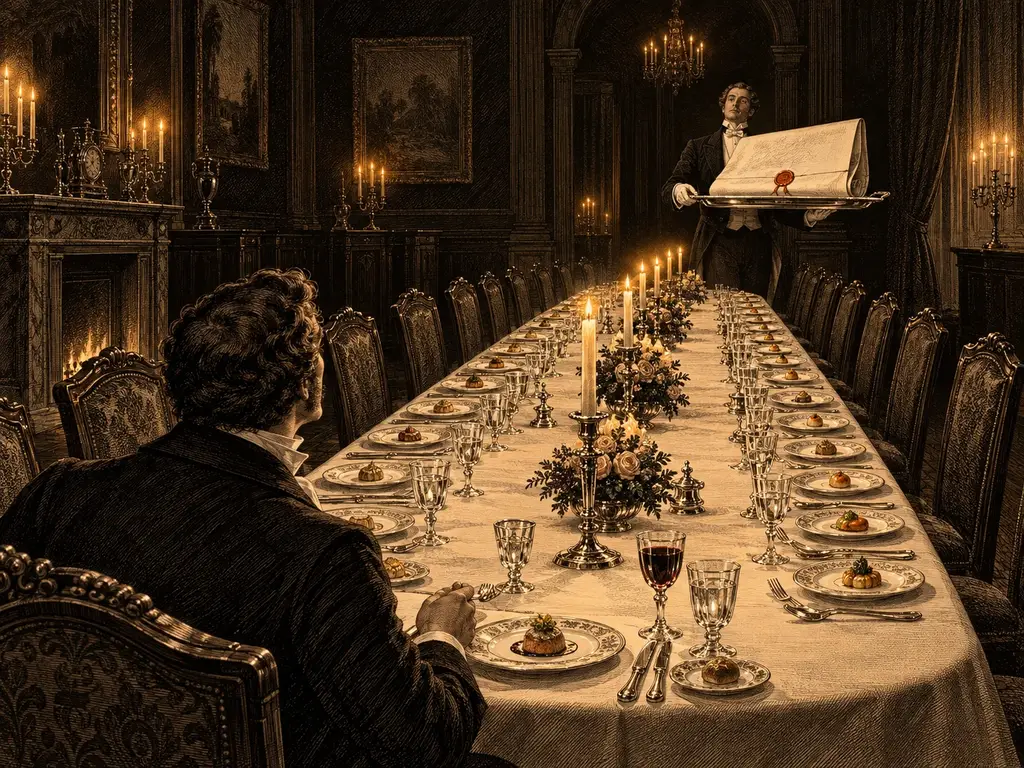
Five bets totaling 143 units cover 36 of the 37 numbers so that each of them nets exactly +1. The uncovered number costs 143. With la partage the edge is 2.02%, but the shape is the trap: 36 spins in 37 win a unit, and the expected lossmathExpected lossExpected value times total amount wagered; the average amount lost over a session or a period.Read full → arrives all at once.
How is Roulette Dinner played?
Choose a number to leave out, say 17. Then place five bets: 72 unitsmoneyUnitThe base stake a system or a player works in. Progressions are described in units so they apply at any table.Read full → on high (19–36), 48 on the first dozenbetDozen1–12, 13–24 or 25–36, pays 2:1.Read full → (1–12), 12 on the streetbetStreetThree numbers in a row of the layout, pays 11:1. French: transversale.Read full → 13–14–15, 4 straight upbetStraight upA single number, pays 35:1.Read full → on each of 16 and 18, and 3 on zerowheelZeroThe single green pocket that no even-money, dozen or column bet covers; the source of the house edge. Also: single zero, 0.Read full →. That is 143 units, and every covered number returns exactly 144 of them. The table needs la partageruleLa partageFrench rule: when zero hits, half of an even-money stake is returned. Halves the house edge on those bets to 1.35%.Read full →: on zero, the 3-unit straight up returns 108 and la partage returns half of the 72 on high, which makes 144 again.
What does it cost?
The expected valuemathExpected valueThe average result per bet over the long run. −1/37 of the stake for every standard European bet.Read full → per spin is (36 × 1 − 143)/37 = −107/37, about −2.89 units, which is 2.02% of the 143 staked. That is below the usual 2.70% because half the money sits on an even-money betbetEven-money betRed/black, odd/even, high/low. 18 numbers, pays 1:1.Read full → that la partage protects. Without the rule it is exactly 2.70%. The spread of results is the striking part: a standard deviationmathStandard deviationSquare root of variance; the typical distance of a result from the expected value.Read full → of 23.35 units on a bet whose usual result is +1. After one loss, winning it back takes 143 winning spins in a row, and the chance of that is 1.99%.
Does it work with any number?
The layoutequipmentLayoutThe printed betting grid on the table. Also: table, felt, cloth.Read full → changes with the number left out, never the result. For a number in 19–24 the 72 units go on low (1–18) and the 48 on the third dozen. For a number in 1–12 or 25–36, the 72 units go on the opposite half and the other 17 numbers of its own half are covered with straight ups, streets and six linesbetSix lineSix numbers in two adjacent rows, pays 5:1. French: sixain.Read full →. To leave out 5: 72 on high, 4 each on 4 and 6, 12 on the street 1–2–3, 24 on each of the six lines 7–12 and 13–18, and 3 on zero. It works for any number because every bet on a single-zero wheel carries the same edge, so any mix of them that returns 144 on 36 numbers costs the same.
Why does it feel like a system?
It wins 36 spins in 37. A 20-spin session has a 57.8% chance of never meeting the uncovered number, and a player who stops there remembers the system as a steady earner. The other 42.2% of sessions contain a −143, and one of those erases 143 winning spins. The shape is the MartingalestrategyMartingaleProgression that doubles the bet after each loss. See the Strategy section for what it does and does not do.Read full →’s: frequent small wins paid for by a rare large loss. It is also expensive to run: at $1 a unit it puts $143 on the table every spin to win $1.
What does covering more numbers change?
The expected value of several bets is the sum of their expected values, so covering more of the layout changes the shape of the results, never their price. At $1 a unit Roulette Dinner costs $2.89 a spin on average, the same as $107 a spin on redbetRedEven-money bet on the 18 red numbers. French: rouge.Read full → at a European table. The name promises the price of dinner. The arithmetic says the casino eats first.
Questions
No. Every number is equally likely. The system only needs one to leave out.
Zero then nets −35 instead of +1, and the edge is the usual 2.70%.
It is 0.7% when it wins, against an expected loss of 2.02% on every spin.
Comic relief
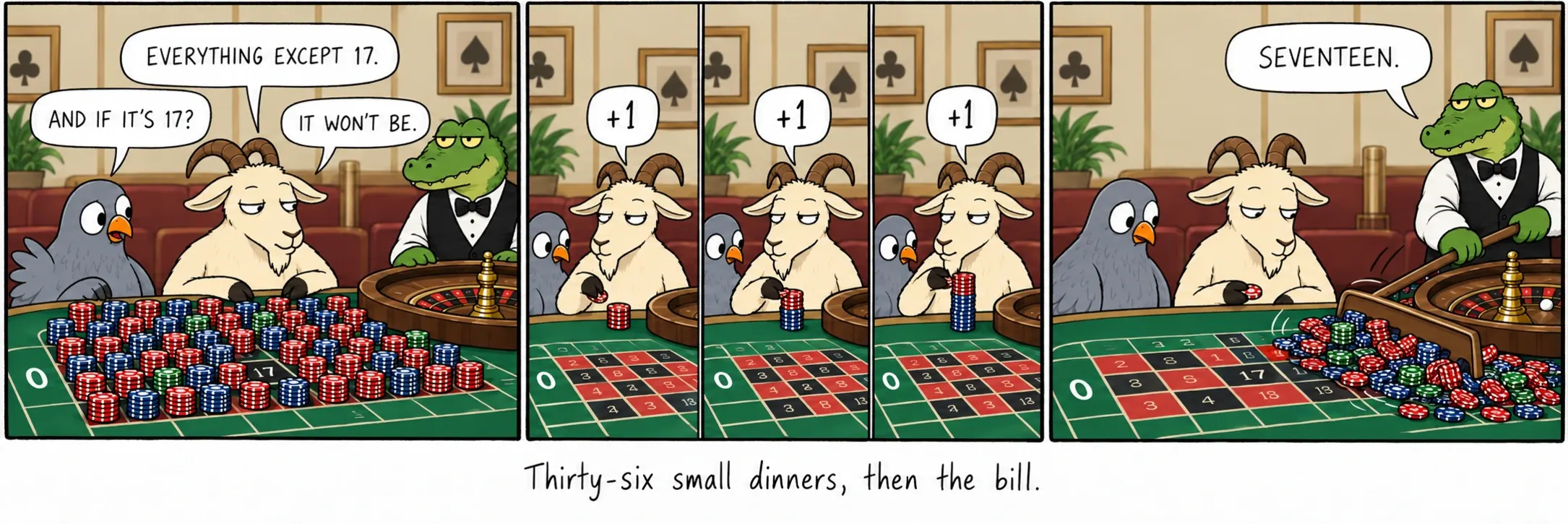
Thirty-six small dinners, then the bill.
Sources
- Bollman, M. Mathematics of the Big Four Casino Table Games: Blackjack, Baccarat, Craps, & Roulette.
- Ethier, S. N. The Doctrine of Chances: Probabilistic Aspects of Gambling.