Card Roulette Poker Bets
Three cards, wild jokers and a pay table: the poker bets card roulette adds, counted hand by hand.
In a three-card hand a straight is rarer than a flush, so the usual poker order changes. Triple Flop’s six poker bets cost from 4.69% to 36.1%, depending on the pay table. Its 55-card version prices most roulette bets at 5.45% and its jackpot at 19.66%. Ca$h Card’s $5 poker bonus cannot be priced without knowing how its $25,000 prize is shared.
Three cards change the order
With five cards a flush beats a straight. With three, the order turns round: a straight needs three ranks in a row, a flush only three cards of one suit, and there are more ways to make the flush. Of the 22,100 three-card hands in a 52-card deck, 720 are straights and 1,096 flushes, not counting straight flushes. Three of a kind, with 52 hands, is rarer than both, so in three-card poker it ranks above the straight. Card-roulette pay tablesmoneyPay tableThe list of what each bet or result pays. On machines and side bets, it is where the house edge is set.Read full → follow this order.
Triple Flop: all six poker bets
Triple Flop deals from 38 cards, six to ace in each suit plus two jokers. The two cards after the roulette card complete a three-card hand, with the jokers wild. Bollman (2021) prices the Pair, Flush and Royal Jackpot bets. We counted all 8,436 hands to price the other three, reading the rules as he does: a joker becomes whatever card makes the best hand, a straight flush also pays the Straight and Flush bets, and the Pair bet does not pay on three of a kind. Wizard of Odds (2026) lists the same hand counts for all six bets, including the three we counted, under a pay table that pays a pair of aces 6 to 1 instead of 5 to 1. On that table the Pair bet costs 4.69% and is the cheapest of the six.
Where the jokers go
The jokers are in 1,296 of the 8,436 hands, about one in six. They carry the long shots: 36 of the 40 royals and 120 of the 144 other straight flushes use a joker, and so do 504 of the 2,232 winning pairs. That is why the payoutmoneyPayoutWhat a winning bet returns, quoted as “X to 1” on top of the returned stake.Read full → for a royal made with a joker, not the 1,000-to-1 natural royal, sets the price of the Royal Jackpot. The Pair bet’s 2,232 winners are 1,536 natural pairs of sixes to kings, 192 natural pairs of aces, 360 pairs of nines to kings made with a joker and 144 of aces. No joker ever makes a pair of sixes, sevens or eights: with one of those in the hand, the joker always makes something better, a higher pair or a straight.
Triple Flop with 55 cards
A second version uses a full deck with three jokers as the zeroswheelZeroThe single green pocket that no even-money, dozen or column bet covers; the source of the house edge. Also: single zero, 0.Read full →, on a 13-by-4 layoutequipmentLayoutThe printed betting grid on the table. Also: table, felt, cloth.Read full → with a row for each rank and a columnbetColumnTwelve numbers in one vertical column of the layout, pays 2:1.Read full → for each suit. Bets on 1, 2, 4, 13 or 26 cards pay (52 − n)/n to 1, an edge of 3/55, 5.45%. Two bets round their payouts down and cost more. The jackpot pays 1,000 to 1 for three jokers, 500 to 1 for a natural royal and 250 to 1 for a royal made with jokers, which includes an ace, king or queen with two jokers. That is 77 winning hands in 26,235, and the bet costs 19.66%.
Ca$h Card’s poker bonus
Ca$h Card’s $5 bonus bet uses all three cards dealt in a round, and the jokers and the Ca$h Card are not wild. A straight pays more than a flush because it is rarer, as above. The price is harder to pin down than the counts. The top prize is shared among everyone who wins it on the same round, and the rules leave unclear whether the three special cards must come in that order, which would cut its chance to a third. On our count, if one player took the whole $25,000 and any order counted, the bet would return slightly more than it costs; if the order counts, it costs about 10%. With the rules as printed we leave it unpriced.
Three more three-card bets
Turn3, dealt at Barona in California, where the law requires cards, uses a 37-card deck that stands for a single-zero wheel. The first card settles the ordinary bets and two more make a three-card hand. A run of 0, 1, 2 pays 100 to 1, any other run of three 25 to 1, three cards of one color 3 to 1. Of the 7,770 hands 1,667 win, and the bet costs 3.31%, cheap for a side betbetSide betAn optional extra wager attached to the main game, usually on a streak, a bonus event or a jackpot. Almost always dearer than the standard bets.Read full →. Fazi’s online Triple Poker spins one ballequipmentBallThe small ball launched along the track against the rotor. Modern balls are ivorine or Teflon, 18–21 mm.Read full → on three rings of 0 to 36, so each spin gives three numbers. Three zeros pay 999 to 1, three of a kind 99, a run 19, a pair 4 and three of one color 1. The Wizard of Odds prints 4.83%; our count of all 50,653 results gives 4.52%, or 4.76% if 0, 1, 2 is not a run. Royal Flop, seen in Aruba in 2019, deals two cards from the Triple Flop deck to go with the spin and pays only for flushes and better, up to 150 to 1 for a royal in diamonds. It costs 22.85%.
What the counts show
A pay table is only as clear as the rules behind it.
- In three cards, straights are rarer than flushes and three of a kind rarer than both.
- Wild jokers make most of the long shots, so the payouts for hands with jokers set the price.
- Rounding one payout down, like the 55-card double streetbetStreetThree numbers in a row of the layout, pays 11:1. French: transversale.Read full →, more than doubles the edge on that bet.
- A shared or ordered top prize can move a bet from the player’s side to the house’s. Read the small print before pricing it.
Questions
Of those priced here, Barona’s Turn3 at 3.31%. Next come Fazi’s Triple Poker, 4.52% to 4.83%, and Triple Flop’s Pair at 4.69% where a pair of aces pays 6 to 1.
In three cards it is rarer: 720 hands against 1,096.
In Triple Flop’s poker bets, yes. In Ca$h Card’s bonus, no.
Fun with Math
Try these yourself first. Each solution is folded; open it when you are ready.
In three-card poker from an ordinary 52-card deck, which is rarer: a straight or a flush? In five-card poker the flush is the rarer one.
Show the solution
Answer With three cards the straight is rarer: 720 hands against 1,096.
There are 22,100 three-card hands. A straight is three ranks in a row, from A-2-3 to Q-K-A: 12 runs. Each card can be any of 4 suits, 64 ways, but 4 of those are straight flushes, so each run gives 60 plain straights: 720.
A flush is three cards of one suit: 286 ways in each of 4 suits, 1,144, less the 48 straight flushes: 1,096.
With only three cards, matching a suit twice is easier than extending a run of ranks. With five cards it is the other way round: 10,200 straights and 5,108 flushes. A pay tablemoneyPay tableThe list of what each bet or result pays. On machines and side bets, it is where the house edge is set.Read full → copied from five-card poker would pay the wrong hand more.
The 55-card Triple Flop has three jokers, wild in the poker bets. As Bollman describes it, an ace, king or queen with two jokers reads as a royal flush, and any lower card with two jokers as three of a kind. Count the three-of-a-kind hands, and price a bet that pays 80 to 1 on them.
Show the solution
Answer 406 hands in 26,235. At 80 to 1 the bet would give the player about 25%; without the two-joker hands it would cost 11.7%.
Natural three of a kind: 13 ranks, and 4 ways to choose three suits, 52 hands. A pair and one joker: 13 ranks × 6 pairs × 3 jokers = 234, and a pair cannot become anything better. Two jokers and a card from two to jack: 40 cards × 3 pairs of jokers = 120. In all 406, about 1 in 64.6.
At 80 to 1 the bet hands back 81 unitsmoneyUnitThe base stake a system or a player works in. Progressions are described in units so they apply at any table.Read full →, stake included, on 406 hands in 26,235: 81 × 406/26,235 = 1.254 for every unit staked, a gain of 25% for the player.
If hands with two jokers did not count, 286 hands would win and the bet would cost 11.7%. How the jokers are read decides who has the edge. Bollman’s answer key prints an edge of 4.29%, which would need 310 winning hands; we could not find a reading of the rules that gives 310. We checked our counts by listing every hand by computer.
With three wild jokers in a 55-card deck, how often is the three-card flop nothing at all: no pair, straight or flush?
Show the solution
Answer 16,440 hands in 26,235, about 62.7%, against 74.4% with a 52-card deck.
A wild joker always makes at least a pair, because it can copy either of the other cards. So a hand with nothing in it must come from the 52 ordinary cards, and the count is the same 16,440 as in the 52-card table on this page.
Only the total changes: 26,235 hands instead of 22,100. 16,440/26,235 = 62.7%. The three jokers move about twelve hands in every hundred out of “nothing” and into a paying hand. Bollman’s answer key prints 0.6977; a full listing of the 26,235 hands by computer gives 62.7%.
Comic relief
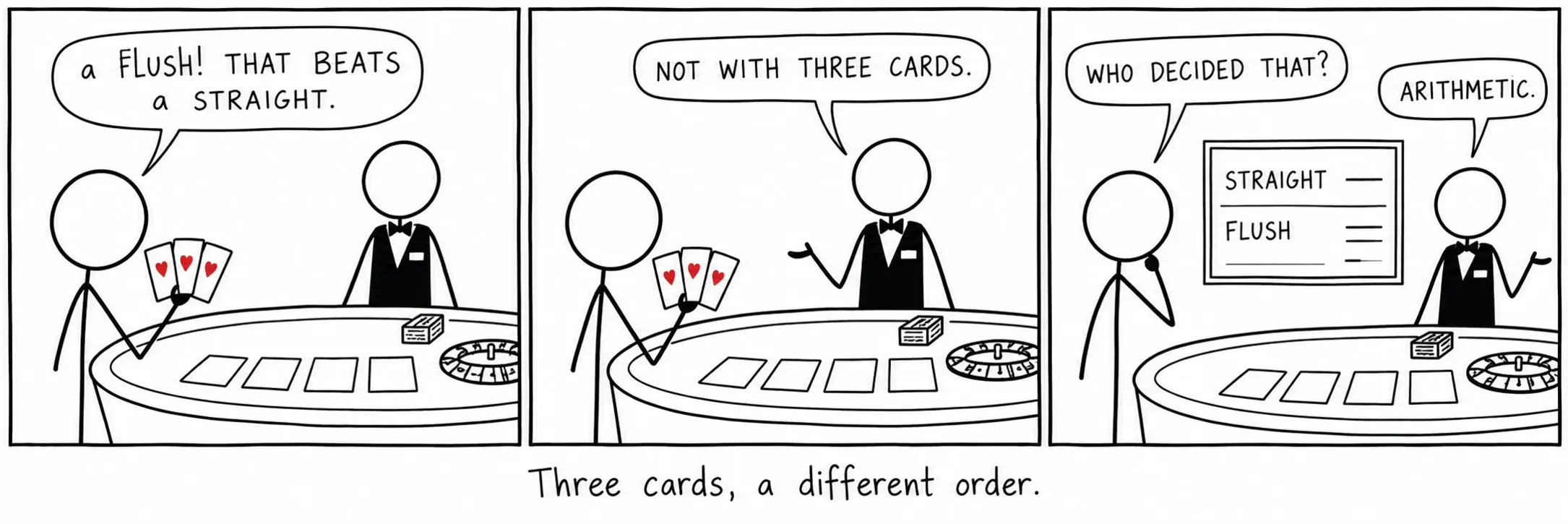
Three cards, a different order.
Sources
- Bollman, M. Mathematics of the Big Four Casino Table Games: Blackjack, Baccarat, Craps, & Roulette.
- Wizard of Odds. “Triple Flop Roulette.”
- Wizard of Odds. “Turn3”, “Triple Poker” and “Royal Flop Roulette”.