Monte Carlo Roulette
The casino that turned a tiny principality into the home of the single-zero wheel.
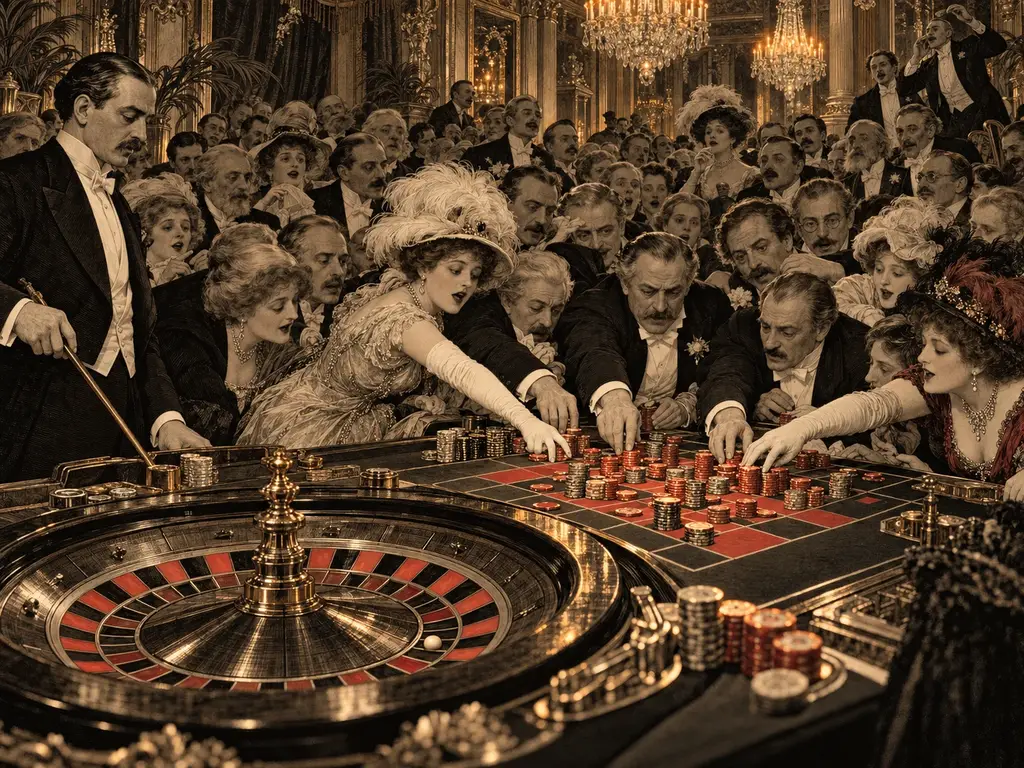
Opened in 1863 under François Blanc, the Casino de Monte-Carlo made the European wheel the continental standard and gave roulette its most famous anecdotes, from Jagger’s biased wheel to the 26 blacks of 1913.
Why Monaco
In the 1850s Monaco was a bankrupt rock with a prince, a palace and no industry. Gambling was being outlawed across the German states, where the spa casinos had flourished. Prince Charles III granted a casino concession in 1856; the first attempts failed for lack of a railway and a road. François Blanc, who had made Bad Homburg famous, bought the concession in 1863, built the Société des Bains de Mer, lobbied for the railway from Nice, and named the new quarter Monte Carlo after the prince. The casino funded the state so thoroughly that income tax was abolished in 1869 and has never returned.
The single zero as policy
Blanc brought the single-zerowheelZeroThe single green pocket that no even-money, dozen or column bet covers; the source of the house edge. Also: single zero, 0.Read full → wheel from Homburg. In Monte Carlo it was not a competitive tactic but the standard: every table, every day. Players from across Europe learned roulette at 2.70% and expected it elsewhere, which is why the double zerovariantDouble zeroThe 00 pocket of the American wheel. Its presence raises the house edge from 2.70% to 5.26%.Read full → survives only where Monte Carlo never set the norm.
First casino concession in Monaco. Fails: no road, no railway, few players.
François Blanc takes over. Société des Bains de Mer founded.
Railway from Nice opens. Visitors arrive by the trainload.
Income tax abolished in Monaco.
Joseph Jagger finds a bias in the wheels and wins a fortune; the casino moves its wheels about, then replaces them.
Charles Wells “breaks the bank” several times in a few days, with luck and a system he never explained.
26 blacks in a row. The gambler’s fallacy gets its other name.
Casino de Monte-Carlo loses its monopoly on Riviera gambling as French casinos reopen.
Breaking the bank
Each table had a cash reserve, the “bank”. When a player won more than the reserve, the table was draped in blackbetBlackEven-money bet on the 18 black numbers. French: noir.Read full → cloth while more cash was fetched: the bank was “broken”. It happened regularly and was excellent publicity; it did not mean the casino had lost money overall, only that one table’s float was exhausted. Charles Wells did it several times in 1891 with an extraordinary run, became a music-hall song, and lost part of it back that winter.
The stories
Joseph Jagger’s biased wheellabBiased wheelA wheel whose physical defects make some pockets more likely than 1/37. Rare, detectable only with thousands of recorded spins.Read full → (around 1880), Wells (1891) and the 26 blacks (1913) all happened here, and each appears on its own page. The casino’s publicity department, which was ahead of its time, made sure every one of them was reported in the London papers. A legend of a place where fortunes were won sold more railway tickets than any honest account of the 2.70%.
Monte Carlo today
The casino still runs, and roulette is still the center of the main salon, with single-zero wheels and French rules (la partageruleLa partageFrench rule: when zero hits, half of an even-money stake is returned. Halves the house edge on those bets to 1.35%.Read full → or en prisonruleEn prisonFrench rule: when zero hits, an even-money bet is held for the next spin instead of lost. Halves the house edge on those bets.Read full → on even money). The Société des Bains de Mer is still the principality’s main company. The Monte Carlo method in mathematics, named by Ulam and von Neumann in the 1940s after the casino, is what powers the simulators on this site.
Questions
No. They have been barred since the 19th century; the casino was for visitors.
It is reported consistently in later accounts; the casino’s own records from the period are not public. The probabilitymathProbabilityChance of an outcome, from 0 to 1 or 0% to 100%. One number: 1/37 = 2.70%.Read full → is consistent with it happening somewhere in fifty years of play.
Stanislaw Ulam’s uncle gambled there; the name was a code word for random sampling on the Manhattan Project.
Comic relief
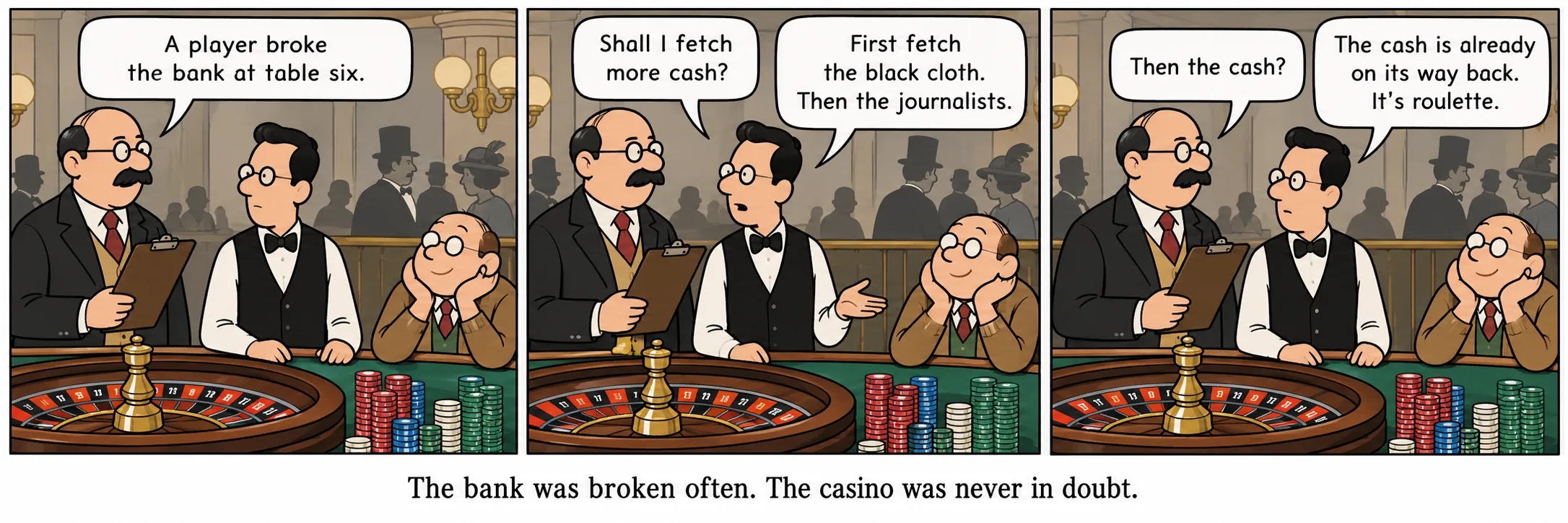
The bank was broken often. The casino was never in doubt.
Sources
- Schwartz, D. G. Roll the Bones: The History of Gambling.
- Barnhart, R. T. Beating the Wheel.
- Kavanagh, T. M. Dice, Cards, Wheels: A Different History of French Culture.