Deceleration
The one part of the spin that is genuinely predictable.
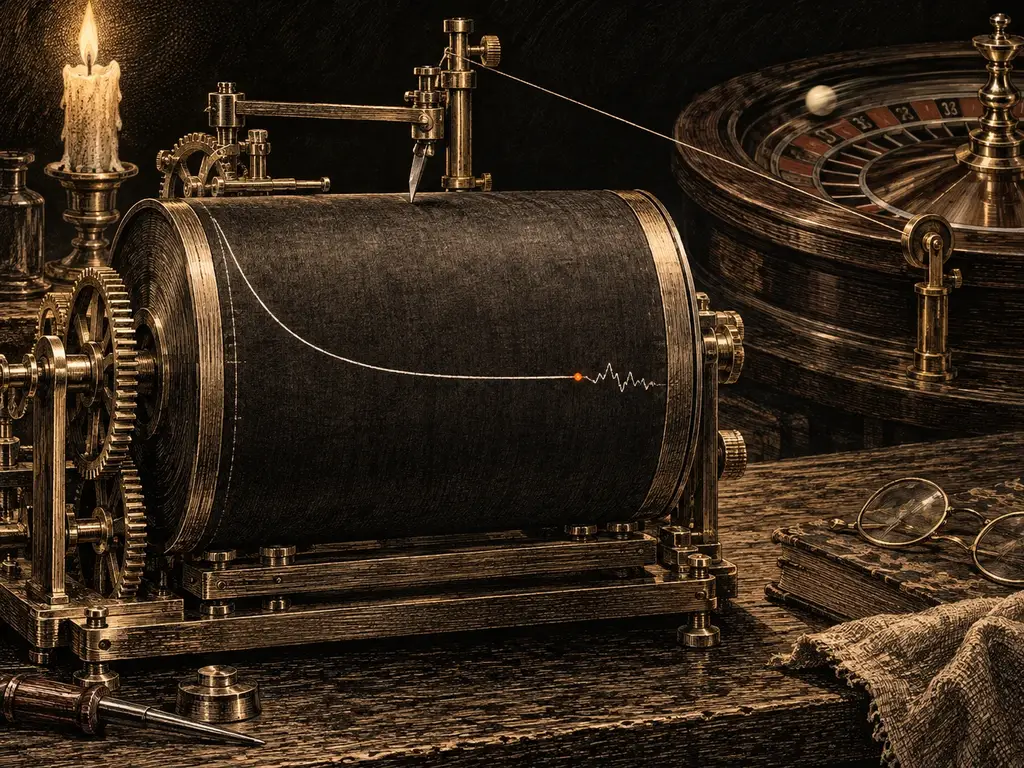
Ball deceleration on the track follows a smooth curve set by friction and drag. From a few revolution times you can estimate the drop time to within a fraction of a second. The scatter afterwards undoes most of that precision.
The model
Treat the ballequipmentBallThe small ball launched along the track against the rotor. Modern balls are ivorine or Teflon, 18–21 mm.Read full → as decelerating under a constant term a (rolling friction) and a term proportional to speed b·v (air drag and velocity-dependent losses): dv/dt = −(a + bv). The solution is an exponential approach toward the critical drop speed. Lap time T = 2πr/v therefore grows each lap by an increasing amount. Fit a and b from the first few laps and the remaining laps, and the drop time, follow. Nothing here is exotic; it is first-year mechanics applied to a ball on a track.
What the estimate buys
A drop time to within 0.2 seconds, combined with a rotorequipmentRotorThe spinning part of the wheel that carries the pockets.Read full → speed of 15 pocketsequipmentPocketOne of the 37 numbered compartments on the rotor. Also: slot, cup.Read full → per second, locates the pocket under the drop point to within about three pockets. That is the good news for a predictor. The bad news is that the ball then crosses the apronequipmentApronThe sloped area between the ball track and the pockets, where the deflectors sit.Read full →, hits a deflectorequipmentDeflectorOne of the metal obstacles on the apron that scatter the falling ball. Also: canoe, diamond, pin.Read full → and bounces across the fretsequipmentFretThe metal divider between two pockets on the wheel.Read full →, and the final pocket is spread across a distribution 20 to 30 pockets wide. The precision of the track phase is largely consumed by the scatter of the drop phase.
What is left
If the scatter distribution has a mode, so that the ball lands near the drop pocket more often than at random, then betting a sectorwheelSectorA contiguous arc of pockets on the wheel, as distinct from a group on the layout.Read full → around the predicted pocket gives a small edge. Small and Tse (2012) measured this in the laboratory with a camera and found predicted-sector hit rates high enough to turn the house edgemathHouse edgeThe share of each stake the casino keeps on average: 2.70% in European roulette.Read full → positive by a few percent. Their conditions, a full overhead view, a known wheel, bets placed after the ball is launched, do not exist at a live table.
What changes from hour to hour
The two constants are not fixed for a wheel. The Eudaemons, who timed a casino wheel for years in the 1970s, found that the air does most of the slowing, more than the track, and that the ball matters: a Teflon ball lost speed twice as fast as one made of billiard-ball composite. They also watched their predictions slide by 5 to 10% an hour when a door was opened or the weather turned, because damp or heavy air slows the ball sooner. Their program therefore kept separate settings for the ball’s rate of slowing and for the speed at which it leaves the track, and the player reset both at every table and again whenever the predictions began to drift.
Why the Lab explains this
Not so that anyone can do it. To show what the game’s randomness actually consists of: a deterministic phase that casinos defend with early bet closure and minimum revolutions, and a chaotic phase that they defend with deflectors and low frets. A player who understands this understands why the 2.70% is safe.
Doing the arithmetic yourself
Time the ball past a deflector on any stream for three laps and extrapolate; you will be within a lap of the drop most of the time, which is the deterministic phase working as described. Then watch where the ball actually lands relative to the pocket under the drop point, and keep a tally for fifty spins. The tally is a scatter distribution, and its width is the answer to “why can’t this be beaten?”.
Formula
Questions
No. Friction varies with dust, humidity and wear. Predictors refit every spin.
Three give a rough estimate; five or six a good one. Studios’ minimum of four leaves little time to bet, and bets are closed anyway.
A few, briefly, with devices, before casinos adapted and laws followed. See advantage play.
Fun with Math
Try these yourself first. Each solution is folded; open it when you are ready.
In Thorp’s illustrative model of a slowing ballequipmentBallThe small ball launched along the track against the rotor. Modern balls are ivorine or Teflon, 18–21 mm.Read full →, if one revolution on the track takes T seconds, the ball has 1/(e^(3T/20) − 1) − 10/3 revolutions left before it leaves the track. How many are left after a revolution of half a second, and after one of a full second? How far does a timing slip of 0.012 seconds at T = 0.8 move the prediction?
Show the solution
Answer About 9.5 revolutions after a half-second lap and 2.85 after a one-second lap. The slip moves the prediction by about 0.12 of a revolution, roughly 4½ pocketsequipmentPocketOne of the 37 numbered compartments on the rotor. Also: slot, cup.Read full →.
T = 0.5: 3T/20 = 0.075 and e^0.075 ≈ 1.0779, so 1/0.0779 ≈ 12.84, and 12.84 − 3.33 ≈ 9.51 revolutions. T = 1: e^0.15 ≈ 1.1618, 1/0.1618 ≈ 6.18, and 6.18 − 3.33 ≈ 2.85. A fast lap means many revolutions to go, and a lap twice as slow leaves less than a third as many.
At T = 0.8 the formula gives 4.51 revolutions; at T = 0.812 it gives 4.39. A slip of 12 thousandths of a second, about the time the ball takes to roll its own width, moves the prediction by 0.12 of a revolution: about 4½ pockets of a 37-pocket wheel. That one slip is most of the 5.5 pockets Thorp’s error budget allows for timing the ball (see Advantage Play), and it is why the clock, not the arithmetic, limits a predictor.
Comic relief
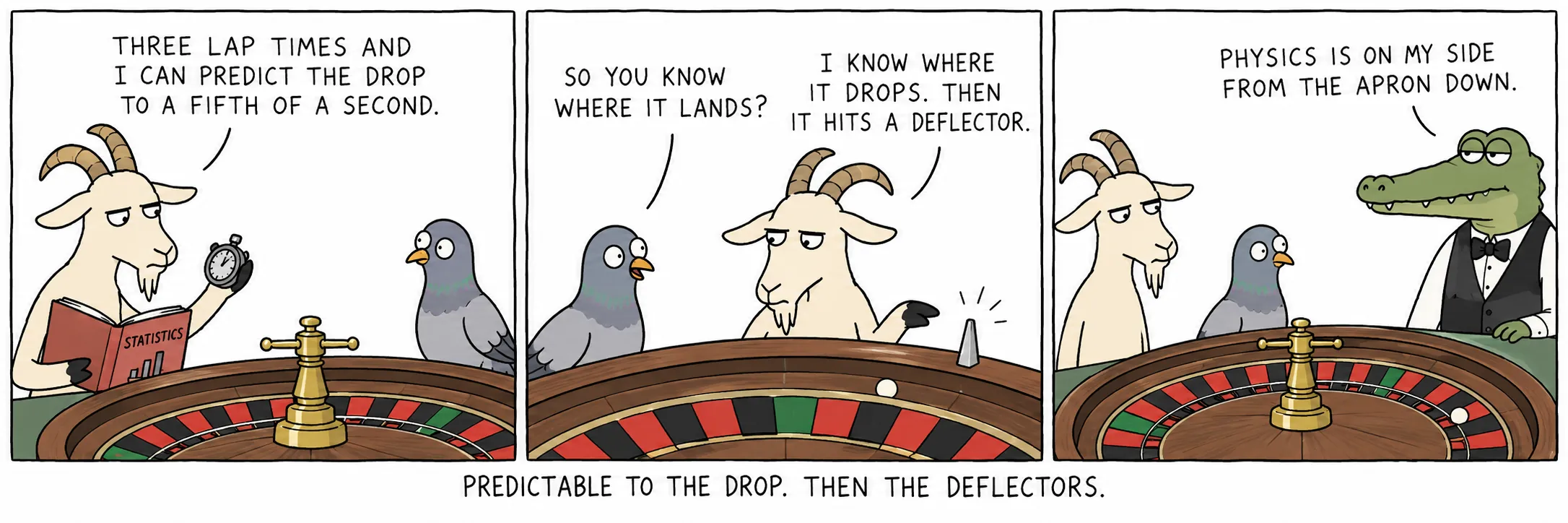
Predictable to the drop. Then the deflectors.
Sources
- Small, M. & Tse, C. K. “Predicting the outcome of roulette.”
- Bass, T. A. The Eudaemonic Pie.
- Thorp, E. O. “Optimal gambling systems for favorable games.”