Oscar’s Grind Roulette Strategy
The Oscar’s Grind roulette strategy raises the stake by one unit after a win, holds it after a loss, and stops each cycle at +1 unit.
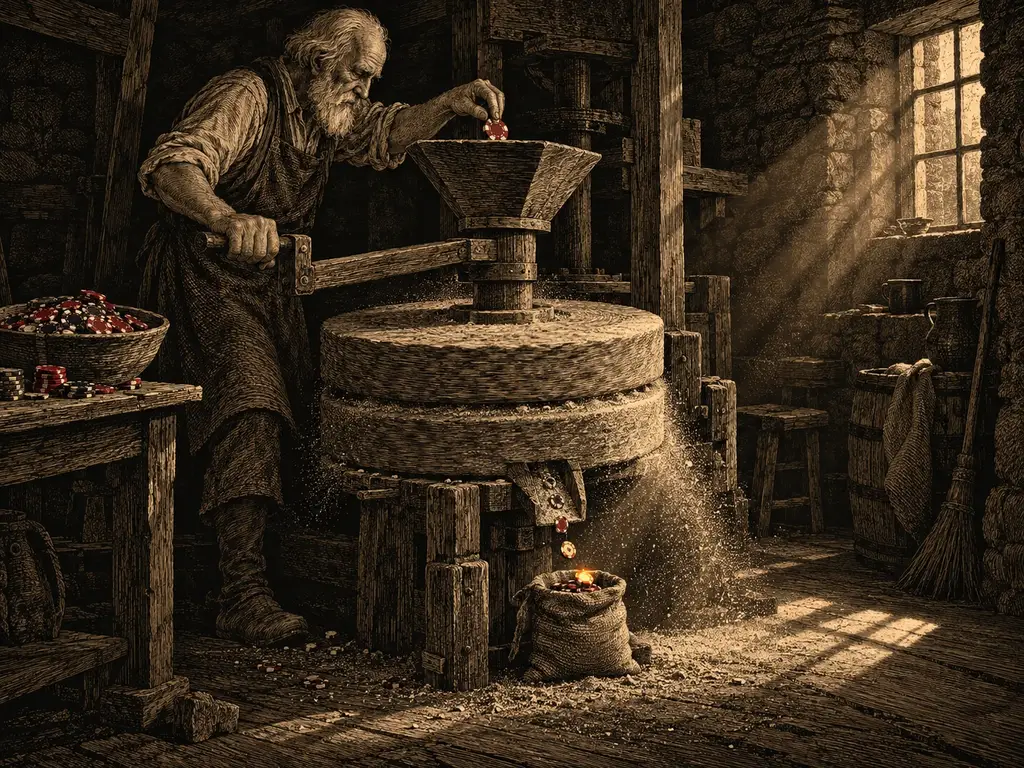
It does not beat the wheel. Oscar’s Grind targets one unit per completed cycle. Incomplete cycles can lose heavily, and the stake can grow after interspersed wins and losses. Standard single-zero bets still have a 2.70% edge.
Walk the system
A loss keeps the stake. A win adds one unit, but never more than the cycle needs to reach +1. At +1 a new cycle starts.
Stakes and results are in units of the base bet.
This drawing caps stakes at eight base units. The uncapped system can require larger bets.
How does the Oscar’s Grind roulette system work?
Start a cycle at one unitmoneyUnitA base amount used to express stakes or results.Read full definition →. Lose, and bet the same again. Win, and raise the next bet by one unit, but never bet more than it takes to bring the cycle to exactly +1 unit. When the cycle reaches +1, start a new one at one unit. The one-unit target applies to completed, unclipped cycles; it does not guarantee completion.
What does a cycle look like?
L L L W W W: stakes 1, 1, 1, 1, 2, 1. After −3 + 1 + 2 = 0 the rule caps the last bet at what is needed, 1 (not 3), to reach +1. Results −1 −1 −1 +1 +2 +1 = +1. Cycle complete after six spins with three wins and three losses.
| spin | result | stake | cycle total | next stake |
|---|---|---|---|---|
| 1 | L | 1 | −1 | 1 (hold after loss) |
| 2 | L | 1 | −2 | 1 |
| 3 | L | 1 | −3 | 1 |
| 4 | W | 1 | −2 | 2 (raise after win) |
| 5 | W | 2 | 0 | 1 (capped: only 1 needed for +1) |
| 6 | W | 1 | +1 | cycle complete; restart at 1 |
What does a session look like?
Consecutive losses leave the scheduled stake unchanged, but keep reducing the bankrollmoneyBankrollThe amount set aside for play. Bankroll management concerns stakes and limits within that amount.Read full definition →. Interspersed wins can then raise the stake without completing the cycle. Neither the cycle length nor the drawdownmoneyDrawdownA fall from a bankroll peak to a later value. Maximum drawdown is the largest such fall in the record.Read full definition → has a fixed upper bound imposed by the system.
- p10 −$500
- p25 −$500
- median −$500
- p75 −$500
- p90 +$860
Does Oscar’s Grind work?
It does not beat the house edgemathHouse edgeThe casino’s expected net gain expressed as a fraction of the stake, under specified probabilities and payouts.Read full definition →. For a bounded session of independent standard single-zerowheelZeroThe 0 outcome, conventionally shown in green. Ordinary color, parity, high/low, dozen and column bets do not include it.Read full definition → bets, expected lossmathExpected lossThe probability-weighted average net loss under a stated model. With a constant edge, it equals edge times expected total stakes.Read full definition → equals expected turnovermoneyTurnoverThe sum of amounts wagered over a session or period, including money wagered again after a return. Also called handle or action.Read full definition → divided by 37. Comparing its session cost with flat bettingstrategyFlat bettingUsing the same stake on each bet or spin, as specified by the strategy.Read full definition → requires the same bankroll, horizon and stopping rules; the name alone does not establish a ranking.
Who chooses it, and why?
It offers a specific routine and a small cycle target. A small target can be misleading: a cycle may take many spins, require larger stakes or end unfinished when the bankroll or a stop rule intervenes.
Simulator · Oscar’s Grind
2,000 sessions of even-money bets from a $1,000 bankroll.
Base bet $10 · table limit $500 · up to 100 spins per session
Questions
Its stake adjustments differ, but large losses are possible. A fair comparison needs explicit session settings; both retain the same edge per dollar under the same rules.
There is no fixed maximum number of spins for completion. A bankroll limit, table limittableTable limitA permitted minimum or maximum stake, applied per bet, bet category or total wager according to the table.Read full definition → or stop rule can end a cycle before its target is reached.
Oscar is the name attached to the system. Its origin does not change the arithmetic or establish that it is profitable.
Comic relief
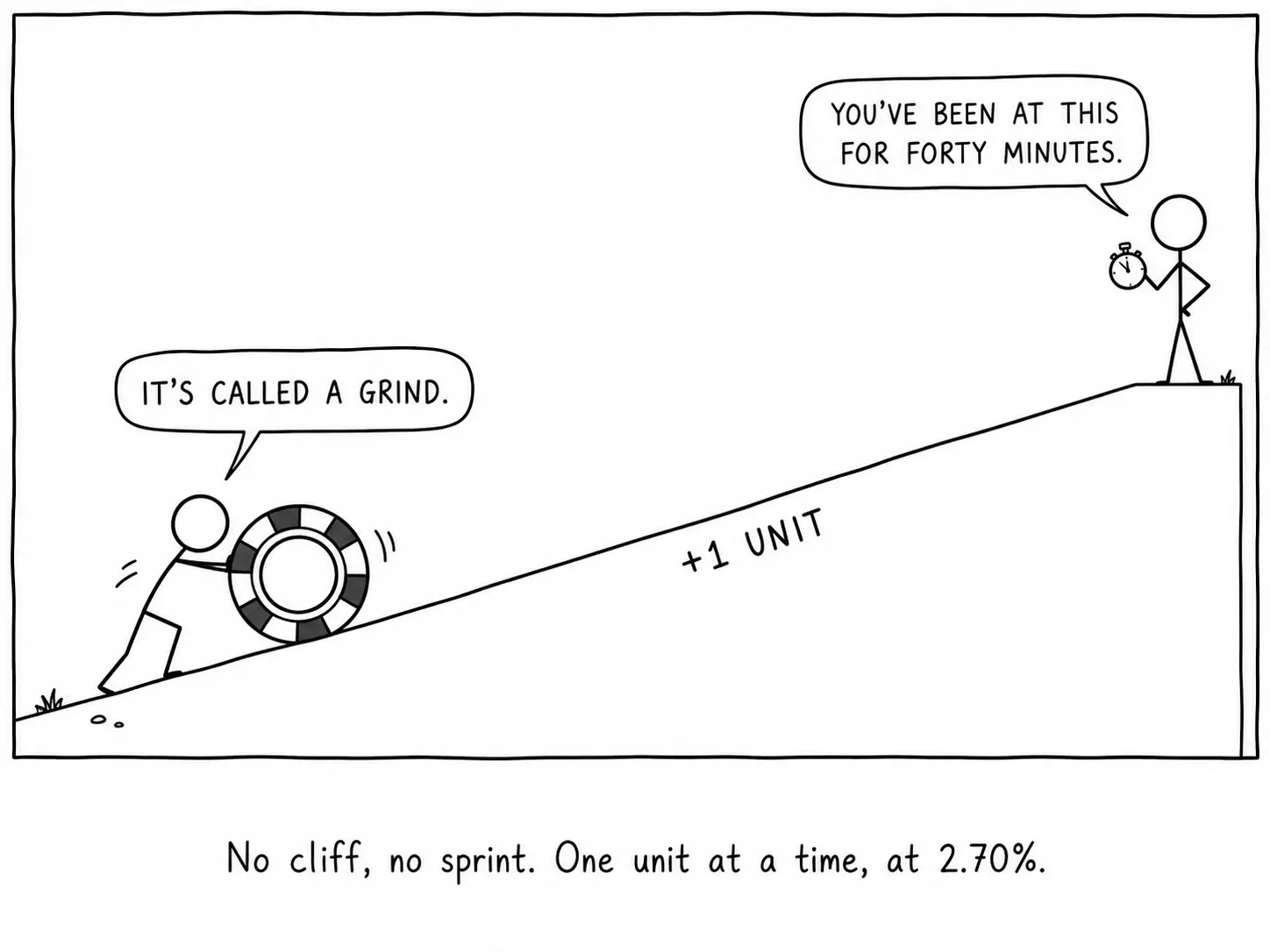
One unit per completed cycle. Completion is not guaranteed, and unfinished cycles can lose heavily.
Sources
- RouletteDoc. Strategy description and examples.
- Roulette77. Strategy description and examples.
- Ethier, S. N. The Doctrine of Chances: Probabilistic Aspects of Gambling.
- Epstein, R. A. The Theory of Gambling and Statistical Logic, 2nd ed.