Shotwell Roulette Strategy
The Shotwell strategy combines a $5 six-line with four $1 straight-ups on an American wheel. It has a low hit rate and a 5.26% normal edge.

Ten pockets are covered for $9. A six-line hit nets $21 and a straight hit nets $27, not the $36 gross straight-up return.
Rule as described
Shotwell uses one of three fixed rows: six-line 1–6 plus straight-ups 8, 10, 20, 26; six-line 10–15 plus 16, 17, 18, 28; or six-line 19–24 plus 1, 2, 4, 26. Choose one row, place $5 on the six-line and $1 on each straight-up. A pattern in previous RNG results does not change the probabilitymathProbabilityA measure of how likely an event is, from zero to one. Percentages express the same scale from 0% to 100%.Read full definition → of the next independent outcome.
Payout table
All ten selected pocketsequipmentPocketA compartment on the rotor in which the ball can settle. The number of pockets depends on the wheel.Read full definition → are profitable, but 28 American pockets lose the full layoutequipmentLayoutThe marked betting surface, whether printed on a table or displayed on a screen.Read full definition →.
| outcome | pockets | net on $9 stake |
|---|---|---|
| selected six-line | 6 | +$21 |
| selected straight-up | 4 | +$27 |
| uncovered | 28 | −$9 |
Worked example
Use the 1–6 row. If 4 lands, the $5 six-line returns $30 including stake; subtract all $9 placed to get +$21. If 20 lands, its straight returns $36 against that same $9 total: +$27. A 00 loses all $9. The hit chance is 10/38 = 26.316%, not a prediction based on previous spins.
Cost and risk
Expected valuemathExpected valueThe sum of each possible net result multiplied by its probability. It can be positive, zero or negative.Read full definition → is (6 × 21 + 4 × 27 − 28 × 9) / 38 = −9/19, about −$0.474 per spin. That is 1/19 of the $9 stake, about 5.26%, under standard double-zerowheelZeroThe 0 outcome, conventionally shown in green. Ordinary color, parity, high/low, dozen and column bets do not include it.Read full definition → payoutsmoneyPayoutThe amount paid on a winning wager. Check whether the quoted figure is net profit or total return including the stake.Read full definition →; it excludes the special five-number basketbetBasketA name used for bets covering zero and nearby layout numbers. The covered numbers and payout depend on the game.Read full definition →, which this layout does not use. The large positive wins are balanced by frequent full-layout losses, so coverage does not support a claim of a reduced edge.
Questions
The winning straight gains $35 excluding its returned $1 stake. The $5 six-line and three other $1 straights lose $8: $35 − $8 = +$27.
No observed past pattern makes an independent RNG outcome due. A real physical-wheel bias would require strong, reproducible evidence rather than this system name.
Comic relief
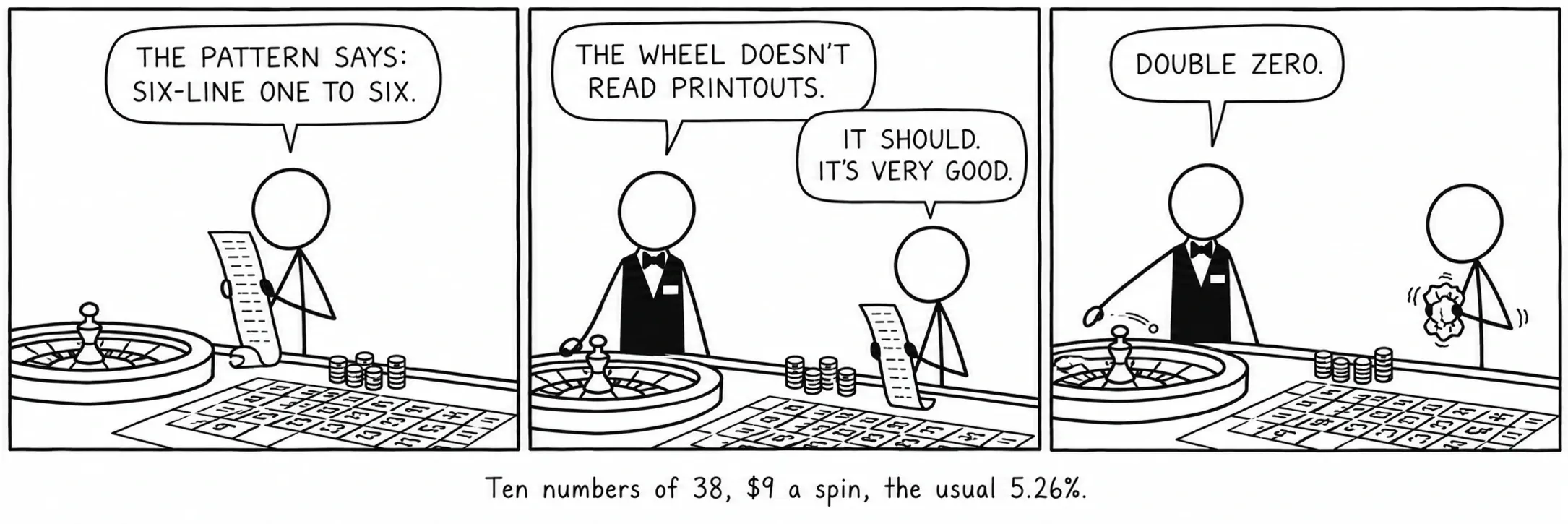
On a fair double-zero wheel with standard payouts, this $9 spread has an expected loss of $9/19 per spin, about $0.47.
Sources
- RouletteDoc, “Shotwell strategy” — listed rows and stated rationale
- Roulette77. Strategy description and examples.
- RouletteUK, “Shotwell strategy” — weighted nine-unit and equal five-unit variants
- Wizard of Odds, Roulette Basics — American pocket count and payouts
- Wizard of Odds, The Truth about Betting Systems