Six Line Quattro Roulette Strategy
Six-Line Quattro places the same stake on four six-lines, covering 24 numbers, then triples every line after a losing spin. A hit with four one-unit lines nets two units, not one.
Four six-lines cover 24 of 37 European pocketsequipmentPocketA compartment on the rotor in which the ball can settle. The number of pockets depends on the wheel.Read full definition →. The base layoutequipmentLayoutThe marked betting surface, whether printed on a table or displayed on a screen.Read full definition → nets +2 on a hit and loses 4 units on a miss; ten successive tripling steps make each line 59,049 times its base.
Steps and defined layout
Select four non-overlapping six-lines and place b unitsmoneyUnitA base amount used to express stakes or results.Read full definition → on each, for 4b total. A landing number in any selected six-line resets every line to b; an uncovered result triples every line stake to 3b, then 9b, and so on. The analysis assumes the four lines have no common numbers, as standard disjoint six-lines can be chosen. Each per-line stake triples after a loss, so the combined four-line stake triples too.
Base payout table
A six-line pays 5:1 net, so one winning line returns six units including its own chipmoneyChipA token used to place a wager, with a printed or assigned value. Also called a check in some casino terminology.Read full definition →.
| European outcome | pockets | four lines at 1 each |
|---|---|---|
| selected six-line | 24 | +2 |
| uncovered number or zero | 13 | −4 |
| all outcomes | 37 | 4 units staked |
Worked example
At the base level, place one chip on each of four six-lines. If a selected number lands, the relevant line returns six units gross while three losing chips return nothing: 6 − 4 = +2. After one miss, put three chips on each line for 12 units total. A hit then returns 18 gross from its winning line and nets +6 for that single spin, but the prior four-unit miss leaves the two-spin cycle +2.
Expectation and risk
The chance of a selected number on a single-zerowheelZeroThe 0 outcome, conventionally shown in green. Ordinary color, parity, high/low, dozen and column bets do not include it.Read full definition → wheel is 24/37 = 64.865%. The base expected result is 24/37 × 2 + 13/37 × −4 = −4/37, equal to one thirty-seventh of the four-unit total stake. The per-line levels are 1, 3, 9, 27 and continue geometrically; after ten tripling escalations the multiplier is 3^10 = 59,049. Such growth meets practical bankrollmoneyBankrollThe amount set aside for play. Bankroll management concerns stakes and limits within that amount.Read full definition → and table limitstableTable limitA permitted minimum or maximum stake, applied per bet, bet category or total wager according to the table.Read full definition → long before it offers any mathematical advantage.
Questions
One winning six-line at one unit returns six gross. Against all four one-unit placements, the net is 6 − 4 = +2.
No. It describes the hit probabilitymathProbabilityA measure of how likely an event is, from zero to one. Percentages express the same scale from 0% to 100%.Read full definition → for one spin. The 13 misses lose four units each, leaving a negative expected result.
Comic relief
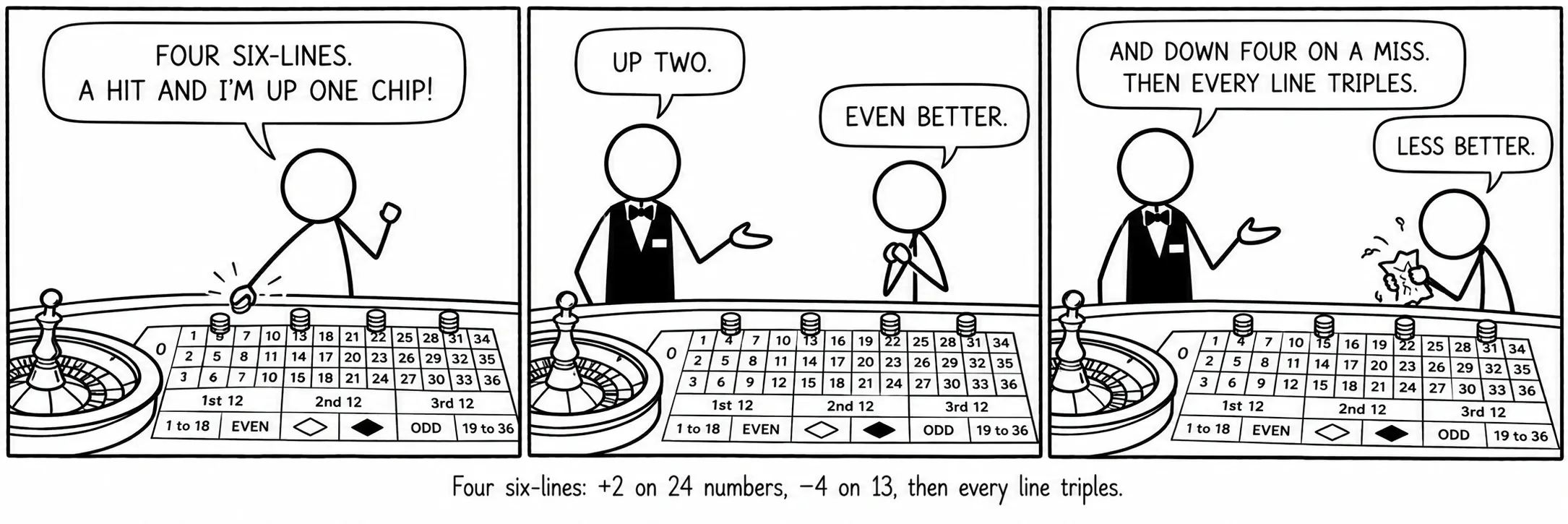
Start with one unit on each of four non-overlapping six-lines: a hit nets +2 and a miss loses 4. Triple after a loss; reset after a win.
Sources
- RouletteDoc, Strategy overview
- Roulette77, “Six-Line Quattro” — four-line tripling rule
- Wizard of Odds, Roulette Basics — six-line payout and European edge
- Wizard of Odds, The Truth about Betting Systems — progression expectation