ATM Roulette Strategy
ATM combines low (1–18) with the third dozen, then advances through four unequal stake pairs after misses. Its fourth pair makes a third-dozen hit a net loss, and no action is specified after a fourth miss.
The stake pairs are 3/2, 9/6, 33/22, and 74/36. A low hit after prior misses nets +1, −2, −9, or −37 at those four stages.
Steps and stopping boundary
Stake the first number of each pair on low and the second on the third dozenbetDozenA bet on 1–12, 13–24 or 25–36, ordinarily paying 2 to 1.Read full definition →: 3/2, then 9/6, 33/22, then 74/36. The groups are disjoint. An uncovered result advances to the next pair. For this article, a covered result resets to 3/2, including the fourth-stage third-dozen result even though its combined net is negative. This explicitly separates a winning component from a profitable spin. No next action is stated after a fourth miss, so a run should stop there rather than assume a fifth pair. This analysis uses a single-zerowheelZeroThe 0 outcome, conventionally shown in green. Ordinary color, parity, high/low, dozen and column bets do not include it.Read full definition → wheel and standard payoutsmoneyPayoutThe amount paid on a winning wager. Check whether the quoted figure is net profit or total return including the stake.Read full definition →.
Per-spin outcomes
The final pair is especially important because a covered third-dozen result does not profit.
| low / third-dozen pair | low hit | third-dozen hit | miss |
|---|---|---|---|
| 3 / 2 | +1 | +1 | −5 |
| 9 / 6 | +3 | +3 | −15 |
| 33 / 22 | +11 | +11 | −55 |
| 74 / 36 | +38 | −2 | −110 |
Worked example
After two opening misses, losses total 5 + 15 = 20 and the active pair is 33/22. A low hit earns 11 on that spin, so the cycle is still −9. At the fourth pair, a third-dozen hit returns 108 gross from the 36-unitmoneyUnitA base amount used to express stakes or results.Read full definition → dozen chipmoneyChipA token used to place a wager, with a printed or assigned value. Also called a check in some casino terminology.Read full definition →; against 110 total staked, that spin nets −2. It is covered in the sense that a bet wins, yet it is a losing result for the complete layoutequipmentLayoutThe marked betting surface, whether printed on a table or displayed on a screen.Read full definition →.
Expectation and risk
Each pair covers 30 of 37 pocketsequipmentPocketA compartment on the rotor in which the ball can settle. The number of pockets depends on the wheel.Read full definition →, but a base spin has expected result −5/37. After preceding misses, a low hit produces cycle nets of +1, −2, −9, and −37 across the four stages, so the schedule is not a loss-recovery progressionstrategyProgressionA rule that changes stakes over a sequence of bets, often using previous wins or losses.Read full definition →. The final pair places 110 units to pursue an outcome that can still net −2 on a covered dozen. A fourth miss loses 185 units across the stated sequence and reaches an unspecified boundary; neither a guessed continuation nor a larger bankrollmoneyBankrollThe amount set aside for play. Bankroll management concerns stakes and limits within that amount.Read full definition → changes the negative expectation of the wagers made.
Questions
No. At 74/36, its 108-unit gross dozen return is less than the 110-unit combined stake, so the net is −2.
No next pair is specified. Treating a fifth pair as part of the system would invent a rule.
Comic relief
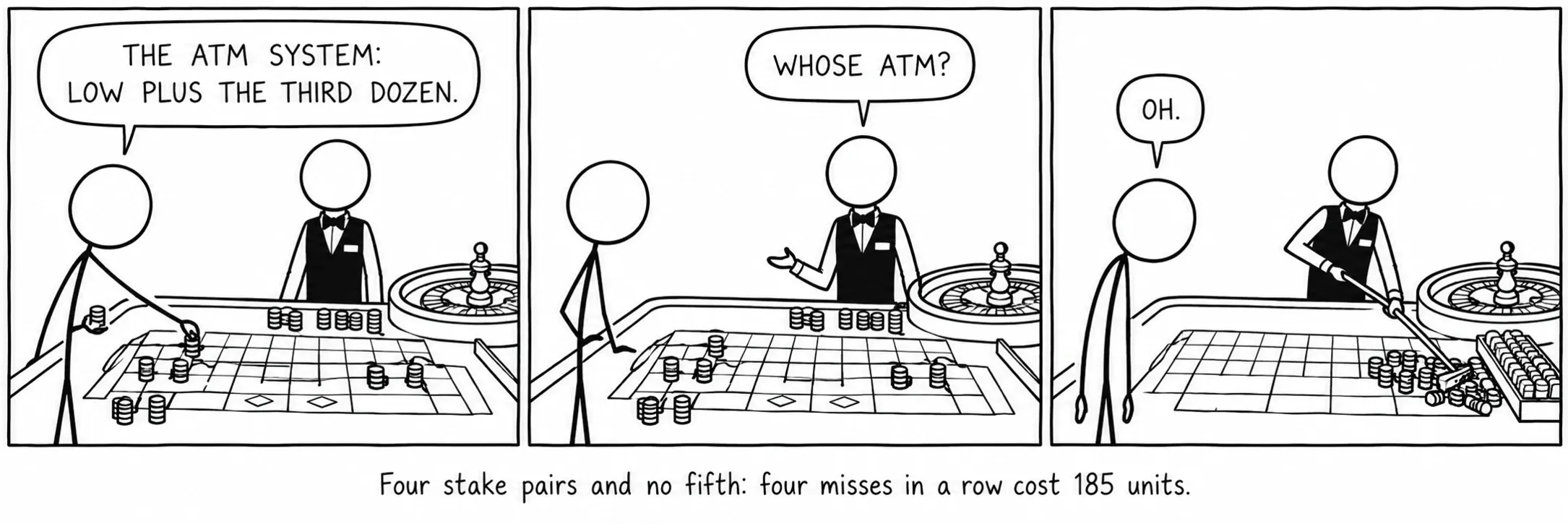
Four stake pairs and no fifth: four misses in a row cost 185 units.
Sources
- RouletteDoc, Strategy overview
- Roulette77, “ATM System” — stated stake pairs
- Wizard of Odds, Roulette Basics — low and dozen payouts
- Wizard of Odds, The Truth about Betting Systems — progression expectation