Sample Size
How many spins before a pattern means anything.

To detect a pocket hitting 1 in 30 instead of 1 in 37 with reasonable confidence takes roughly 4,000 spins. A 1-in-35 pocket, the kind that would actually pay, takes about 70,000.
Why so many
The signal, a few extra hits per thousand spins, is small against binomial noise of √(n·p·(1−p)) ≈ √(n/37). Noise falls like 1/√n, so halving the uncertainty costs four times the spins. A pocketequipmentPocketOne of the 37 numbered compartments on the rotor. Also: slot, cup.Read full → at 1/30 produces 33 hits per thousand against 27 expected: six extra hits, with a standard deviationmathStandard deviationSquare root of variance; the typical distance of a result from the expected value.Read full → of about five. One sample of a thousand cannot tell those apart reliably.
The formula
For a one-sided test of a single pocket at the 5% level with 80% power, the required n is approximately ((1.645·√(p₀(1−p₀)) + 0.84·√(p₁(1−p₁))) / (p₁ − p₀))², with p₀ = 1/37 and p₁ the suspected rate. That holds for one pocket chosen in advance. If you are scanning all 37 pockets for the hottest, multiply by roughly two to three to keep the false-positive rate honest.
Practical reading
A hot numbermythHot numberA number that has appeared more often than expected recently. On a fair wheel it predicts nothing.Read full → after 300 spins is noise. After 3,000 it is a reason to collect 3,000 more from the same wheel. After 30,000 it may be a wheel worth measuring physically. Every documented bias exploit in history was built on tens of thousands of recorded spins, and every one of them took months.
Cost of the data
At 50 spins an hour, 10,000 spins is 200 hours of recording, or several weeks of copying published histories, from a single identified wheel headequipmentWheel headSynonym for rotor: the spinning part carrying the numbers.Read full → that the casino has not rotated or re-fretted in the meantime. This, not the statistics, is why bias play has died: the maintenance cycle is shorter than the data-collection cycle.
Sample size for the edge itself
The same arithmetic says how long it takes a player to see the house edgemathHouse edgeThe share of each stake the casino keeps on average: 2.70% in European roulette.Read full → in their own results: around 1,400 even-money spins for one sigma, 10,000 for the edge to be unmistakable. Anyone claiming a system works on fewer spins than that is reporting noise.
Formula
Questions
Testing sectorswheelSectorA contiguous arc of pockets on the wheel, as distinct from a group on the layout.Read full → instead of pockets helps, because a physical defect usually affects an arc and the signal adds across pockets. It does not change the order of magnitude.
Yes, if the wheel head is the same and has not been serviced. That is the hard part to know.
Convention. It means a real bias of the stated size would be detected four times in five.
Comic relief
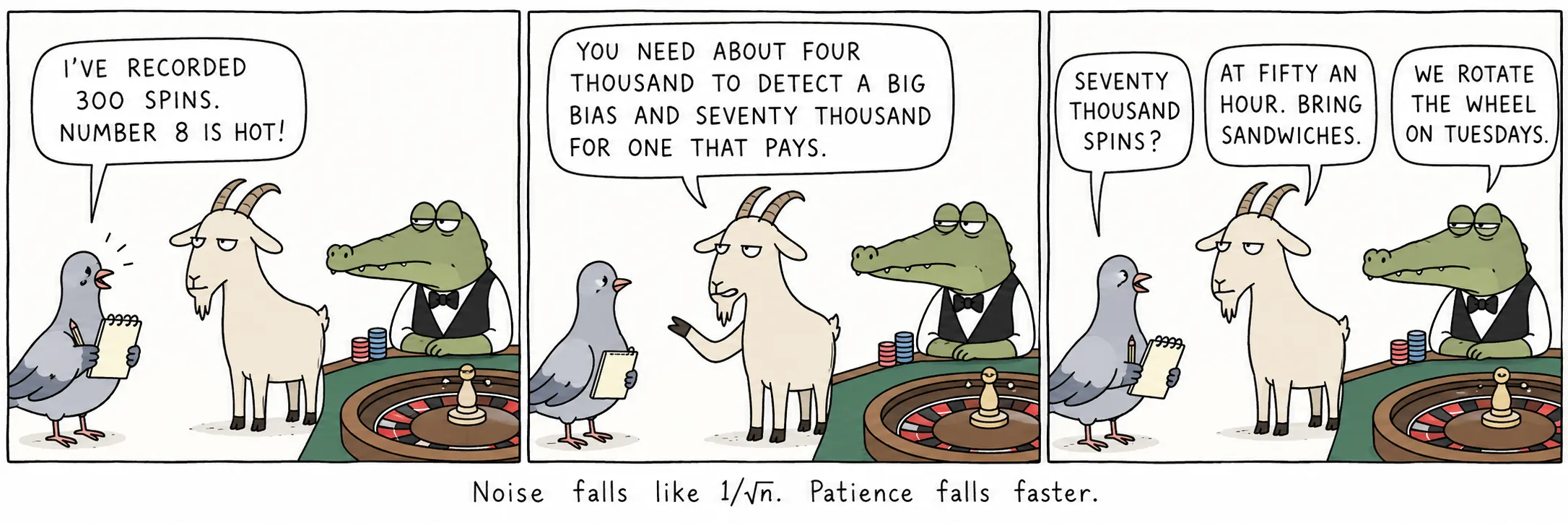
Noise falls like 1/√n. Patience falls faster.
Sources
- Feller, W. An Introduction to Probability Theory and Its Applications, Vol. 1.
- Barnhart, R. T. Beating the Wheel.