En Prison Roulette Rule
“In prison”: an eligible even-money stake is held after zero and resolved under the table’s rules.

In en prisonruleEn prisonA zero rule that holds an even-money stake for possible recovery on a later spin. The details vary by game.Read full definition → roulette your chipmoneyChipA token used to place a wager, with a printed or assigned value. Also called a check in some casino terminology.Read full definition → is held; if the next spin wins, you get the stake back (no winnings). With standard single-zero probabilities, common mathematical models give an edge around 1.35–1.39%, depending on repeated zeros.
Sequence
Suppose a $10 redbetRedAn even-money wager on the 18 red numbers. French: rouge.Read full definition → bet is imprisoned after zerowheelZeroThe 0 outcome, conventionally shown in green. Ordinary color, parity, high/low, dozen and column bets do not include it.Read full definition →. On the following spin, red normally releases the $10 stake without extra winnings, while blackbetBlackAn even-money bet on the 18 black numbers. French: noir.Read full definition → loses it. Another zero needs a specific rule: the stake might remain imprisoned, be partly returned or be lost. Do not treat those versions as identical.
$10 on red is held under en prison.
$10 stake returned, no profit.
$10 stake lost.
Apply the table’s repeated-zero rule; this is an alternative outcome, not a later step.
The arithmetic
In a model where repeated zeros leave the stake imprisoned unchanged, the eventual nonzero result is equally likely to be red or black. Half of imprisoned stakes are therefore recovered, giving the same 1/74 house edgemathHouse edgeThe casino’s expected net gain expressed as a fraction of the stake, under specified probabilities and payouts.Read full definition → as la partageruleLa partageA rule returning half of a qualifying even-money stake when zero lands. On a fair single-zero wheel it gives an edge of 1/74, about 1.35%.Read full definition →. If a second zero loses the stake, recovery probabilitymathProbabilityA measure of how likely an event is, from zero to one. Percentages express the same scale from 0% to 100%.Read full definition → is only 18/37 and the original bet’s edge is 19/1369, about 1.39%. A rule returning half the stake on the second zero also gives 1/74. These calculations assume independent, uniformly distributed single-zero outcomes.
| specified repeated-zero model | edge per original bet |
|---|---|
| stake remains imprisoned unchanged | 1.35% |
| half stake returned on second zero | 1.35% |
| whole stake lost on second zero | 1.39% |
| no en prison or half-return | 2.70% |
Rules vary
France’s published French-roulette rules provide a choice of half-return or prison, with the stake’s stated value reduced after successive zeros. That is more detailed than saying that every second zero is ignored. Check the rule covering repeated zeros, early withdrawal and the last spin of a session before comparing games.
Interaction with your own limits
An imprisoned stake may remain unresolved when your planned session ends. Check whether it must stay until settlement or can be partly withdrawn. A fixed spin count and a fixed number of completed bets are different limits when a bet can last several spins.
Questions
Only as the table’s rules allow. Some rules offer a partial return; others require waiting for settlement.
Standard en prison applies to eligible even-money betsbetEven-money betA bet paying a profit equal to the stake, such as red/black, odd/even or high/low.Read full definition →, not dozensbetDozenA bet on 1–12, 13–24 or 25–36, ordinarily paying 2 to 1.Read full definition → or columnsbetColumnTwelve numbers in one vertical layout column, ordinarily paying 2 to 1.Read full definition →.
La partage has an exact 1/74 edge on standard single-zero even-money bets. The prison models shown here range from 1/74 to 19/1369 per original bet, a difference of about 0.04 percentage points. Resolution time and withdrawal conditions also differ.
Fun with Math
Try these yourself first. Each solution is folded; open it when you are ready.
Consider a specific en prisonruleEn prisonA zero rule that holds an even-money stake for possible recovery on a later spin. The details vary by game.Read full definition → rule on an independent, uniform single-zerowheelZeroThe 0 outcome, conventionally shown in green. Ordinary color, parity, high/low, dozen and column bets do not include it.Read full definition → wheel. An even-money betbetEven-money betA bet paying a profit equal to the stake, such as red/black, odd/even or high/low.Read full definition → caught by zero gets one more spin: a win returns the stake, anything else loses it, a second zero included. Work out the house edgemathHouse edgeThe casino’s expected net gain expressed as a fraction of the stake, under specified probabilities and payouts.Read full definition →.
Show the solution
Answer 19/1,369, about 1.39%.
Take $1 on redbetRedAn even-money wager on the 18 red numbers. French: rouge.Read full definition →. It wins outright with chance 18/37: +1.
Zero comes up with chance 1/37. Then the next spin returns the stake with chance 18/37 (net 0) and loses it otherwise. So the bet loses with chance 18/37 on the first spin, plus 1/37 × 19/37 after a zero: 666/1,369 + 19/1,369 = 685/1,369.
Expected valuemathExpected valueThe sum of each possible net result multiplied by its probability. It can be positive, zero or negative.Read full definition →: 666/1,369 − 685/1,369 = −19/1,369 ≈ −1.39%. La partageruleLa partageA rule returning half of a qualifying even-money stake when zero lands. On a fair single-zero wheel it gives an edge of 1/74, about 1.35%.Read full definition → hands back half at once and costs 1/74 ≈ 1.35%: the second zero is the whole difference.
Comic relief
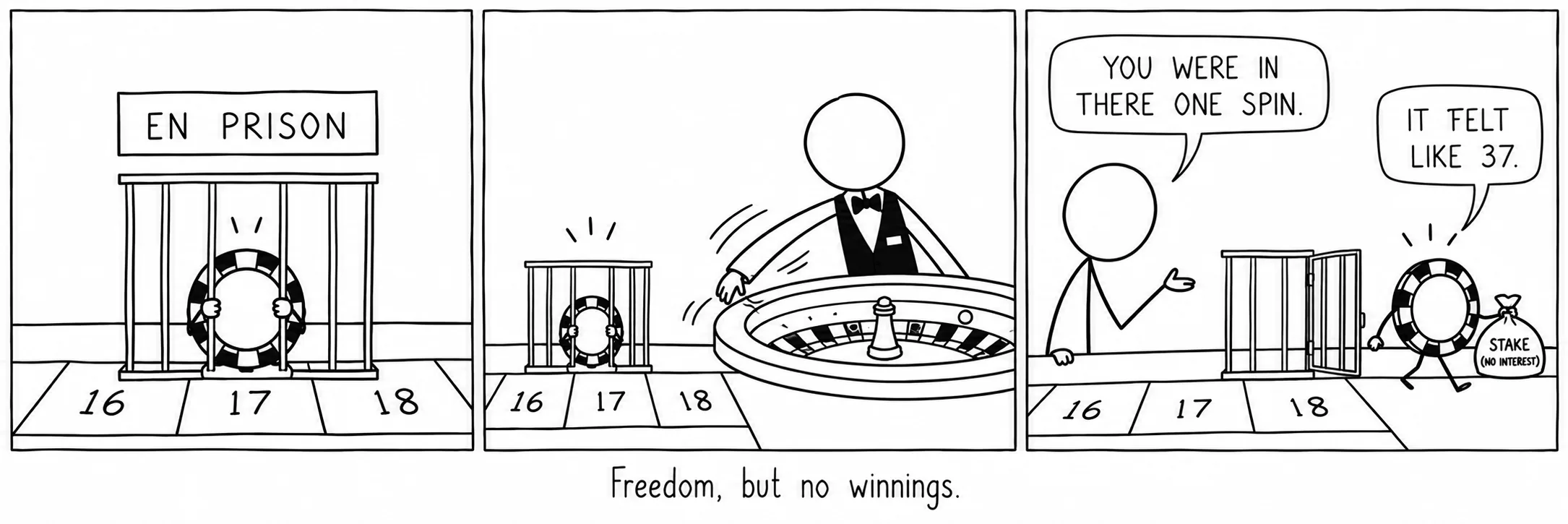
In this example, red releases the imprisoned red stake without profit. Other outcomes follow the table’s rules.
Sources
- Ethier, S. N. The Doctrine of Chances: Probabilistic Aspects of Gambling.
- Wykes, A. The Complete Illustrated Guide to Gambling.
- Wizard of Odds. “Roulette Basics”, imprisonment variants.