Bad Homburg and the Spa Casinos
Where the single zero was born, and why the spas had casinos at all.
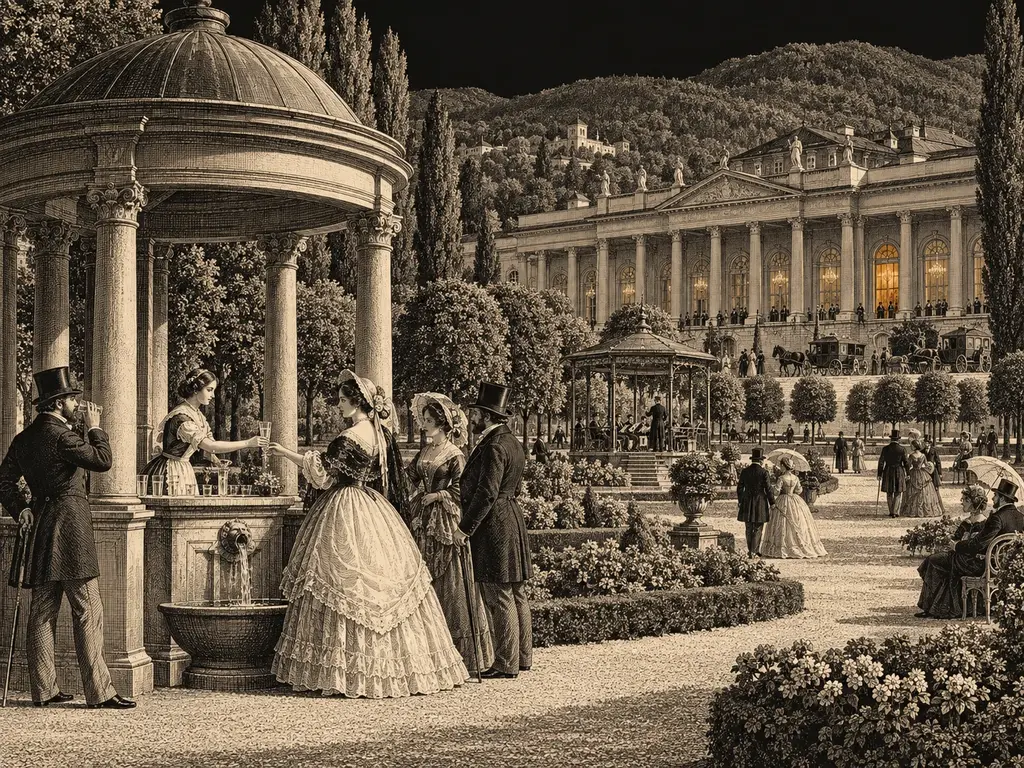
In the 1840s the German spa towns of Baden-Baden, Wiesbaden and Bad Homburg competed for wealthy visitors with casinos attached to their baths. Homburg won the roulette war by removing a zero. Prussia closed them all in 1872.
Taking the waters
A 19th-century spa cure took weeks and attracted people with money and time. Towns competed on hotels, concerts and, from the 1820s, gaming rooms, licensed by small German states that needed the revenue. Baden-Baden’s Kurhaus and Wiesbaden’s Kurhaus ran roulette and trente-et-quarante for an international clientele; the French, whose own casinos were banned from 1837, came in numbers.
Homburg’s price cut
Bad Homburg was smaller and later. The Blanc brothers took the concession in 1841 and in 1843 advertised a wheel with a single zerowheelZeroThe single green pocket that no even-money, dozen or column bet covers; the source of the house edge. Also: single zero, 0.Read full →: the house edgemathHouse edgeThe share of each stake the casino keeps on average: 2.70% in European roulette.Read full → halved from 5.26% to 2.70%, and the advertising said so. Players moved. Within a decade Homburg was the fashionable spa and Blanc the richest man in Hesse. The rivals eventually matched the single zero, but by then the brand was made.
Dostoevsky
Fyodor Dostoevsky lost heavily at Wiesbaden and Homburg in the 1860s, pawning his wife’s jewelry and writing The Gambler (1866) in 26 days to pay a publisher. The novel’s Roulettenburg is a composite of the spas, and its description of the tables, the systems and the compulsion is the best literary account of roulette ever written. He stopped gambling in 1871, a year before the tables closed.
1872
After unification, Prussia closed every casino in Germany; the last tables at Homburg and Baden-Baden shut on New Year’s Eve 1872. The Blanc operation had already moved to Monaco in 1863, taking the single zero with it. The German spas reopened their casinos in the 20th century (Baden-Baden in 1933, Homburg and Wiesbaden after the war) and run single-zero roulette to this day, with the French rules Homburg made standard.
What the spas left behind
The single-zero wheel, the casino as part of a resort, and the idea that a casino competes on price. Also the literary roulette player: Dostoevsky’s Alexei, Turgenev’s observations, and a century of novels in which a spa casino is where a fortune or a reputation is lost. The arithmetic was always 2.70%; the spas supplied the setting.
Questions
Yes. The Kurhaus casino reopened in 1933 and runs single-zero roulette with French rules.
The first to make it a policy and advertise it. Isolated single-zero wheels may have existed earlier.
Moral politics and a unified state that did not need small-principality gaming revenue.
Comic relief
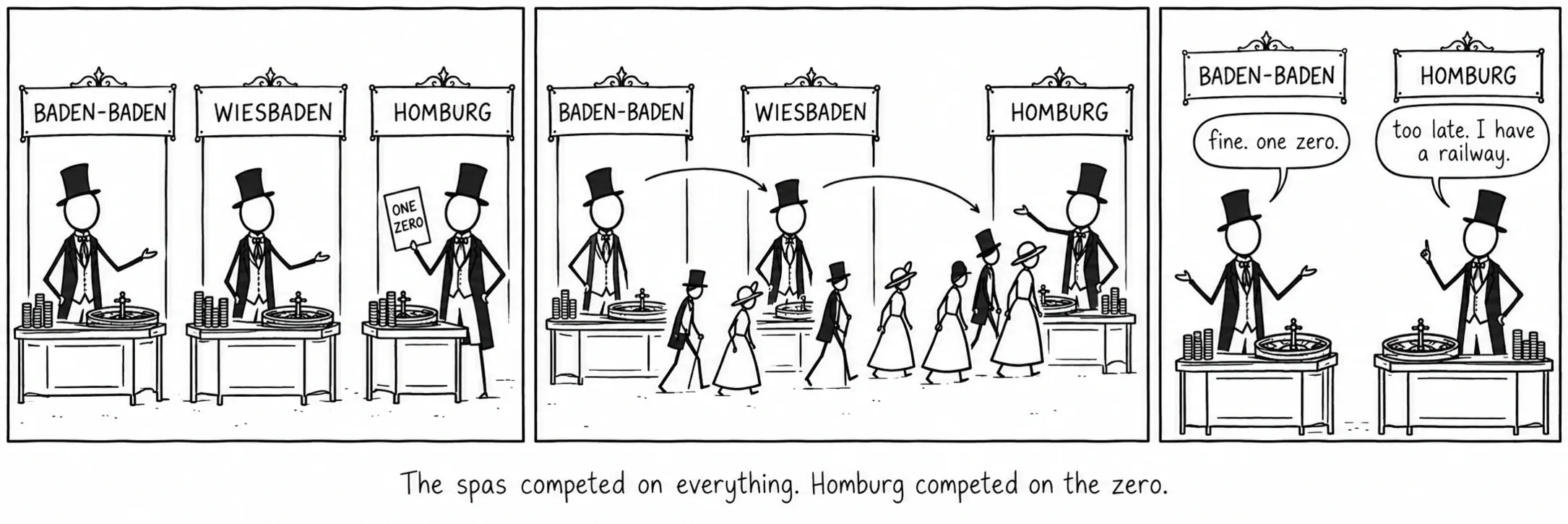
The spas competed on everything. Homburg competed on the zero.
Sources
- Schwartz, D. G. Roll the Bones: The History of Gambling.
- Kavanagh, T. M. Dice, Cards, Wheels: A Different History of French Culture.