Roulette Red / Black Strategy
Most systems are built on red/black because it is the closest thing to a coin flip on the table.

On independent uniform single-zero spins, red wins with probability 18/37, about 48.65%. Under standard rules, expected loss is 1/37 of the stake; actual results vary. Switching colors after past results does not remove that edge.
Following and opposing streaks
Under independent uniform single-zerowheelZeroThe 0 outcome, conventionally shown in green. Ordinary color, parity, high/low, dozen and column bets do not include it.Read full definition → spins with standard payoutsmoneyPayoutThe amount paid on a winning wager. Check whether the quoted figure is net profit or total return including the stake.Read full definition →, following a color streak or betting against it gives the same expected net return per unitmoneyUnitA base amount used to express stakes or results.Read full definition →: −1/37, about −2.70%. Each selected color has probabilitymathProbabilityA measure of how likely an event is, from zero to one. Percentages express the same scale from 0% to 100%.Read full definition → 18/37 of winning the next spin. The players can still finish with very different results. Their expected cash losses match only when their expected total stakes match.
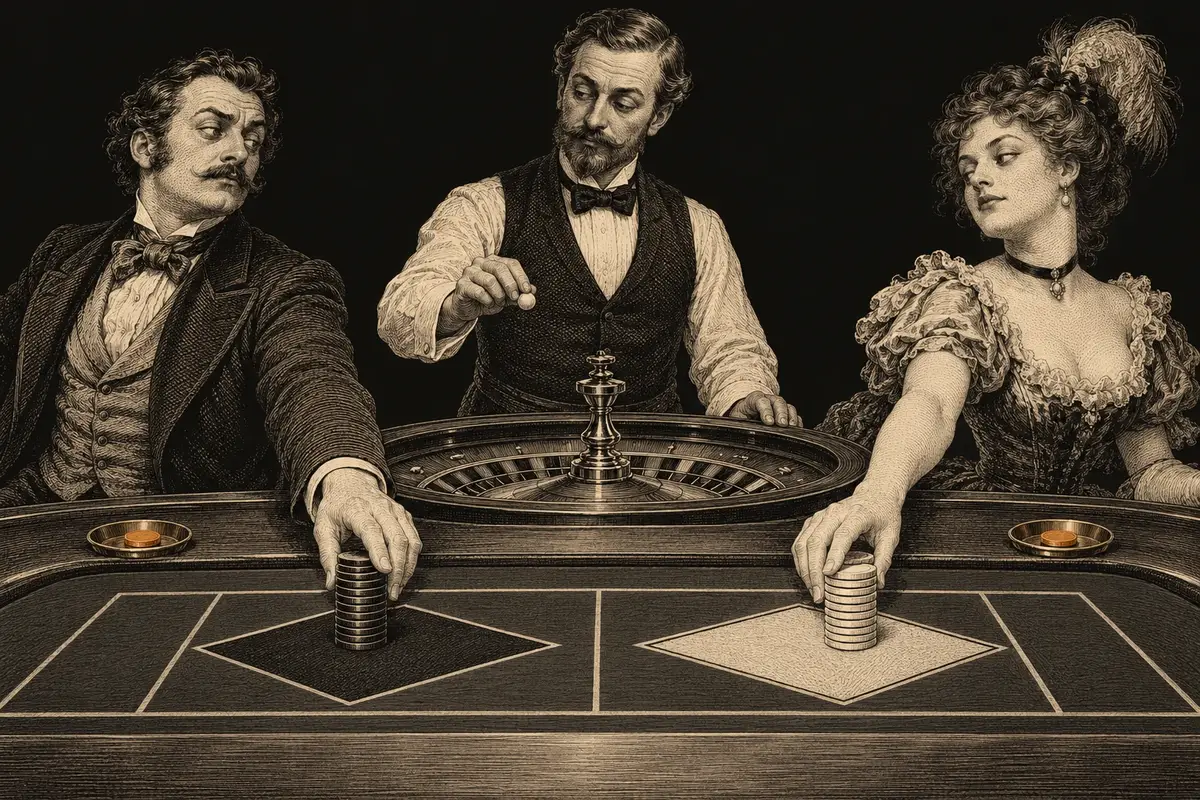
What a 200-spin session contains
Runs are common in independent outcomes. In 200 spins, the probability of at least five consecutive redsbetRedAn even-money wager on the 18 red numbers. French: rouge.Read full definition → or five consecutive blacksbetBlackAn even-money bet on the 18 black numbers. French: noir.Read full definition → somewhere is about 99.83%; for eight it is 47.29%, and for ten 13.71%. These are whole-session probabilities, not the chance of a run starting on the next spin.
| same-color run somewhere in 200 spins | probability |
|---|---|
| 5 or more | 99.83% |
| 6 or more | 94.45% |
| 7 or more | 74.07% |
| 8 or more | 47.29% |
| 10 or more | 13.71% |
| 12 or more | 3.38% |
Roulette color strategy: progressions and switching rules
Everything in the Strategy section can be run on red/black: MartingalestrategyMartingaleA progression that doubles after each loss and usually returns to the base stake after a win.Read full definition →, FibonaccistrategyFibonacciA staking progression using 1, 1, 2, 3, 5, 8, 13 and so on, commonly moving forward after a loss and back two places after a win.Read full definition →, D’Alembert, LabouchèrestrategyLabouchèreA cancellation progression: bet the sum of the two end numbers, remove them after a win, and append the stake after a loss. With one number left, bet that number.Read full definition →, ParolistrategyParoliA positive progression that raises stakes after wins. A common version uses 1, 2 and 4 units, resetting after a loss or three wins.Read full definition →. Some systems add color-specific rules such as switching color after two losses or betting the color that has appeared less often in the last twenty spins. A choice based only on past independent outcomes does not improve the next bet’s probability. Changes to stake or stopping rules can still alter turnovermoneyTurnoverThe sum of amounts wagered over a session or period, including money wagered again after a return. Also called handle or action.Read full definition → and risk.
Where to play it
La partageruleLa partageA rule returning half of a qualifying even-money stake when zero lands. On a fair single-zero wheel it gives an edge of 1/74, about 1.35%.Read full definition → on eligible single-zero even-money betsbetEven-money betA bet paying a profit equal to the stake, such as red/black, odd/even or high/low.Read full definition → halves the edge from 1/37 to 1/74. En prisonruleEn prisonA zero rule that holds an even-money stake for possible recovery on a later spin. The details vary by game.Read full definition → depends on the rules for imprisoned bets and repeated zeros. For 100 fully funded $10 bets, la partage gives expected lossmathExpected lossThe probability-weighted average net loss under a stated model. With a constant edge, it equals edge times expected total stakes.Read full definition → $13.51 instead of $27.03; the table name alone does not establish the zero rule.
Red/black and the Monte Carlo fallacy
A 1938 TIME report retold a run of 26 blacks at Monte Carlo in 1913. That retrospective account is not a spin-by-spin primary record or a verified figure for money lost. The mathematical point stands independently of the story: a past run does not change the next independent spin.
Simulator · Flat
2,000 sessions of even-money bets from a $1,000 bankroll.
Base bet $10 · table limit $500 · up to 100 spins per session
Questions
Identical. 18 numbers each.
Under independent uniform spins, switching colors based on past results does not improve the next bet’s odds. It can change which bets win in a particular session.
With equal stakes and standard single-zero rules, red or black breaks even overall; zero loses both stakes. There is no profitable outcome, and expected loss is 1/37 of the total staked. Unequal stakes or special zero rules change the net outcomes.
Comic relief
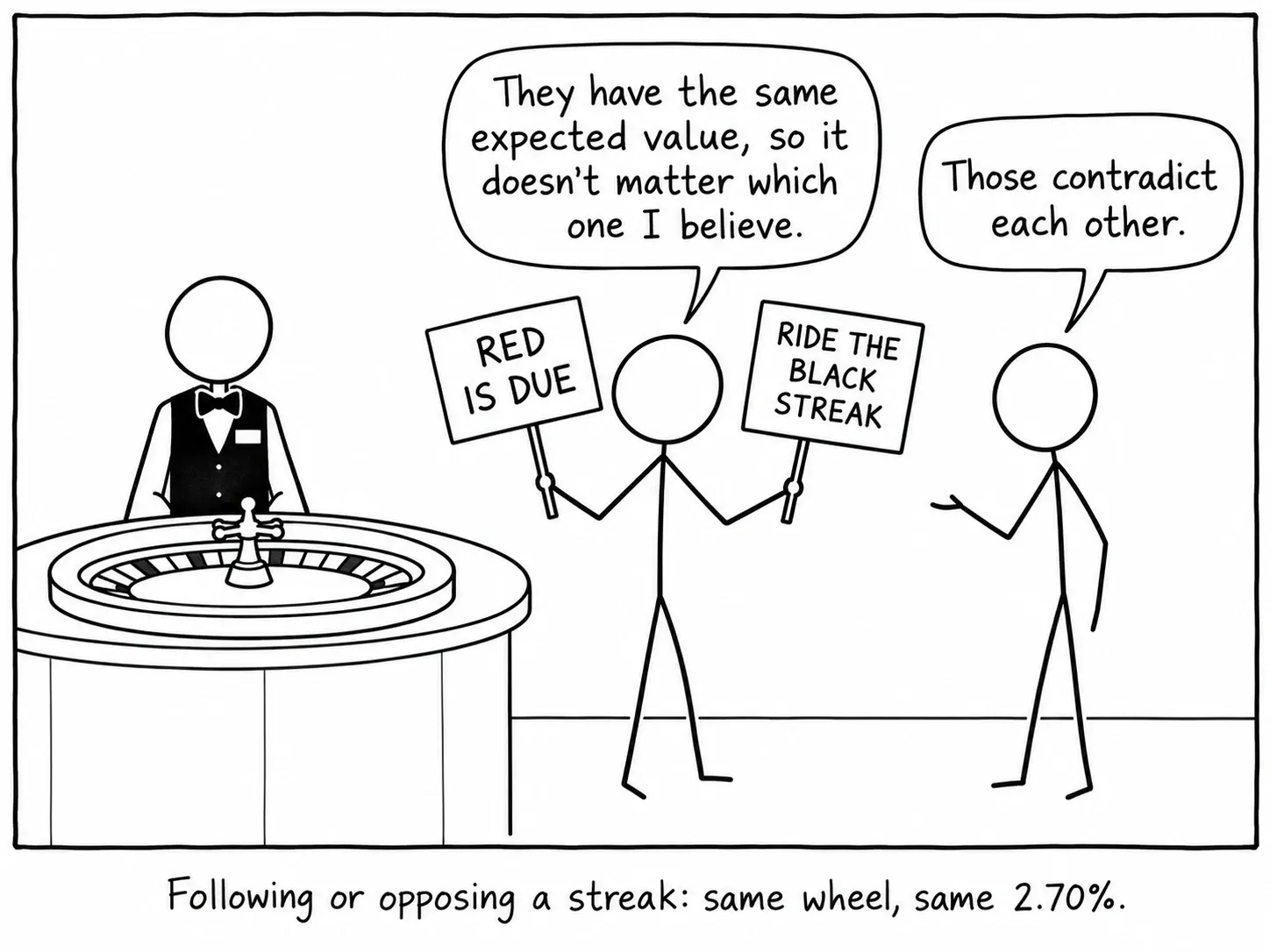
On independent fair single-zero spins with standard payouts, each red or black bet has an expected loss of 1/37 of its stake.
Sources
- RouletteDoc. Roulette strategies overview.
- Roulette77. Roulette strategies overview.
- Ethier, S. N. The Doctrine of Chances: Probabilistic Aspects of Gambling.
- Feller, W. An Introduction to Probability Theory and Its Applications, Vol. 1.