Myth: A Roulette Strategy That Always Wins
Winning often is different from having a positive expected return.

A staking system can change how wins and losses are distributed. For independent uniform spins with standard payouts, it does not remove the house edge. A claimed success rate is incomplete without the size of wins and losses, bankroll, limits and stopping rule.
The claim
A strategy may be promoted through winning sessions, screenshots or a spreadsheet. Those observations can be real without demonstrating a profitable expectation. They do not show all possible results or establish what happens under the stated limits.
Why it is wrong, in one line
For an independent uniform single-zerowheelZeroThe 0 outcome, conventionally shown in green. Ordinary color, parity, high/low, dozen and column bets do not include it.Read full definition → model with standard full-loss-on-zero payoutsmoneyPayoutThe amount paid on a winning wager. Check whether the quoted figure is net profit or total return including the stake.Read full definition →, each unitmoneyUnitA base amount used to express stakes or results.Read full definition → staked has expected net return −1/37. In a bounded session, with bets chosen using information available before each spin, expected lossmathExpected lossThe probability-weighted average net loss under a stated model. With a constant edge, it equals edge times expected total stakes.Read full definition → is 1/37 of expected turnovermoneyTurnoverThe sum of amounts wagered over a session or period, including money wagered again after a return. Also called handle or action.Read full definition →.
This statement needs its assumptions. Different payouts require a different edge, and an unbounded theoretical stopping rule cannot be handled by silently ignoring convergence conditions. A finite bankrollmoneyBankrollThe amount set aside for play. Bankroll management concerns stakes and limits within that amount.Read full definition →, table limitstableTable limitA permitted minimum or maximum stake, applied per bet, bet category or total wager according to the table.Read full definition → and a defined stopping rule make a real system concrete enough to evaluate.
Why it seems to work
Some progressionsstrategyProgressionA rule that changes stakes over a sequence of bets, often using previous wins or losses.Read full definition → produce frequent small wins and occasional larger losses. The exact frequency depends on the bankroll, maximum stake, session length and reset rules. There is no universal 80% MartingalestrategyMartingaleA progression that doubles after each loss and usually returns to the base stake after a win.Read full definition → session-win rate.
For an illustrative comparison, suppose a session wins $40 with probabilitymathProbabilityA measure of how likely an event is, from zero to one. Percentages express the same scale from 0% to 100%.Read full definition → 80% and loses $500 with probability 20%. Its expected result is 0.8 × $40 − 0.2 × $500 = −$68. These assumed outcomes are not simulated results for a particular Martingale configuration.
The test anyone can run
The Strategy Simulator can help explore a specified configuration. Read its bankroll, bet rules, session length and stopping conditions before interpreting the output. A finite simulation can have a positive sample mean even when the theoretical expected return is negative. Repeatability and uncertainty matter; neither one winning session nor a simulation alone proves a universal claim.
A system that cannot lose
Not placing a wager avoids gambling losses. That is different from finding a betting method with a guaranteed profit. A rule advertised as risk-free may conceal this distinction, an uncovered outcome, a funding requirement or a limit it cannot satisfy.
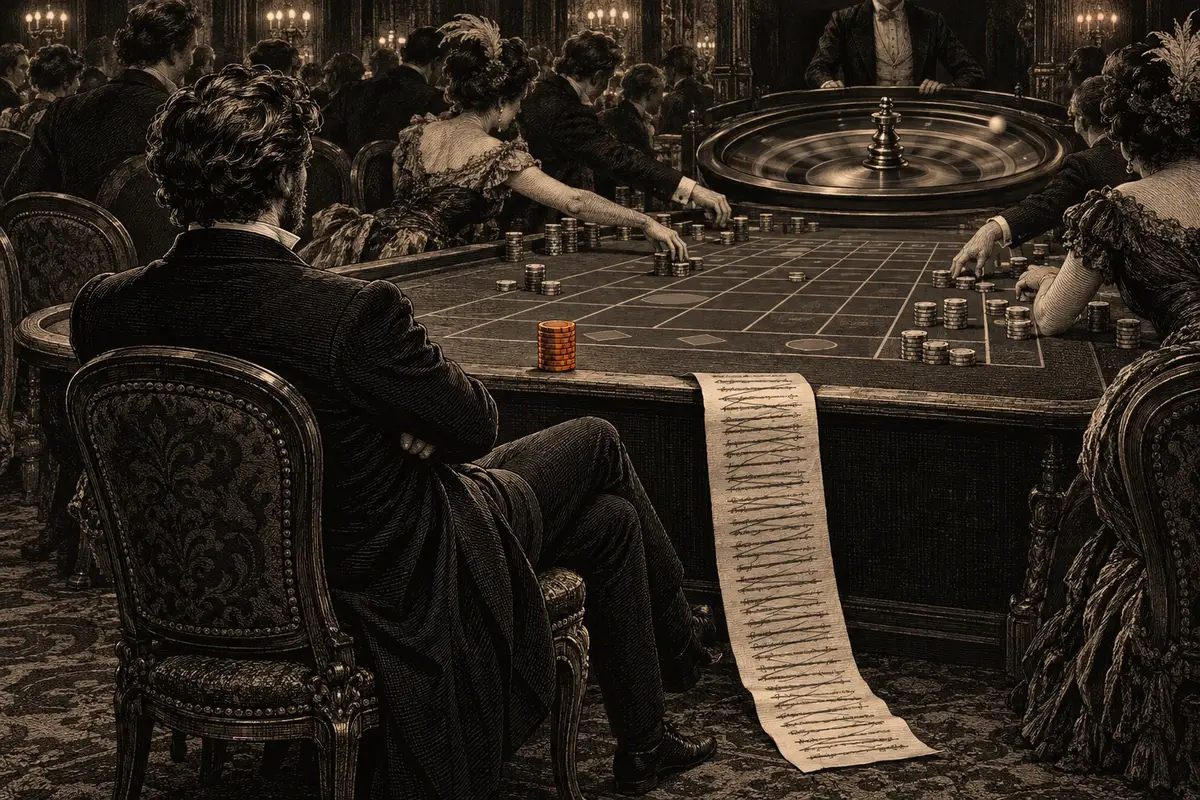
Betting examples, one line each
The examples below specify the bets being compared. They assume independent uniform single-zero spins and standard payouts. A high chance of receiving a payout is not the same as a positive expected return.
| system | what it does | what the calculation shows |
|---|---|---|
| Black plus third column | 1 unit on black and 1 on the third column, which holds only four black numbers | Net results are +3, +1, 0 or −2 units; the expected loss is 2/37 of a unit on the two-unit stake |
| Red snake | 1 unit each on 1, 5, 9, 12, 14, 16, 19, 23, 27, 30, 32 and 34 | Covers 12/37 outcomes, about 32.43%; the full spread still has a 2.70% house edge |
| Six line plus four numbers | 1 unit on the 1–6 six line, plus 1 unit each on 7, 8, 9 and 10 | Covers 10/37 outcomes, about 27.03%; the five-unit spread still has a 2.70% house edge |
| The $450 ladder | One number: $5 per spin for 20 spins, then $10 for 20, then $15 for 10; stop on the first hit | No hit in all 50 spins has probability (36/37)^50 ≈ 25.41%; that outcome loses $450 |
| Three simultaneous Martingales | Run one progression on red/black, one on odd/even and one on high/low, all on the same spins | the joint risk depends on the stake and reset rules; the three bets share a spin and are not independent |
| Waiting for a missed bet | Bet an even-money option after five misses, or a column after seven misses | The next-spin win probabilities remain 18/37 and 12/37 respectively; waiting alone creates no edge |
| “19 spins make it 50–50” | bet one number 19 times | 1 − (36/37)^19 ≈ 40.58%, not 50% |
The honest version
Stake rules change the distribution of session results and the amount wagered. Under the stated model they do not create an advantage. A progression costs more in expectation than another plan only when it produces more expected turnover at the same house edgemathHouse edgeThe casino’s expected net gain expressed as a fraction of the stake, under specified probabilities and payouts.Read full definition →; larger total stakes should not be assumed without comparing the plans.
Questions
No. Assess the complete record, total stakes, losses and uncertainty. A past winning run does not establish positive expectation, and losses are not scheduled to arrive as compensation.
No. A stopping rule changes exposure and the distribution of results. It does not create positive expectation under the stated bounded-session model.
It could change the probability model if supported by evidence. That is different from merely changing stakes after independent results.
Fun with Math
Try these yourself first. Each solution is folded; open it when you are ready.
A joke system forbids the outside redbetRedAn even-money wager on the 18 red numbers. French: rouge.Read full definition →/blackbetBlackAn even-money bet on the 18 black numbers. French: noir.Read full definition → and odd/even bets and any bet on the zeroswheelZeroThe 0 outcome, conventionally shown in green. Ordinary color, parity, high/low, dozen and column bets do not include it.Read full definition →. Among straight-up numbers it forbids odd reds, even blacks, 30, and every pocketequipmentPocketA compartment on the rotor in which the ball can settle. The number of pockets depends on the wheel.Read full definition → from 11 clockwise through 14 in the standard American wheel order. Which numbers remain?
Show the solution
Answer None. It places no bets and has no gambling gain or loss; a house-edge percentage is undefined with zero turnovermoneyTurnoverThe sum of amounts wagered over a session or period, including money wagered again after a return. Also called handle or action.Read full definition →.
Banning red, black, odd, even and the zeros leaves single numbers and small groups among 1 to 36.
No odd reds and no even blacks leaves the even reds (12, 14, 16, 18, 30, 32, 34, 36) and the odd blacks (11, 13, 15, 17, 29, 31, 33, 35): sixteen numbers. Banning 30 leaves fifteen.
On the American wheel the run from 11 clockwise to 14 covers 32 of the 38 pockets. The six outside it are 0, 28, 9, 26, 30 and 2. All fifteen survivors are inside the run, so the last rule removes them too. The rules eliminate every remaining number. With nothing wagered there is no gambling loss, but there is also no positive gambling return.
Consider three capped MartingalestrategyMartingaleA progression that doubles after each loss and usually returns to the base stake after a win.Read full definition → streams on standard single-zero even-money betsbetEven-money betA bet paying a profit equal to the stake, such as red/black, odd/even or high/low.Read full definition →. Each uses stakes 1, 2, 4, 8, 16 and 32, then stops after six losses. For one fresh stream with sufficient funds, find its failure probabilitymathProbabilityA measure of how likely an event is, from zero to one. Percentages express the same scale from 0% to 100%.Read full definition →, expected cycle result and expected turnover.
Show the solution
Answer It loses all six about once in 55 cycles, 1.83% of the time, and that costs 63 unitsmoneyUnitA base amount used to express stakes or results.Read full definition →. On average a cycle loses about 0.17 units out of 6.42 units staked: 2.70%, the price of every bet on the wheel.
A bet loses with chance 19/37, the zero included. Six in a row: (19/37)⁶ = 0.0183, about 1 in 55, and then the stakes 1 + 2 + 4 + 8 + 16 + 32 = 63 are gone. Otherwise the cycle ends with a win and +1 unit.
Average: 1 × (1 − 0.0183) − 63 × 0.0183 = 1 − 64 × 0.0183 = −0.17 units.
Money staked: the first bet is always placed, the second only after a loss, and so on: 1 + 2 × (19/37) + 4 × (19/37)² + … + 32 × (19/37)⁵ = 6.42 units. And −0.17/6.42 = −2.70%.
For three such cycles, expected turnovers and losses add, even if the streams share spins and are correlated. Under identical cycle rules and sufficient funds, the totals are three times one stream’s expectations. A shared bankrollmoneyBankrollThe amount set aside for play. Bankroll management concerns stakes and limits within that amount.Read full definition → or a shared stop rule can change which bets are actually placed.
Comic relief
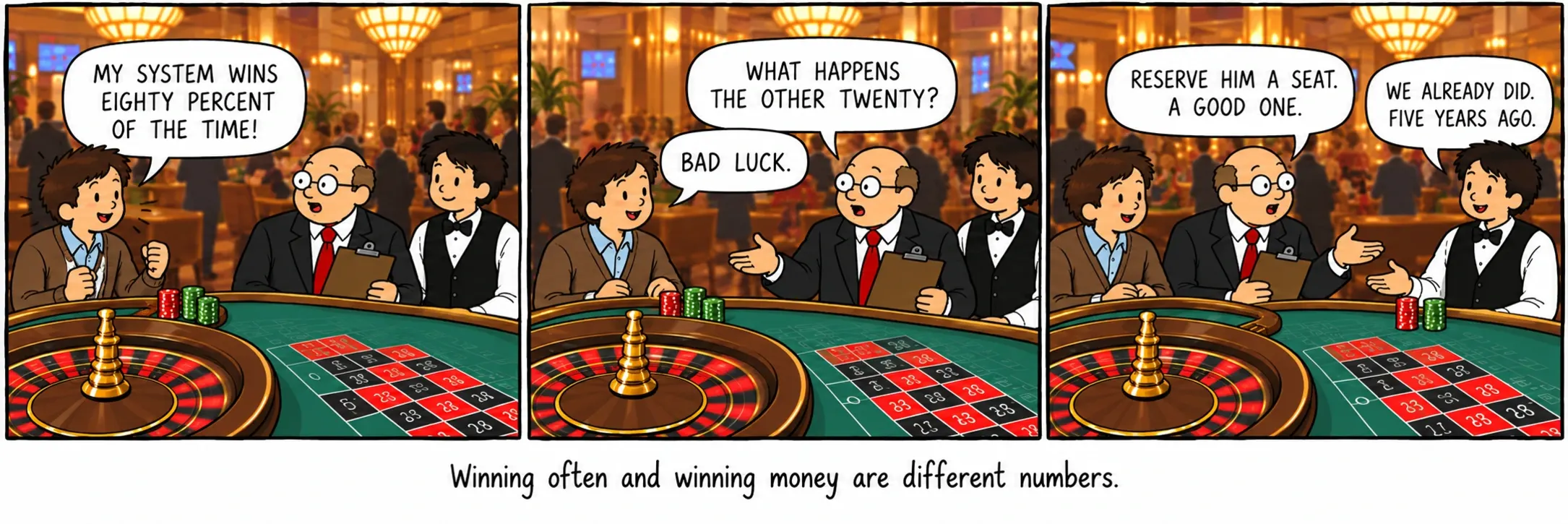
Hypothetical example: four $40 wins minus one $500 loss equals −$340.
Sources
- Thorp, E. O. “Optimal gambling systems for favorable games.”
- Thorp, E. O. The Mathematics of Gambling.
- Doob, J. L. “Note on probability.”
- Halmos, P. R. “Invariants of certain stochastic transformations: the mathematical theory of gambling systems.”
- Ethier, S. N. The Doctrine of Chances: Probabilistic Aspects of Gambling.
- Bollman, M. Mathematics of the Big Four Casino Table Games: Blackjack, Baccarat, Craps, & Roulette.
- Bollman, M. Basic Gambling Mathematics: The Numbers Behind the Neon, 2nd ed.