The 1-3-2-6 System
Four bets in sequence after wins: 1, 3, 2, 6 units. Any loss resets. A full cycle nets +12 units for 2 units of your own money at risk.

It does not beat the wheel. It is a positive progressionstrategyProgressionAny rule that changes the stake based on previous results. Negative progressions raise it after losses, positive after wins.Read full → that presses winnings in a fixed pattern. Probability of completing the four-win cycle is (18/37)⁴ ≈ 5.6%. Expected lossmathExpected lossExpected value times total amount wagered; the average amount lost over a session or a period.Read full → is 2.70% of turnover.
Walk the system
A win moves one step on. A loss, or a fourth win, goes back to the start.
Stakes and results are in units of the base bet.
How does the 1-3-2-6 system work?
Bet one unitmoneyUnitThe base stake a system or a player works in. Progressions are described in units so they apply at any table.Read full →. Win: bet three (the two units now on the table plus one more). Win: bet two, pocketing four. Win: bet six. Win: collect, cycle complete at +12 units. Any loss at any stage returns to one unit. The sequence is designed so that a loss on the second bet costs only two units of your own money and a loss on the third or fourth leaves you ahead or level for the cycle.
How often does each ending come up?
p = 18/37 per win. Lose at stage 1: 51.4%. Win 1, lose at 2: 25.0%. Win 2, lose at 3: 12.2%. Win 3, lose at 4: 5.9%. Complete: 5.6%. Expected cycle result: −1(0.514) − 2(0.250) + 2(0.122) + 0(0.059) + 12(0.056) = −0.514 − 0.500 + 0.244 + 0 + 0.672 = −0.098 units. Expected turnovermoneyTurnoverThe total amount wagered over a session or period, counting re-bet winnings. Also: handle, action.Read full → per cycle ≈ 1 + 3(0.486) + 2(0.237) + 6(0.115) = 3.62 units. Ratio: −2.7%.
What does a session look like?
Three cycles in four lose one or two units. One in eighteen completes for +12. Sessions drift down in small steps with occasional +12 jumps; the probabilitymathProbabilityChance of an outcome, from 0 to 1 or 0% to 100%. One number: 1/37 = 2.70%.Read full → of a 100-spin session ending ahead is around 39%. No cliff, no large exposure, and the house takes its 2.70% of everything pressed.
Does the 1-3-2-6 system work?
No. The order of the four bets decides which losses hurt, not how much is lost. The arithmetic above comes to −2.7% of everything wagered, the same as one bet on redbetRedEven-money bet on the 18 red numbers. French: rouge.Read full →.
The tempting thought is that from the third bet on you are playing with winnings. Winnings are your money from the moment they are paid, and the wheel charges the same 2.70% on them.
Are there other versions?
1-3-2-4 is a gentler version (full cycle +10, final stake 4). 1-2-3-6 and 1-3-2-6 are often confused; the ordering changes which losses hurt. All versions share the expected valuemathExpected valueThe average result per bet over the long run. −1/37 of the stake for every standard European bet.Read full →; the sequence only redistributes it.
Simulator · 1-3-2-6
2,000 sessions of even-money bets from a $1,000 bankroll.
Base bet $10 · table limit $500 · 100 spins per session
Questions
So that a loss at stage 2 costs only 2 units of your own money (you had +1, bet 3, lost: −2).
Different shape. ParolistrategyParoliPositive progression: double after a win, reset after a loss or after three wins in a row. Also: reverse Martingale.Read full → risks 1 unit per cycle for +7; this risks up to 2 for +12. Same edge.
Comic relief
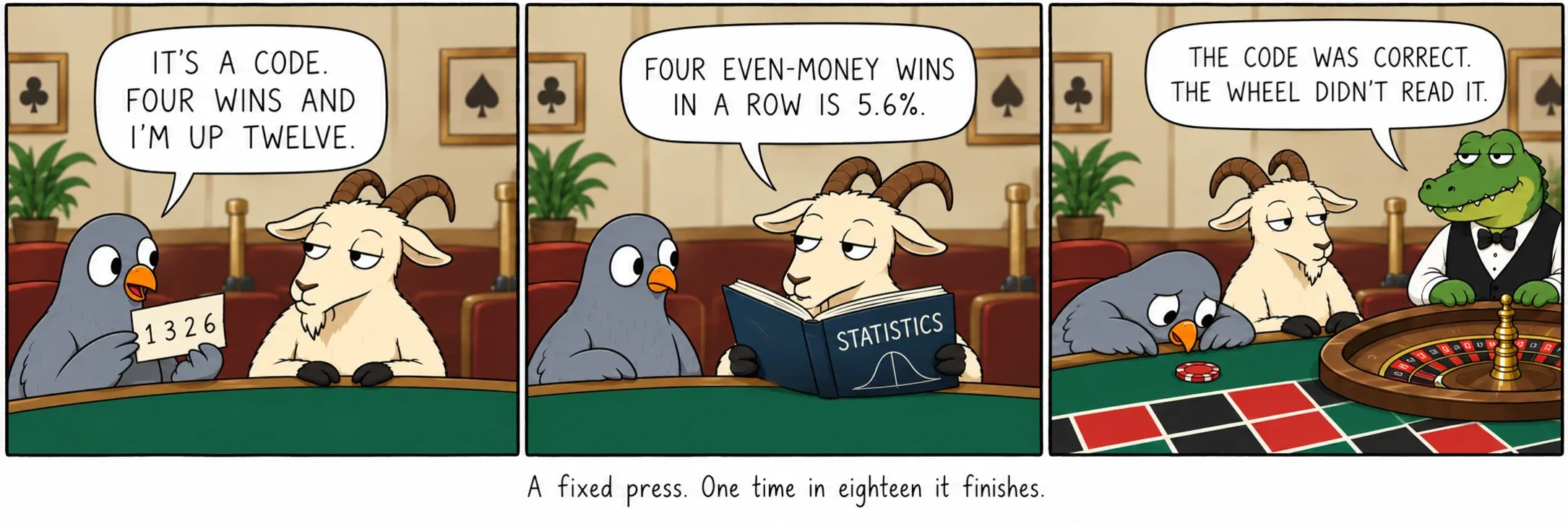
A fixed press. One time in eighteen it finishes.
Sources
- Ethier, S. N. The Doctrine of Chances: Probabilistic Aspects of Gambling.
- Epstein, R. A. The Theory of Gambling and Statistical Logic, 2nd ed.