The Man Who Broke the Bank
A fraudster, a secret system, an extraordinary week, and a music-hall song that outlived them all.
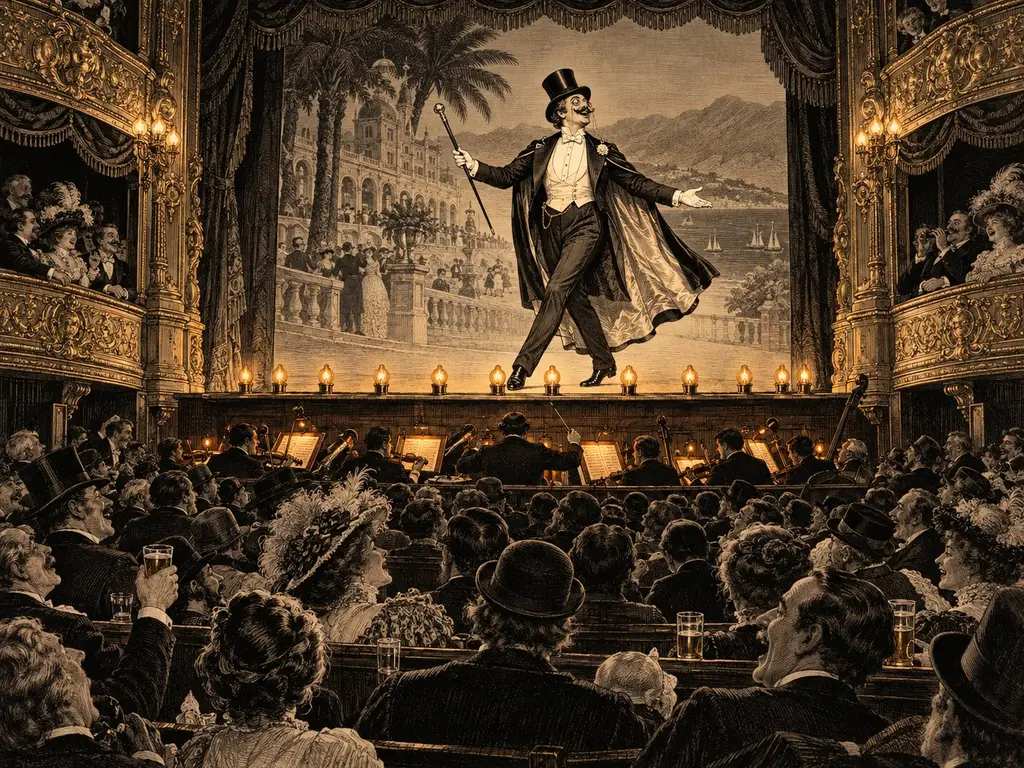
Charles Wells broke the bank at Monte Carlo several times in 1891 with a run of luck and a system he never explained. The song written about him in 1892 made “breaking the bank” a phrase. He lost part of the money back that winter and spent years in prison for frauds.
Who he was
Charles Deville Wells (1841–1922) was an engineer and serial fraudster who raised money from investors for inventions that did not exist. In July 1891 he arrived at Monte Carlo with £4,000 of such money. Over five days he broke the bank, exhausting a table’s cash reserve, several times, and left with about £40,000 by his own account, several million pounds today.
What he actually did
He said he had an infallible system and never said what it was. Witnesses saw no obvious pattern in his play, and no reliable account names a method; the MartingalestrategyMartingaleProgression that doubles the bet after each loss. See the Strategy section for what it does and does not do.Read full → often attached to his name is a guess. It hardly matters: every system on the layoutequipmentLayoutThe printed betting grid on the table. Also: table, felt, cloth.Read full → has the same expected valuemathExpected valueThe average result per bet over the long run. −1/37 of the stake for every standard European bet.Read full →, so whatever he did, the result was a long run of luck. The probabilitymathProbabilityChance of an outcome, from 0 to 1 or 0% to 100%. One number: 1/37 = 2.70%.Read full → of a run of luck as long as his is small for any individual player and large for the thousands who pass through a casino in a season. Somebody was going to be Wells. It was Wells.
The song
Fred Gilbert’s “The Man Who Broke the Bank at Monte Carlo” (1892), sung by Charles Coborn, was an enormous hit in London’s music halls and crossed to America. Its narrator struts along the boulevard with an independent air, and the phrase “broke the bank” has meant a spectacular win ever since. The song does not mention the second visit.
The second visit and after
Wells came back that autumn and won again, then lost part of the money on a visit in the winter of 1891–92. He spent heavily on a luxury yacht, the Palais Royale, with investors’ money; it never reached Monte Carlo. Late in 1892 French police held him at Le Havre, and in March 1893 a London court gave him eight years’ penal servitude for fraud. He was freed in 1899, got three more years in 1906 for another fraud, and in about 1911 ran a fake bank in Paris that promised 1% a day, which put him in a French prison. He died in London in 1922. The casino, which had paid out £40,000 in 1891 and received more than that in publicity, did very well out of him.
Born in Hertfordshire.
Patents and fraudulent investment schemes.
Monte Carlo: breaks the bank several times; wins ≈ £40,000.
Returns; wins again.
Loses part of it back. The song, 1892. A yacht that never sails to Monaco.
Convicted of fraud in London; eight years.
Another fraud, three more years.
Jailed in France for a bank fraud.
Dies in London.
Why the story matters
It is the clearest case of a system “working” and then not. The system did nothing either time; the luck came and went, as the variancemathVarianceA measure of how widely results spread around the expected value. High for straight up, low for even-money bets.Read full → pages say it must. The casino lost one week and won a legend. Every system sold since has a Wells in its testimonials, and every one of them has a second visit the testimonial does not mention.
Questions
No evidence of it at the tables. His frauds were elsewhere.
Several million pounds, by most measures.
Each table had a cash reserve; when it ran out, the table paused and more was fetched. The casino never ran out of money.
Comic relief
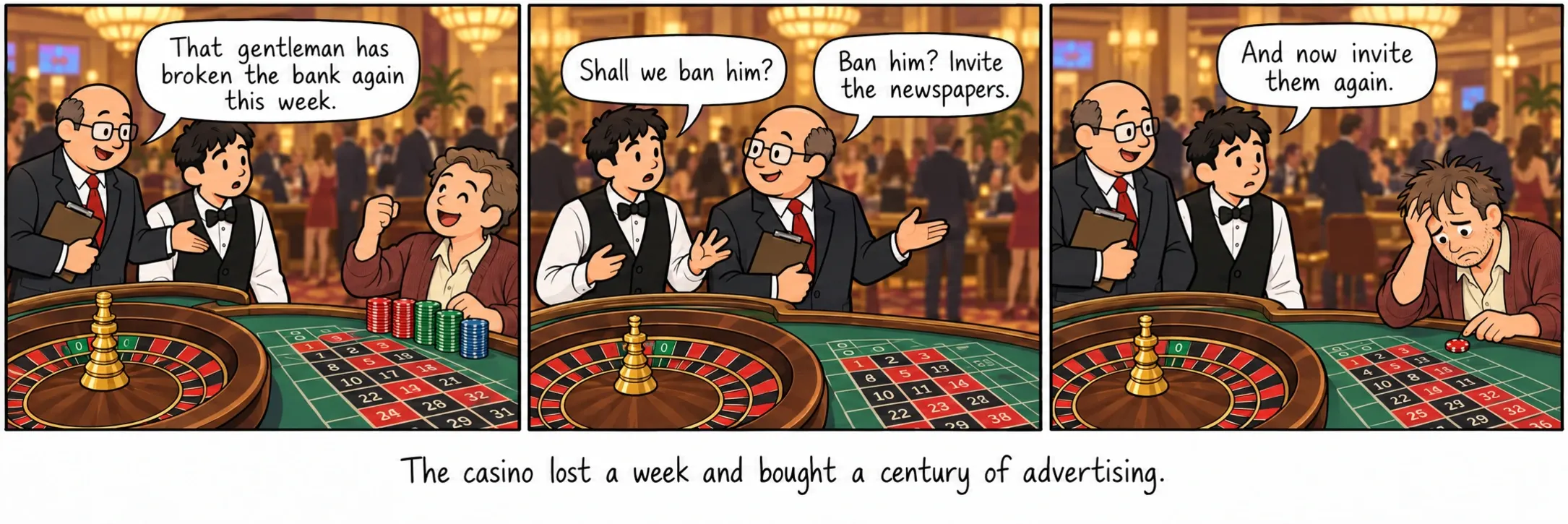
The casino lost a week and bought a century of advertising.
Sources
- Quinn, R. The Man Who Broke the Bank at Monte Carlo.
- Old Bailey Proceedings Online. Trial of Charles Wells, March 1893 (t18930306-349).
- Schwartz, D. G. Roll the Bones: The History of Gambling.
- Kavanagh, T. M. Dice, Cards, Wheels: A Different History of French Culture.