The Eudaemons
Physics students, a casino wheel bought for cash, and a computer small enough to wear to the table.

From 1976 to 1981 a group of physics students at Santa Cruz built digital computers that timed the ball and the rotor and named a sector of the wheel while bets were still open. Their tests promised a 44% advantage and a first long session gave about 25%. The hardware kept failing, the version built into a shoe was beaten by electrical noise in 1981, and they won a few thousand dollars.
A hunch in a Las Vegas bar, 1975
In the summer of 1975 Norman Packard, a physics student, spent two months counting cards at blackjack in Las Vegas with a friend, Jack Biles, and barely broke even. Over a last drink Biles said he would bet that roulette could be beaten with physics, and Packard remembered a cryptic line in Edward Thorp’s Beat the Dealer about a method for roulette. The two borrowed a tape recorder, stood beside wheels in several casinos and tapped the microphone each time the ballequipmentBallThe small ball launched along the track against the rotor. Modern balls are ivorine or Teflon, 18–21 mm.Read full → passed a fixed point. Plotted on graph paper, the taps showed the ball slowing and falling in a regular way. Packard’s school friend Doyne Farmer, a graduate student at the University of California, Santa Cruz, called it a waste of time until he did the sum himself: a person who can time the ball to about a tenth of a second should, on paper, be able to say where it will land to within a few numbers.
A wheel in the physics laboratory
In the spring of 1976 Farmer and Dan Browne paid $1,500 in cash for a reconditioned casino wheel at a workshop in Reno, saying it was for a fraternity party. For months they carried it at night to the university’s teaching laboratory and measured it with infrared sensors, a home-made electronic clock and a camera set off by the sound of the ball striking metal. What they found is still a good short list of what matters in a spin. The air does most of the slowing, more than the track. A wheel that is off level by as little as a tenth of an inch changes where the ball leaves the track, and on a tilted wheel the ball tends to come off at the high side, which makes the prediction easier. Balls differ: a Teflon ball slowed twice as fast as one of billiard-ball composite. And once the ball has left the track it still bounces, on average no more than a quarter to a third of the way round. That bounce was the question the whole plan hung on, and it was not wide enough to wipe out the prediction. By the end of the summer they put the possible advantage at 44%, the figure Thorp had given for his own device.
The company and the pie
They called the venture Eudaemonic Enterprises, from a Greek word for the happiness of a life lived by reason. Everyone who worked on it was to be paid from future winnings in proportion to the hours put in: a slice of what they called the Eudaemonic Pie. The winnings were meant to pay for a community of friends doing science on their own terms.
A computer under the arm, 1976–1978
The first machine grew from a kit computer that came by mail in September 1976 for $250, built on the 6502 processor that Apple’s computers also used. Farmer, who had never programmed before, wrote the equations for the ball and the rotorequipmentRotorThe spinning part of the wheel that carries the pockets.Read full → into it. The casino version was worn strapped to the body, under the arm or, for the women, in a bra. The player at the wheel clicked switches with the big toes: one toe marked the zerowheelZeroThe single green pocket that no even-money, dozen or column bet covers; the source of the house edge. Also: single zero, 0.Read full → and then the ball each time they passed a fixed point, the other moved the program between its settings. Fitting the program to a particular wheel took about twenty minutes of quiet clicking. Then, a few seconds into each spin, the computer named one of eight sectorswheelSectorA contiguous arc of pockets on the wheel, as distinct from a group on the layout.Read full → of the wheel, or signaled “no bet”, by buzzing small plungers against the skin. A second player farther down the table, linked by a weak radio signal, felt the same buzz and covered three or four numbers of that sector, sometimes swapping in a number next to it on the wheel so that the pattern was harder to read.
The first trip, to Lake Tahoe and Reno in December 1977, was one long equipment failure. A few weeks later, at the Golden Gate in downtown Las Vegas, Farmer played alone for four and a half hours at ten cents a chipmoneyChipA token representing a fixed amount, placed on the layout to make a bet. Also: check.Read full →. The profit was small, but over several hundred spins he and Browne put the edge, cautiously, at 25%.
The summer of 1978
That summer the group played in shifts for weeks, downtown and on the Strip, two sessions a day and never the same casino on consecutive nights. They kept a notebook on each casino: its wheels and how far they were off level, its staff, its shift changes. Las Vegas wheels turned out to be obligingly tilted and the late-night games slow, which is what the computer needed, since a slow rotor and a fast ball leave more time to measure and to bet. There were good nights. At Circus Circus a change of croupierpeopleCroupierThe dealer at a roulette table.Read full → at two in the morning turned a losing session into several hundred dollars at 25 cents a chip. And there was a steady run of failures: loose wires, radio links that drifted with the temperature, electric shocks from the antenna wires sewn into their shirts. One night the plungers jammed, the wiring overheated, and Ingrid Hoermann played on through a burn sooner than leave a winning table. Casino staff noticed the winning and never the method; once a croupier, upset at a growing stack of chips, grabbed the turning wheel and wrenched it round.
In thirteen months they made eight trips to Nevada and, betting mostly dimes and quarters, won a few thousand dollars. A session at the California Club in December 1978 brought more than $1,000 in three hours and persuaded them that the method deserved better hardware.
Packard and Biles time roulette balls with a tape recorder in Las Vegas.
A casino wheel bought in Reno; a summer of measurements; the first kit computer.
First casino trip, Lake Tahoe and Reno. The equipment fails.
Golden Gate, Las Vegas: four and a half hours at dime stakes, edge put at 25%.
Weeks of play in Las Vegas with the computer worn on the body.
California Club: more than $1,000 in three hours.
The computer is rebuilt to fit inside a shoe.
Las Vegas: electrical noise swamps the radio link. The project stops.
Nevada outlaws prediction devices. The Eudaemonic Pie is published.
The computer in a shoe, 1980–1981
To get the wires off their bodies they decided to put everything into shoes. Mark Truitt, a new physics graduate who had walked out of a job interview for military radar work, spent a year and a half on it. The idea that made it fit came from a university technician: switch the computer off between predictions, and it needs far fewer batteries. Truitt put the chips on two circuit boards he etched himself, turned one over on top of the other and filled the gap with hard wax, which made a block about two inches by four and half an inch thick that could be walked on. Batteries, antenna and two of the three buzzers went into the heel. Three buzzers at three speeds gave nine signals: eight sectors and “no bet”. A cobbler hollowed out ordinary leather shoes and asked no questions.
In November 1981 Farmer and the writer Thomas Bass took the shoes and $2,500 to Las Vegas. At the first table the first prediction hit, and then the buzzers began to fire at random. Casinos are full of electrical noise, from surveillance cameras, neon signs and slot machines, and it swamped the faint radio link between the shoes; a television set in the motel room did the same thing. Days of repairs by four people did not cure it, and the project stopped there. The equipment went into a trunk in a basement in Santa Cruz.
What 44% means
On an American wheel a straight upbetStraight upA single number, pays 35:1.Read full → wins once in 38 spins on average and pays 35 to 1, which costs the player 5.26%. A 44% advantage is what the same bet is worth when it wins once in 25 spins: 36 chips come back for every 25 staked. So the computer never had to know the number. It had to make the numbers it chose come up about one and a half times as often as chance allows.
Why a big edge still felt like gambling
An edge at 35 to 1 pays slowly and unevenly. One of the group’s advisers warned that a player staking $100 a number could be $10,000 or $20,000 down before the advantage showed, and the arithmetic agrees: with a 44% edge on single numbers a player is still behind after 100 spins nearly one time in four. That is why the Eudaemons started at dimes and built their bankrollmoneyBankrollThe total amount set aside for play. Bankroll management is deciding how much of it to risk per bet and per session.Read full → from winnings, and why Alan Lewis, who joined them in 1978, spent his time on how much to bet. Farmer later thought they had been too cautious. Small stakes kept them safe, and they also meant that years of work earned very little.
What it cost and what it paid
About $15,000 went into parts, tools and Truitt’s wages, most of it from Farmer and from Letty Belin, a lawyer who later married him. Farmer was credited with 3,500 hours of work, Truitt with 3,000 and Packard with 2,000. Against that stand the few thousand dollars won at small stakes. In 1983 Farmer advertised in a gambling magazine for investors, describing a prototype with a proven casino advantage of 20 to 40%. When the Eudaemons played, Belin’s search of Nevada law had found nothing that forbade predicting a game; in May 1985 the state made it a crime to use a device for that. What lasted was the science. Building the computers trained Farmer, Packard and their friends for the study of chaos, which is where they made their names.
Reading the book today
Thomas Bass, who placed the bets on the last trip, told the story in The Eudaemonic Pie (1985), built on long interviews with the group, and it is the source for this page. Its short history of roulette is less safe than its account of the project. It repeats the tale of Jagger’s six hired clerks, which goes back to a book of 1901 and no further (see Joseph Jagger), and it puts Thorp and Shannon’s casino test in 1962, where Thorp’s own accounts say the summer of 1961.
Questions
No. They won a few thousand dollars at dime and quarter stakes, and spent about $15,000 and many thousands of hours.
When they played, Nevada had no law against predicting a game with a device. It has had one since 1985, and most places with casinos now do.
Not where betting closes as the ball is launched, as it does in live studios, and carrying such a device into a casino is a crime in most jurisdictions.
Fun with Math
Try these yourself first. Each solution is folded; open it when you are ready.
The Eudaemons reckoned their computer was worth 44% on a straight upbetStraight upA single number, pays 35:1.Read full → on an American wheel, where the bet pays 35 to 1. How often must the chosen number win for that to be true? And how many of the 38 pocketsequipmentPocketOne of the 37 numbered compartments on the rotor. Also: slot, cup.Read full → would a prediction have to rule out, if the ballequipmentBallThe small ball launched along the track against the rotor. Modern balls are ivorine or Teflon, 18–21 mm.Read full → were equally likely to land in any of the rest?
Show the solution
Answer Once in 25 spins. That is the same as ruling out 13 pockets and leaving 25.
A winning chipmoneyChipA token representing a fixed amount, placed on the layout to make a bet. Also: check.Read full → comes back with 35 more: 36 chips. If the number wins once in n spins, n chips staked bring 36 back, so the bet is worth 36/n − 1.
Set that to 0.44: 36/n = 1.44, so n = 25. With no prediction n is 38 and the bet is worth 36/38 − 1 = −5.26%.
Now suppose a prediction rules out k pockets and the ball is equally likely to land in each of the other 38 − k. A chip on one of those wins once in 38 − k spins. For 44% we need 38 − k = 25, so k = 13: a little more than a third of the wheel.
In the book Farmer is quoted as saying that 40% comes from ruling out eight pockets. On this simple model eight gives 36/30 − 1 = 20%, so the real picture must have been uneven: some of the remaining pockets far more likely than others.
pockets ruled outpockets lefta straight up is worth038−5.26%2360%830+20%1325+44%1919+89%Suppose your number really does win once in 25 spins at 35 to 1, a 44% edge. You bet one chip a spin. How likely are you to be behind after 100 spins? After 500?
Show the solution
Answer About 23% after 100 spins and still about 6% after 500.
After 100 spins you have staked 100 chips, and each win brings back 36. Two wins bring 72, a loss of 28; three bring 108, a gain of 8. So you are behind if you win twice or less.
The chance of no win in 100 spins is (24/25)¹⁰⁰ = 1.7%. Exactly one win: 100 × (1/25) × (24/25)⁹⁹ = 7.0%. Exactly two: 4,950 × (1/25)² × (24/25)⁹⁸ = 14.5%. Together 23.2%.
After 500 spins you need 14 wins to be ahead (14 × 36 = 504), and the average is 20. The chance of 13 or fewer is about 6.2%.
This is the other side of a long-odds bet. The edge is large, and in about one run of 100 spins in four it does not show. A player who does not know for certain that the edge is there cannot tell a bad run from a broken computer, which is the position the Eudaemons were often in.
spinswins needed to be aheadchance of being behind50240.1%100323.2%200618.6%500146.2%The book says that with a 44% edge, $100 staked 50 times an hour should earn $2,200 an hour. Check it. Then work out what the same edge earned at the stakes the group actually played: a dime a spin.
Show the solution
Answer $2,200 is right for $100 a spin. At a dime a spin it is $2.20 an hour.
An edge is a share of everything staked. At $100 a spin and 50 spins an hour, $5,000 is staked, and 44% of that is $2,200.
At 10 cents a spin, $5 is staked in an hour, and 44% of $5 is $2.20. Even covering four numbers at a dime each, it is $8.80 an hour for two people.
The group played low because they were building a bankrollmoneyBankrollThe total amount set aside for play. Bankroll management is deciding how much of it to risk per bet and per session.Read full → from nothing and because, as the puzzle above shows, a 44% edge at 35 to 1 can lose for hours. The price of that caution was that the method could be working perfectly and still pay less than a job.
Comic relief
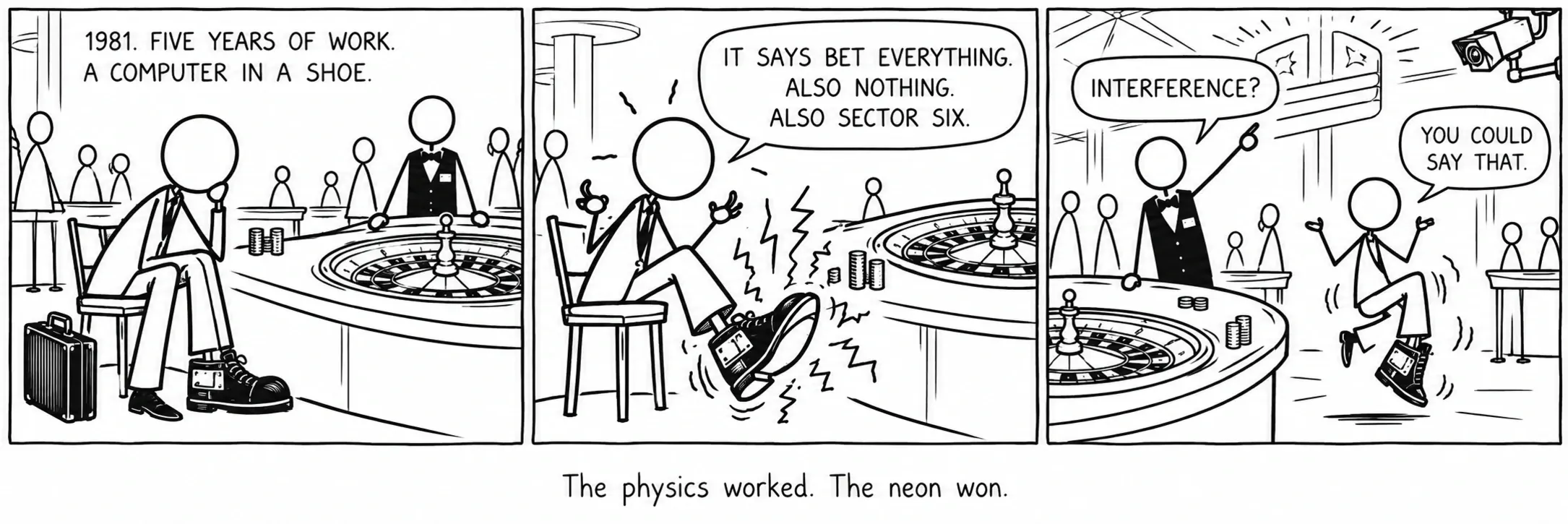
The physics worked. The neon won.
Sources
- Bass, T. A. The Eudaemonic Pie.
- Thorp, E. O. “Optimal gambling systems for favorable games.”
- Thorp, E. O. “The invention of the first wearable computer.”
- Nevada Revised Statutes, chapter 465.