Walkthrough: Two Dozens Roulette Strategy
Ten dollars on each of two dozens, 24 numbers covered, for fifty spins. The roulette two dozens strategy is the coverage bet that wins two spins in three and still costs 2.70%.
A simulated 50-spin session of $10 on the first and second dozens. Thirty-one wins of $10, nineteen losses of $20 (third dozen or zero). Net −$70, having been up $90. The bet that feels safe because it wins often and is priced exactly like every other.
The plan: the roulette two dozens strategy
$10 on the first dozenbetDozen1–12, 13–24 or 25–36, pays 2:1.Read full → and $10 on the second. A number from 1 to 24 pays one dozen $20 and loses the other $10: +$10. A number from 25 to 36, or zerowheelZeroThe single green pocket that no even-money, dozen or column bet covers; the source of the house edge. Also: single zero, 0.Read full →, loses both: −$20. Expected valuemathExpected valueThe average result per bet over the long run. −1/37 of the stake for every standard European bet.Read full →: (24 × 10 − 13 × 20)/37 = −20/37 = −$0.54 per spin, which is 2.70% of $20. Win rate 64.9%, which is the figure that sells the bet.
Spins 1–25
Eighteen wins, seven losses: +$180 − $140 = +$40. The seven losses included zero once and a run of three third-dozen numbers at spins 11–13 that cost $60 in a row and felt like the exception. It was the 35.1% arriving in a clump, which clumps do.
Spins 26–50
Thirteen wins, twelve losses: +$130 − $240 = −$110. Twelve losses in 25 spins is a 20% event, not rare. Final −$70; peak +$90 at spin 31. The bet never produced a large swing in either direction, because the win is $10 and the loss $20; it simply ground.
- p10 −$500
- p25 −$500
- median −$280
- p75 −$40
- p90 +$170
The accounts
Total wagered $1,000 over 50 spins. Expected lossmathExpected lossExpected value times total amount wagered; the average amount lost over a session or a period.Read full → $27; actual −$70, about one standard deviationmathStandard deviationSquare root of variance; the typical distance of a result from the expected value.Read full → below (σ per spin is about $14, so about $100 over 50 spins). The same $20 on redbetRedEven-money bet on the 18 red numbers. French: rouge.Read full → would have had the same expectation and a larger σ, about $140 over the session: two dozens is a lower-variancemathVarianceA measure of how widely results spread around the expected value. High for straight up, low for even-money bets.Read full → way to lose the same amount.
What the session shows
Covering 24 numbers makes roulette feel like a game you usually win, and you do: 64.9% of spins. The payoutmoneyPayoutWhat a winning bet returns, quoted as “X to 1” on top of the returned stake.Read full → is set so that the 35.1% you lose costs twice what the wins pay, and the ratio is tuned by the layoutequipmentLayoutThe printed betting grid on the table. Also: table, felt, cloth.Read full → to −1/37 of the total stake. Add a chipmoneyChipA token representing a fixed amount, placed on the layout to make a bet. Also: check.Read full → on zero for “insurance” and the blended edge is still 2.70%, because the insurance is priced at 2.70% too. The math problem on that page works it through.
Questions
Same arithmetic: 24 numbers, +1 unitmoneyUnitThe base stake a system or a player works in. Progressions are described in units so they apply at any table.Read full → on a hit, −2 on a miss. ColumnsbetColumnTwelve numbers in one vertical column of the layout, pays 2:1.Read full → spread the covered numbers across the wheel; dozens cluster them on the layout. Neither matters.
Covers 25 numbers; zero now nets +$16 instead of −$20 at a cost of $1 per spin. The expected value is −$0.57 on $21, still 2.70%.
It is, and the pay-off is sized to it. Most of the time you win $10. Some of the time you lose $20. The average is the house edgemathHouse edgeThe share of each stake the casino keeps on average: 2.70% in European roulette.Read full →.
Comic relief
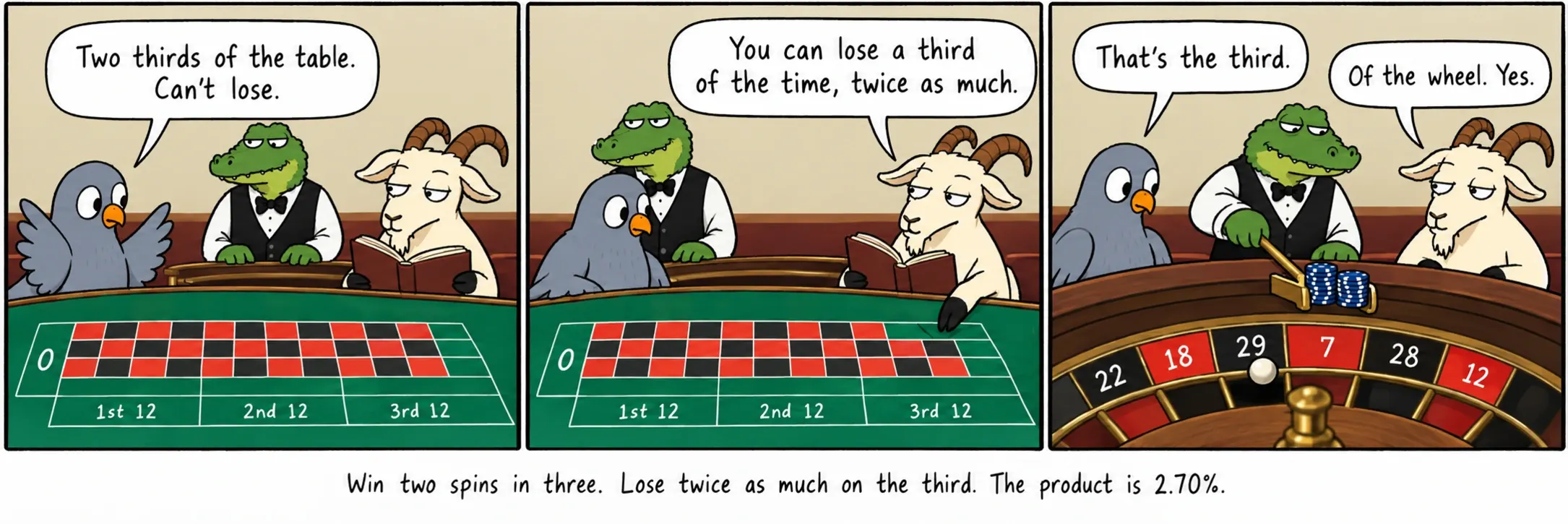
Win two spins in three. Lose twice as much on the third. The product is 2.70%.
Sources
- Ethier, S. N. The Doctrine of Chances: Probabilistic Aspects of Gambling.