Walkthrough: The Bond Spread
$140 on high, $50 on the six line 13–18, $10 on zero: $200 a spin, 25 numbers covered. The James Bond spread for twenty spins.
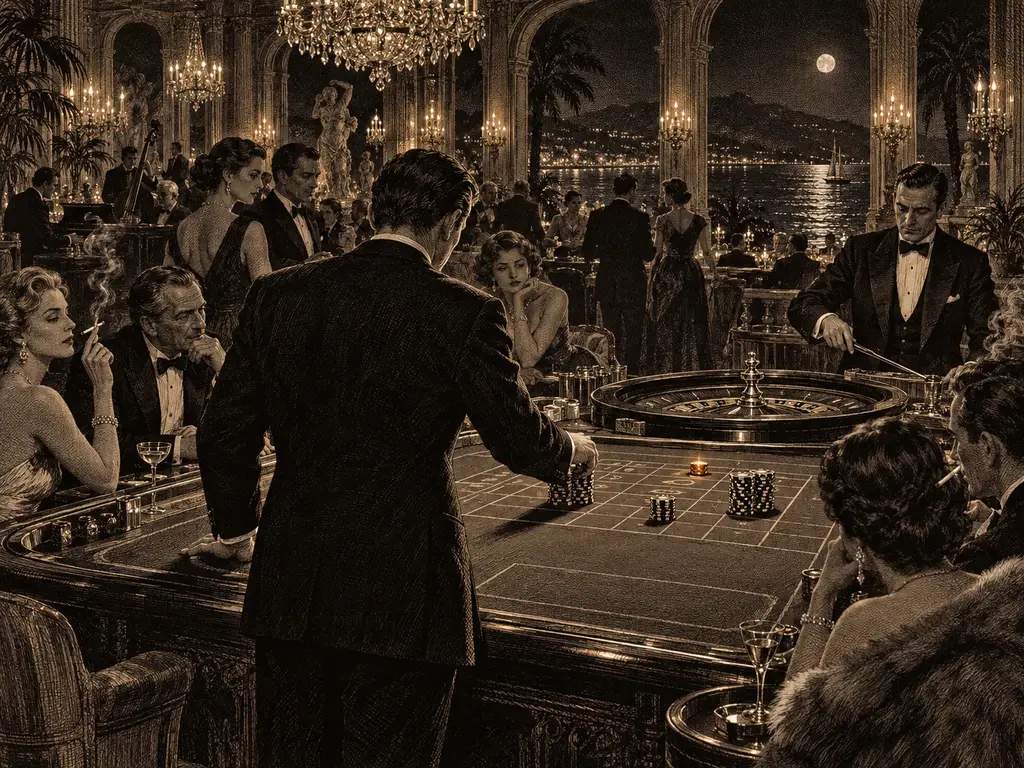
A simulated 20-spin session of the spread sold as the James Bond strategy. Twelve wins of $80, three six-line hits of $100, one zero for $160, and four losses of $200 on 1–12. Net +$620, never down more than $40. The spread covers two thirds of the wheel and loses a third of the time, which is what two thirds means.
The plan
On a French-style table: $140 on 19–36, $50 on the six linebetSix lineSix numbers in two adjacent rows, pays 5:1. French: sixain.Read full → 13–18, $10 on zerowheelZeroThe single green pocket that no even-money, dozen or column bet covers; the source of the house edge. Also: single zero, 0.Read full →. Twenty-five numbers covered. A high number pays $140 and loses $60: +$80. A six-line number pays $250 and loses $150: +$100. Zero pays $350 and loses $190: +$160. Any of 1–12 loses the lot: −$200. Expected valuemathExpected valueThe average result per bet over the long run. −1/37 of the stake for every standard European bet.Read full → per spin is (18×80 + 6×100 + 160 − 12×200)/37 = −$5.41, which is 2.70% of $200. The spread is a flat bet in costume.
Spins 1–10
19 27 7 33 15 0 23 31 11 29. Six highs, one six-line, one zero, two losses: +480 +100 +160 −400 = +$340. Balance +$340 after ten spins, with two losing spins that each took $200. The zero at spin 6 paid $160, which is the only time a zero felt like a friend.
Spins 11–20
5 22 36 14 20 2 28 34 17 25. Two losses in the first six spins pulled the balance back to +$280; then three highs and a six line closed the session at +$620. Twenty spins: 12 highs, 3 six-line hits, 1 zero, 4 losses. Expected net was −$108; actual +$620, about 1.2 standard deviationsmathStandard deviationSquare root of variance; the typical distance of a result from the expected value.Read full → above expectation, a good night.
- p10 −$2,000
- p25 −$2,000
- median −$2,000
- p75 −$2,000
- p90 +$780
The accounts
Total wagered $4,000 in twenty spins. Expected lossmathExpected lossExpected value times total amount wagered; the average amount lost over a session or a period.Read full → $108. The standard deviation of a single spin is about $135, so twenty spins have a standard deviation of about $605; +$620 or better is a one-in-nine night. The same twenty spins at $200 flat on redbetRedEven-money bet on the 18 red numbers. French: rouge.Read full → would have had the same expectation and a wider distribution (σ ≈ $200 per spin): the spread is lower variancemathVarianceA measure of how widely results spread around the expected value. High for straight up, low for even-money bets.Read full → than an even-money betbetEven-money betRed/black, odd/even, high/low. 18 numbers, pays 1:1.Read full → because it wins more often and smaller.
What the session shows
The Bond spread is three bets whose expectations add to −1/37 of the total, like every combination of standard bets. Its real property is coverage: a 67.6% win rate makes an evening feel like a system. The 32.4% of spins that lose take $200 each, and over a long run they take exactly what the arithmetic says. Despite the name, it is not in Fleming’s novels: his Bond backs two dozensbetDozen1–12, 13–24 or 25–36, pays 2:1.Read full →. The strategy pamphlets did the rest.
Questions
The high bet is even money, so on a French table it loses only $70 on zero instead of $140, and a zero nets +$230 instead of +$160. Blended edge about 1.8%. Better, and still negative.
The proportions roughly equalize the wins: $80, $100, $160. Any proportions give the same edge.
Yes. $200 every spin on the same 25 numbers. The costume is the only difference.
Comic relief
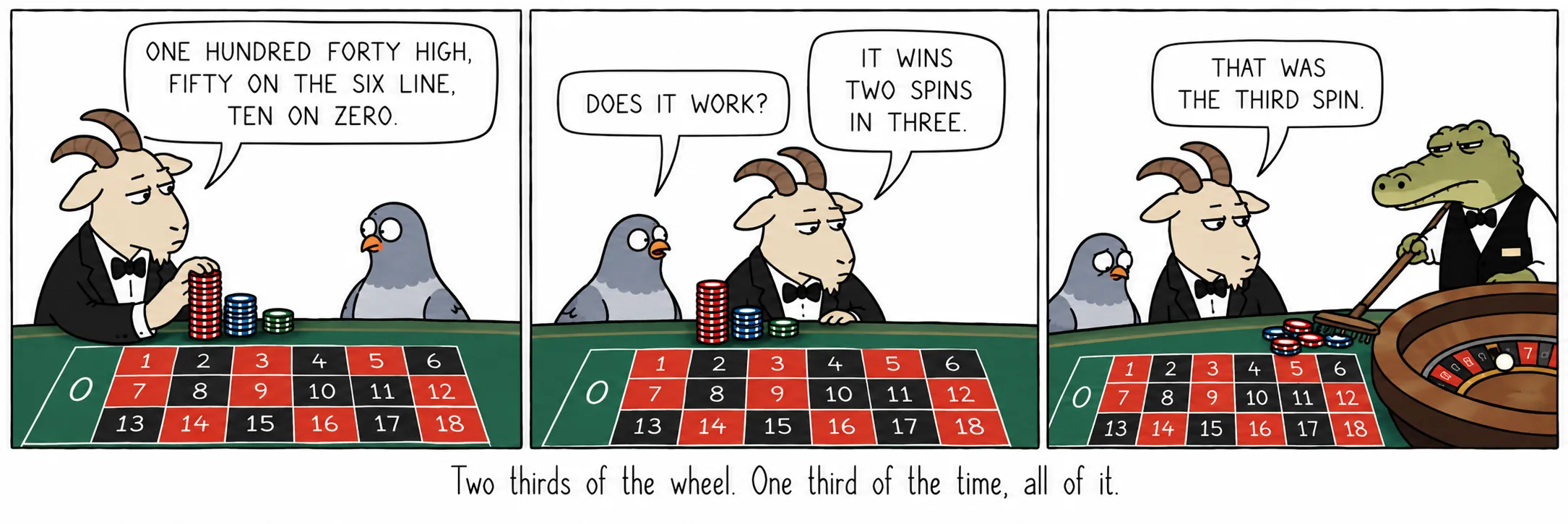
Two thirds of the wheel. One third of the time, all of it.
Sources
- Fleming, I. Casino Royale.
- Ethier, S. N. The Doctrine of Chances: Probabilistic Aspects of Gambling.