Dealers on Systems
The people who watch the most roulette have the least faith in systems. Here is what they see.
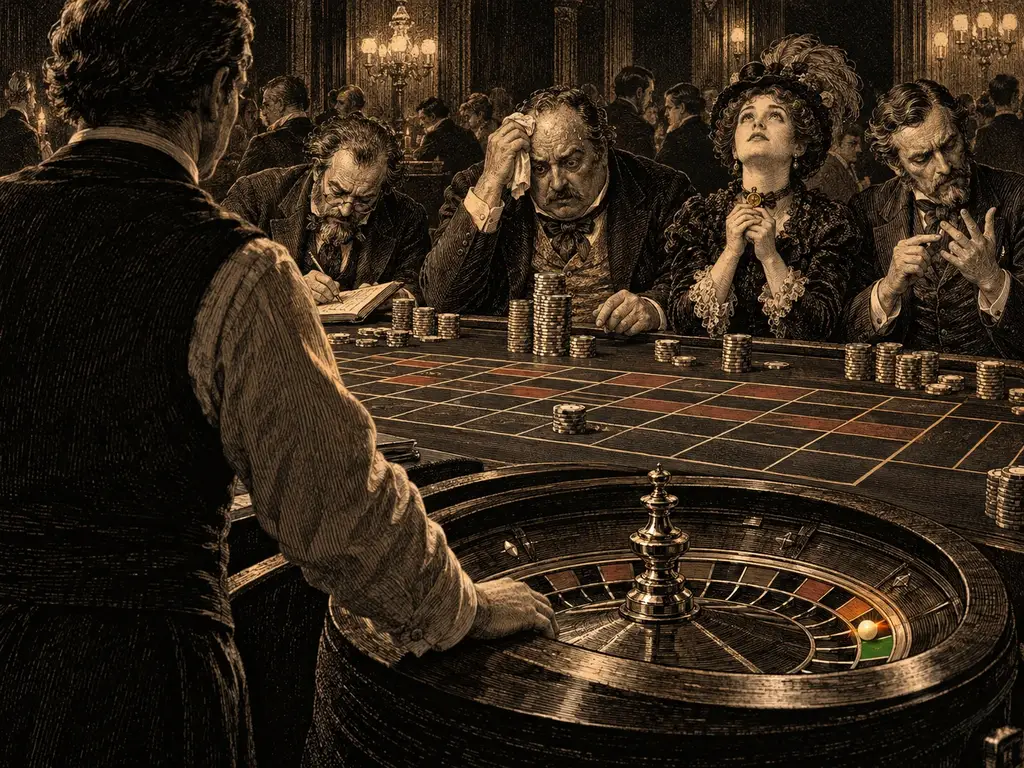
Dealers see hundreds of system players a year and watch each system produce the same arithmetic. Their view is not cynical; it is statistical. A composite of what dealers say about Martingale, notebooks, lucky numbers and the players who come back.
What a dealer sees in a year
Tens of thousands of spins and, among the players, a few hundred who are running a system they believe in. The MartingalestrategyMartingaleProgression that doubles the bet after each loss. See the Strategy section for what it does and does not do.Read full → players are easiest to spot: a flat bet, then a double, then the look at the limit sign. The notebook players record every number and bet sectorswheelSectorA contiguous arc of pockets on the wheel, as distinct from a group on the layout.Read full →. The lucky-number players bet 17 and their birthday. The dozensbetDozen1–12, 13–24 or 25–36, pays 2:1.Read full → players rotate. The dealer watches all of it produce 2.70% of turnovermoneyTurnoverThe total amount wagered over a session or period, counting re-bet winnings. Also: handle, action.Read full →, year after year, without exception.
On Martingale
“They win for an hour. You can see them relax. Then a run of six comes, and it always comes, and you watch them look at the maximum sign and do the arithmetic for the first time. Some bet the maximum anyway. Some reset and start again. One or two leave. The ones who leave are the ones I like.” Dealers describe the Martingale cliff the way pilots describe weather: not as a surprise but as a schedule.
On notebooks
Dealers do not mind them. A notebook changes nothing on a maintained wheel, and the players who keep them tend to be calm. Dealers have seen the hot sector of the notebook player go cold, and the notebook change hands to a new sector, and the arithmetic stay where it was. One dealer’s view, paraphrased: the notebook is a way of paying attention, and paying attention is pleasant, and it costs the same.
On lucky numbers
Seventeen is the most bet number on every wheel in the world, because it is in the middle of the layoutequipmentLayoutThe printed betting grid on the table. Also: table, felt, cloth.Read full → and because of a film. Dealers know it hits 1/37 of the time like every number and that the 17 players are the happiest at the table, because a hit on a straight upbetStraight upA single number, pays 35:1.Read full → is a moment and a loss on a straight up is nothing. The dealer pays 35:1 and hears the story about why 17. The story is always good.
On the players who come back
Dealers worry about them. Not the regular who plays $5 redbetRedEven-money bet on the 18 red numbers. French: rouge.Read full → for an hour and leaves; the one who doubled the buy-intableBuy-inExchanging cash for chips at the table. Done between spins, with the cash placed on the layout rather than handed to the dealer.Read full →, who is explaining the system again, who is “nearly even”. Regulated markets train dealers to recognize this and to involve the pit; the better casinos act on it. Dealers are the first line of responsible gambling, and most of them take it seriously, because they have watched the arithmetic and know how it ends.
The dealers’ consensus
Nobody beats the wheel from the player’s seat. Systems change the evening, not the price. The players who do best are the ones who decided how much to spend before they sat down and spent it. And the house edgemathHouse edgeThe share of each stake the casino keeps on average: 2.70% in European roulette.Read full → is 2.70%, which almost nobody asks about and which is the only number on the table that matters.
Questions
They see every system win for a while. They have never seen one win over a year.
They would tell the pit, and the wheel would be gone before your next session.
The edge, the pace, and how to leave on time.
Comic relief
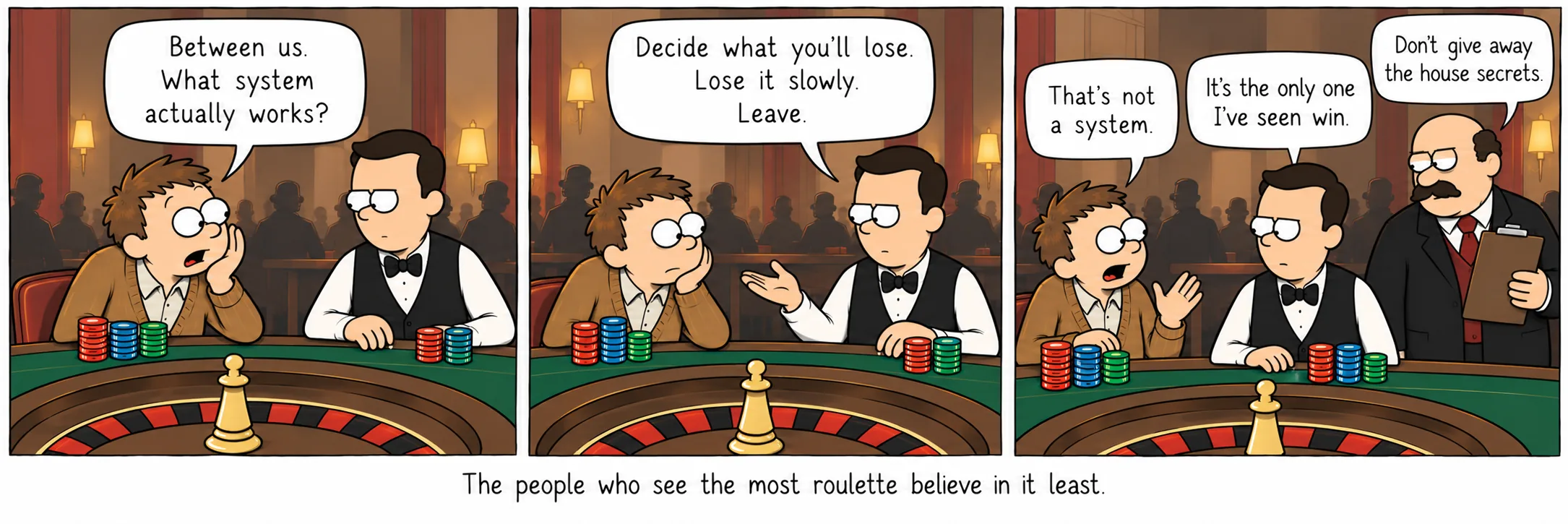
The people who see the most roulette believe in it least.
Sources
- UK Gambling Commission. Remote gambling and software technical standards.
- Wykes, A. The Complete Illustrated Guide to Gambling.
- Thorp, E. O. “Optimal gambling systems for favorable games.”