Wheel-Bias Detective
A log of 3,000 spins from a wheel that may or may not be biased. Use the Lab tools to find the hot sector, or declare the wheel fair.

Five wheels, five verdicts. A heat map, a bar chart with the ±2σ band and a chi-square testlabChi-square testStatistical test comparing observed hits per pocket with the expected n/37. Used to judge whether a wheel is biased.Read full → are on the table; a sector scan is available as a hint at the cost of a point. One of the wheels is fair.
Wheel 1 of 5 · 3,000 spins
Scoring
9–10: Jagger would have wanted you watching the wheel.
6–8: you can read a heat map and resist a false positive.
3–5: you found the strong ones; the subtle bias and the fair wheel are the test.
Under 3: read How to Detect Wheel Bias and Sample Size. Three thousand spins is barely enough for a strong bias and not enough for a subtle one.
What makes it hard
On a fair wheel with 3,000 spins the expected count per pocketequipmentPocketOne of the 37 numbered compartments on the rotor. Also: slot, cup.Read full → is 81 and the standard deviationmathStandard deviationSquare root of variance; the typical distance of a result from the expected value.Read full → is about 9, so a few pockets will sit outside the ±2σ band by chance alone. A biased pocket at +40% sits around 113, about 3.5σ; at +20% it is around 97, under 2σ, and invisible in a single pocket. SectorswheelSectorA contiguous arc of pockets on the wheel, as distinct from a group on the layout.Read full → add up: the 5-pocket scan is how real bias players found wheels, because adjacent pockets share a mechanical fault.
Questions
Because the hardest skill in bias play is not finding a hot sector; it is not finding one that is not there.
Thousands for a strong bias; tens of thousands for a subtle one. Jagger’s family watched the wheels for weeks.
Comic relief
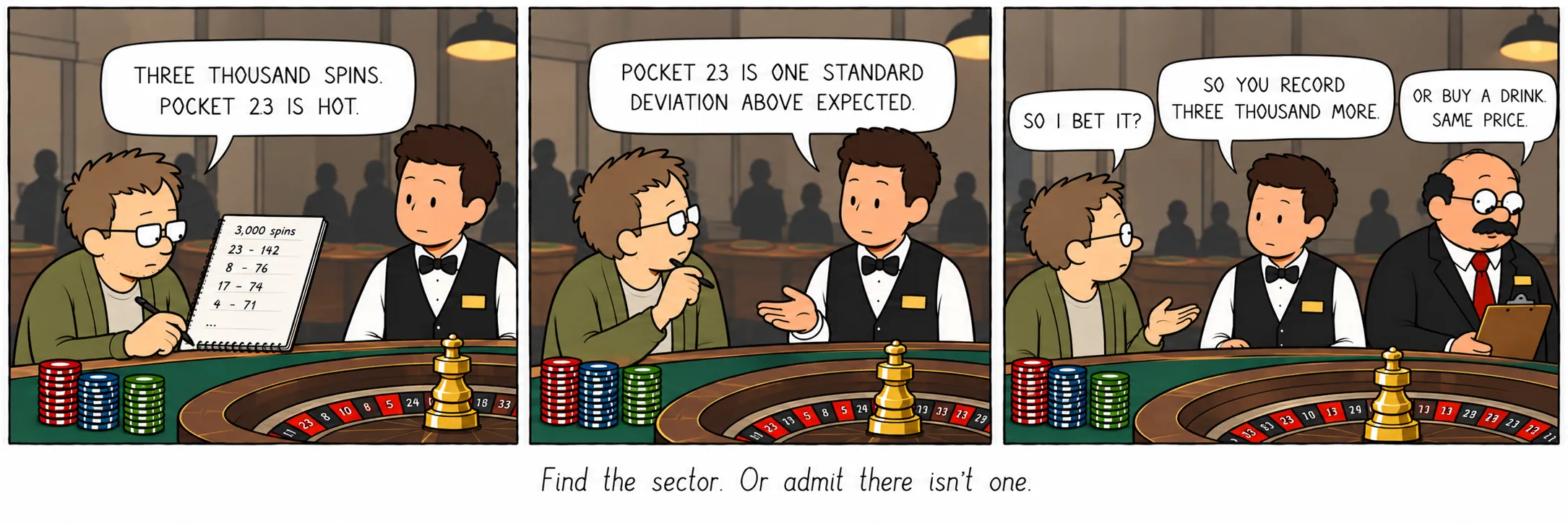
Find the sector. Or admit there isn’t one.
Sources
- Barnhart, R. T. Beating the Wheel.
- Pearson, K. “On the criterion that a given system of deviations from the probable…”