Let-It-Ride and Roulette Jackpot Bets
Bets that run over several spins: a stake left to ride on a repeat, or a small charge every spin toward a jackpot. Both are priced by where they end.
Alphabetic Roulette’s Bonus Box lets a winning stake ride on the same letter. Pro-Aggressive Roulette uses sequences of spins to award shared jackpots. The reset rules and your share of the payout matter when calculating the return.
Bets that last more than one spin
Most roulette bets are settled by one spin. A few run across several: the stake rides on a repeat, as in WINGO, or a small stake goes in on every spin toward a roulette jackpot, as in Roulette Royale. The house edgemathHouse edgeThe casino’s expected net gain expressed as a fraction of the stake, under specified probabilities and payouts.Read full definition → of such a bet depends on where it ends, and often the player chooses that. Two games described by Bollman (2021) show the two kinds at their clearest.
Alphabetic Roulette’s Bonus Box
Bollman describes Alphabetic Roulette at Fitzgerald’s in downtown Las Vegas: 25 pocketsequipmentPocketA compartment on the rotor in which the ball can settle. The number of pockets depends on the wheel.Read full definition →, A to X plus a combined YZ. The extra pocket creates the standard 4% edge; YZ can still be included in a named combination such as “Party Pit”. Bets on 1, 2, 3, 4, 6 or 12 letters paid (24 − n)/n to 1, an edge of 4%. The Bonus Box bet was on a repeat: $1 that the letter just spun would come up again. A repeat paid $23, the ordinary 23 to 1. The player could collect, or let it ride for a second repeat, which paid $550, and then for a third, which paid $14,400.
| stop after | chance | pays | house edge |
|---|---|---|---|
| one repeat | 1 in 25 | $23 | 4.00% |
| two repeats | 1 in 625 | $550 | 11.84% |
| three repeats | 1 in 15,625 | $14,400 | 7.83% |
Compare stopping plans before the first bet
The percentages compare plans before the initial $1 bet. After a win, continuing risks money already available to collect. The original-stake edge does not measure that risk: the next spin loses on 24 of 25 results, even if continuing has a higher conditional expected payoutmoneyPayoutThe amount paid on a winning wager. Check whether the quoted figure is net profit or total return including the stake.Read full definition →.
Words as bets
Two spaces on the Alphabetic layoutequipmentLayoutThe marked betting surface, whether printed on a table or displayed on a screen.Read full definition → could be named by the casino, and the defaults were “Party Pit” and “Roulette”. Any word works on the same rule as long as the rule gives a payout a casino can pay. TROPICAN has eight different letters and pays 2 to 1, at the usual 4%. A five-letter word such as LUXOR does not fit: the rule asks for 3.8 to 1, and at 3½ to 1, the nearest half unitmoneyUnitA base amount used to express stakes or results.Read full definition → below it, the bet would cost 10%.
Pro-Aggressive Roulette: a line in three spins
The 2004 Pro-Aggressive Roulette patent describes a side betbetSide betAn additional wager tied to a game, such as a streak, card hand, bonus event or jackpot. It may be optional or required by the product.Read full definition → on three results forming a line on an American layout. For example, 24, 30 and 27 complete a columnbetColumnTwelve numbers in one vertical layout column, ordinarily paying 2 to 1.Read full definition → segment. The major jackpot uses 0, 00 and 2 in any order. Players must bet on each qualifying spin. Under the basic reset rule, a failed sequence keeps its last result as the new starting point. The patent also offers other reset options and splitsbetSplitA wager on two numbers sharing an allowed layout boundary, ordinarily paying 17 to 1.Read full definition → a jackpot among qualifying winners.
| jackpot | combinations | probability in a fixed three-spin window |
|---|---|---|
| minor: three-number line | 62 | 372 / 54,872 ≈ 1 in 147.51 |
| major: 0, 00 and 2 | 1 | 6 / 54,872 ≈ 1 in 9,145.33 |
What determines the return
To calculate the return, multiply each jackpot’s payout frequency per paid spin by your expected share of that jackpot, then add the results. For a $1 side bet, a total of $1 is break-evenmathBreak-evenA result with no net gain or loss, or a threshold at which expected profit is zero. Specify which meaning applies.Read full definition →. The fixed-window probabilities above cannot simply replace payout frequencies: the reset rules affect which patterns qualify. Sharing matters too. A displayed $2,500 jackpot split equally among five winners pays each $500. A complete return calculation needs the rules for the version being played.
The common thread
A bet that lasts several spins has more than one price. Find them all before you play.
- A bet that runs over several spins is priced by where it stops.
- Distinguish the expected lossmathExpected lossThe probability-weighted average net loss under a stated model. With a constant edge, it equals edge times expected total stakes.Read full definition → of a plan at the start from the money at risk after a win.
- For a charge on every spin, calculate the payout frequency and your expected share of each prize. A rare win need not cover the accumulated charges.
- The same reasoning prices WINGO, Roulette Rage and Roulette Royale on the side-bets page.
Questions
Continuing risks the payout already available to collect and loses on 24 of 25 possible next results. A lower initial-stake edge does not remove that risk.
The frequency depends on the reset and eligibility rules. A fixed three-spin pattern probabilitymathProbabilityA measure of how likely an event is, from zero to one. Percentages express the same scale from 0% to 100%.Read full definition → is not automatically the probability of receiving a payout on a paid spin.
Positive expected valuemathExpected valueThe sum of each possible net result multiplied by its probability. It can be positive, zero or negative.Read full definition → requires the expected payout per paid spin to exceed the stake. Use the actual eligibility rules, payout frequencies and your share of any jackpot.
Fun with Math
Try these yourself first. Each solution is folded; open it when you are ready.
Suppose a uniform 25-pocketequipmentPocketA compartment on the rotor in which the ball can settle. The number of pockets depends on the wheel.Read full definition → letter wheel has one pocket for each of the five distinct letters in LUXOR. A one-unitmoneyUnitA base amount used to express stakes or results.Read full definition → bet wins on any of those five pockets. What is the largest net payoutmoneyPayoutThe amount paid on a winning wager. Check whether the quoted figure is net profit or total return including the stake.Read full definition → in whole or half units that leaves a strictly positive house edgemathHouse edgeThe casino’s expected net gain expressed as a fraction of the stake, under specified probabilities and payouts.Read full definition →?
Show the solution
Answer 3½ to 1, which costs 10%.
LUXOR has five different letters, so the rule asks for 19/5 = 3.8 to 1. At 3.8 the bet would cost the usual 4%.
The whole and half payouts nearest 3.8 are 3½ and 4. At 4 to 1 the bet wins 5 times in 25 and brings back 25 units: no edge at all, a fair gamemathFair gameIn expected-value terms, a game or wager with zero expected net profit for each side under the stated strategy and rules.Read full definition →. So 3½ to 1 is the most that keeps an edge. It brings back 5 × 4.5 = 22.5 units for every 25 staked: 10%.
A word with eight different letters, like TROPICAN, needs 2 to 1, exactly what the rule gives. Different coverage counts need different payouts to keep the same edge.
Comic relief
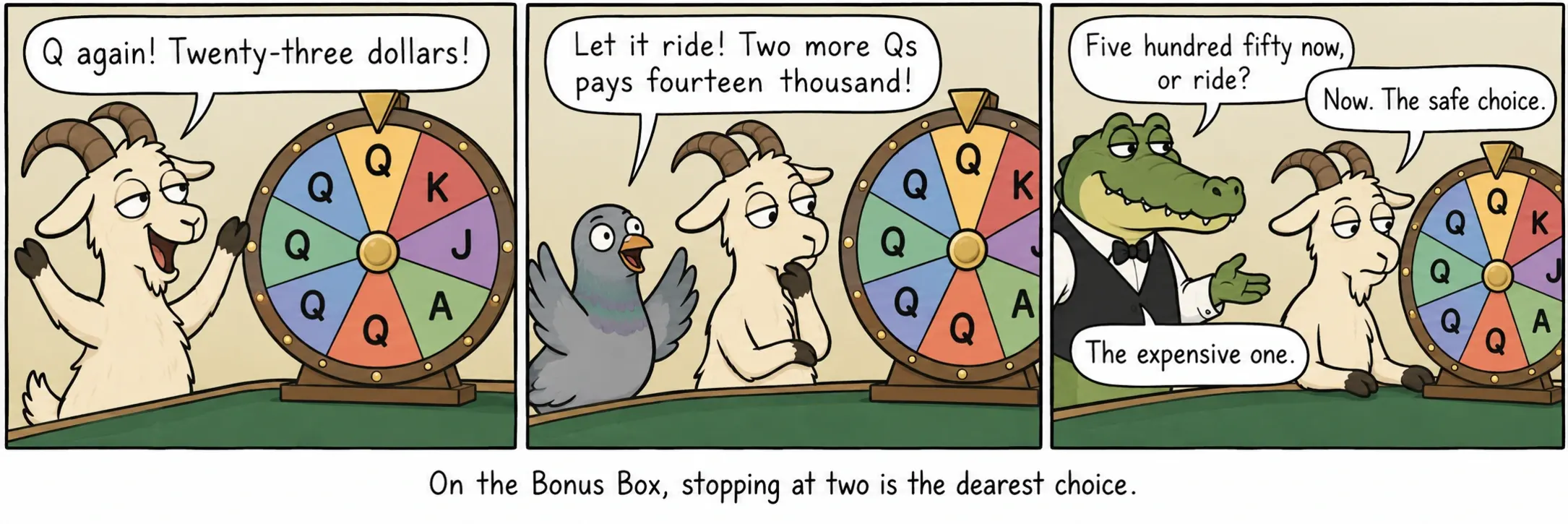
Stopping locks in a win; continuing risks it on another spin.
Sources
- Bollman, M. Mathematics of the Big Four Casino Table Games: Blackjack, Baccarat, Craps, & Roulette.
- Ungaro and Palombo. Progressive roulette, US6776714B2 (2004).