Roulette Tips
Ten roulette tips with a number attached. They explain costs and limits; none makes ordinary independent spinsmathIndependent spinsSpins for which learning an earlier outcome does not change the probabilities assigned to a later one.Read full definition → profitable.

The tips that matter change the price you pay or how much you wager: a single-zero wheel instead of a double-zero one, la partageruleLa partageA rule returning half of a qualifying even-money stake when zero lands. On a fair single-zero wheel it gives an edge of 1/74, about 1.35%.Read full definition → on even-money bets, no five-number bet and no triple-zero wheel, a smaller stake, a slower table and limits decided in advance. Tips that promise to beat the wheel do not work.
Ten tips for playing roulette that hold up
Each tip below either lowers the price of a bet or lowers the amount you wager, the two factors used here to compare expected lossmathExpected lossThe probability-weighted average net loss under a stated model. With a constant edge, it equals edge times expected total stakes.Read full definition →. The pages linked from this one show the working.
Tips that do not hold up
Some advice is repeated so often that it sounds like arithmetic. It is not.
- “Spread your chipsmoneyChipA token used to place a wager, with a printed or assigned value. Also called a check in some casino terminology.Read full definition → over more bets to lower the risk.” It changes how your results are spread out, not what they cost: under standard single-zerowheelZeroThe 0 outcome, conventionally shown in green. Ordinary color, parity, high/low, dozen and column bets do not include it.Read full definition → rules, expected loss remains 1/37 of the total stake.
- “Follow the hot numbersmythHot numberA number appearing frequently in a specified recent record. On independent spins, that label alone does not improve its next-spin chance.Read full definition →”, or the cold ones. The wheel has no memory; see the Andrucci System and Myth: Numbers Are Due.
- “A system makes your betting more efficient.” No staking plan changes the 2.70%; see Can You Beat Roulette?
- “Even-money betsbetEven-money betA bet paying a profit equal to the stake, such as red/black, odd/even or high/low.Read full definition → are a 50–50 chance.” RedbetRedAn even-money wager on the 18 red numbers. French: rouge.Read full definition →, blackbetBlackAn even-money bet on the 18 black numbers. French: noir.Read full definition →, odd, even, high and low win 48.6% of spins on a single-zero wheel and 47.4% on a double-zero one, because the zeros take the rest.
- “Sit out spins to read the table.” Sitting out helps only because the spins you skip cost nothing.
If you want to win more often
Different bets offer different profit probabilities. Expected loss also depends on total stake, number of bets and rules. Even money wins 48.6% of spins, two dozensbetDozenA bet on 1–12, 13–24 or 25–36, ordinarily paying 2 to 1.Read full definition → 64.9%, a straight upbetStraight upA wager on one number, ordinarily paying a profit of 35 to 1.Read full definition → 2.7%. Coverage alone does not establish net-profit probabilitymathProbabilityA measure of how likely an event is, from zero to one. Percentages express the same scale from 0% to 100%.Read full definition →: losing chips must be subtracted from every winning payoutmoneyPayoutThe amount paid on a winning wager. Check whether the quoted figure is net profit or total return including the stake.Read full definition →.
Questions
If you choose to play, eligible single-zero even-money bets with la partage have a 1.35% edge. Smaller stakes and fewer bets reduce expected spending under the same rules.
The same arithmetic applies when probabilities and payouts match. Pace varies by game; compare the actual number of bets and the rules.
No staking tip creates an advantage on ordinary independent spins. A promotion requires a separate calculation of its exact terms, eligibility and wagering conditions.
Comic relief
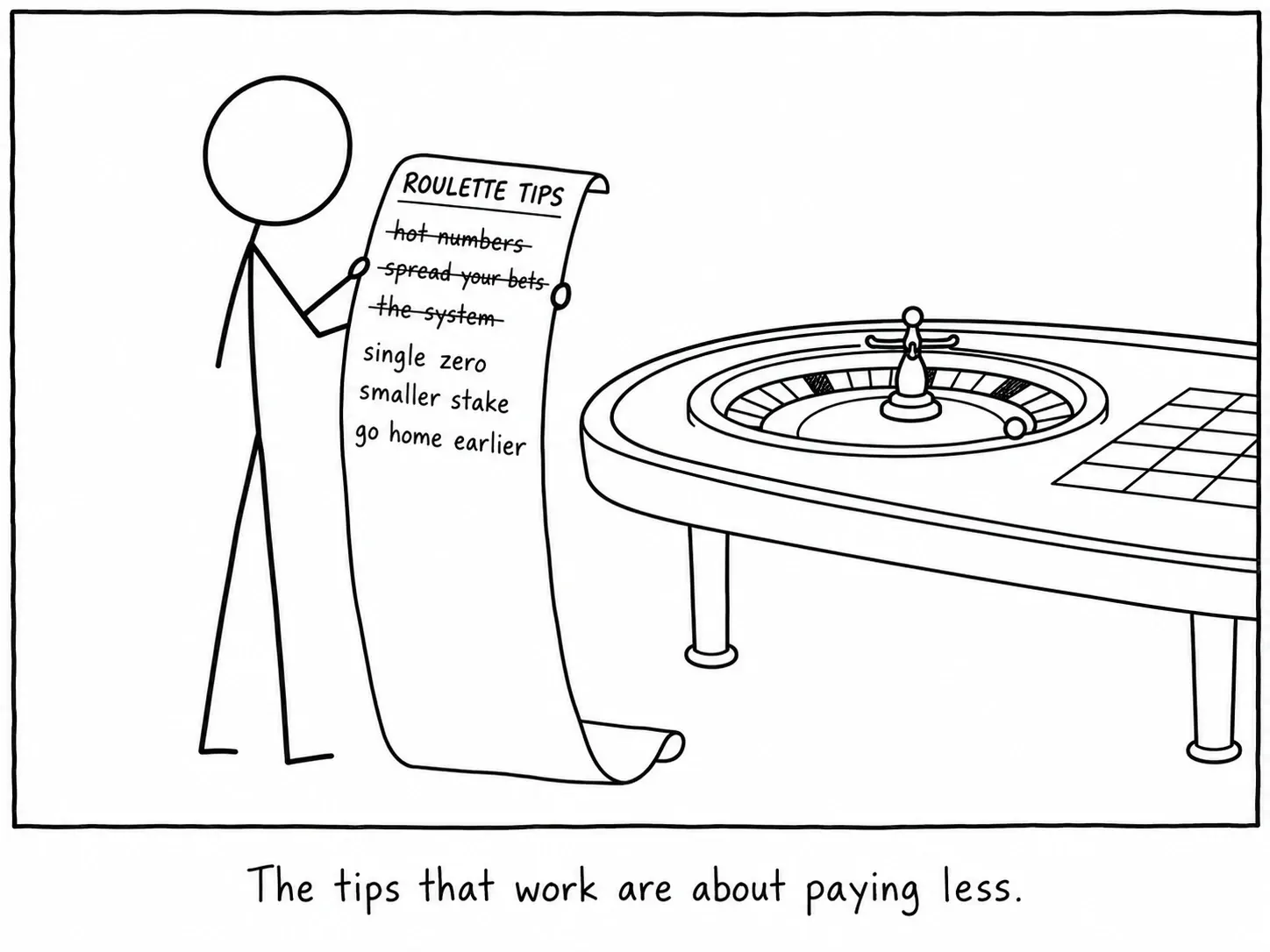
With the same rules, smaller stakes and fewer bets reduce expected loss. They do not guarantee a profit.
Sources
- RouletteDoc. Roulette strategies overview.
- Roulette77. Roulette strategies overview.
- Ethier, S. N. The Doctrine of Chances: Probabilistic Aspects of Gambling.
- Epstein, R. A. The Theory of Gambling and Statistical Logic, 2nd ed.
- Bollman, M. Basic Gambling Mathematics: The Numbers Behind the Neon, 2nd ed.