House Edge
The share of each stake the casino keeps on average.
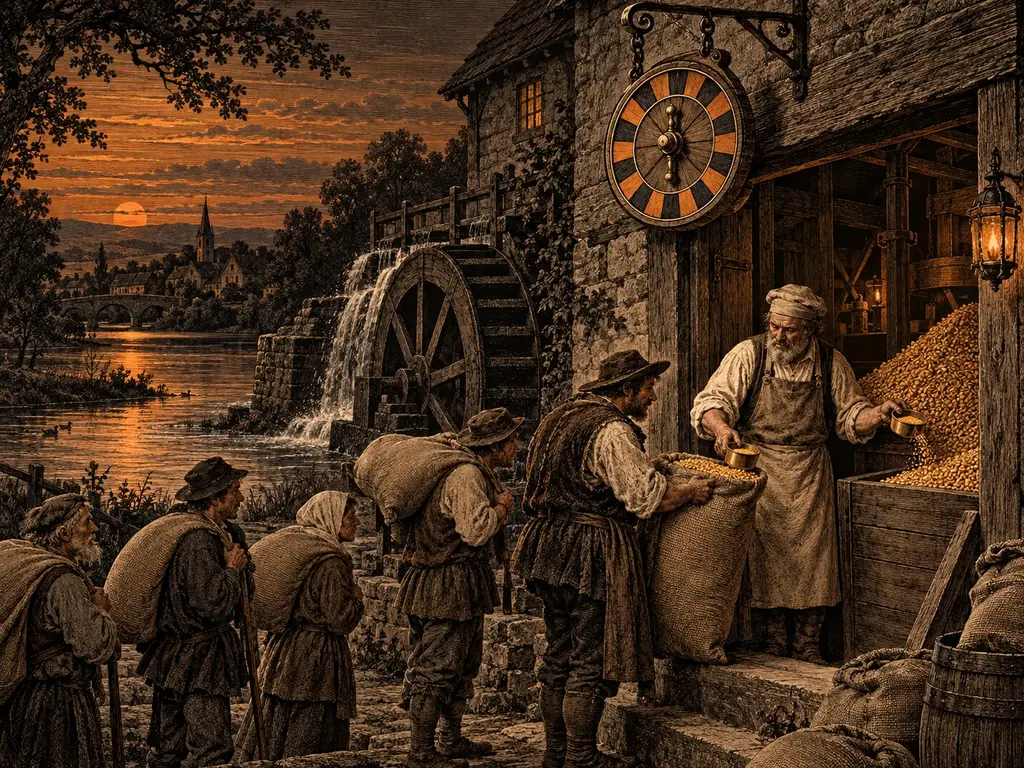
European roulette: 2.70% on every standard bet, because payouts are computed as if there were 36 pockets and there are 37.
Derivation
Fair odds for a straight upbetStraight upA single number, pays 35:1.Read full → would be 36 to 1, because there are 36 ways to lose for every one way to win. The casino pays 35 to 1. The missing unitmoneyUnitThe base stake a system or a player works in. Progressions are described in units so they apply at any table.Read full →, spread over 37 equally likely outcomes, is 1/37 = 2.70% of the stake per spin. The same shortfall appears in every payoutmoneyPayoutWhat a winning bet returns, quoted as “X to 1” on top of the returned stake.Read full → because every payout uses the 36/n − 1 rule: a splitbetSplitTwo adjacent numbers, pays 17:1.Read full → pays 17 instead of 17.5, a dozenbetDozen1–12, 13–24 or 25–36, pays 2:1.Read full → 2 instead of 2.083, redbetRedEven-money bet on the 18 red numbers. French: rouge.Read full → 1 instead of 1.056. The gap is always 1/n units per win, and n/37 wins per spin, so always 1/37 per spin.
Edge versus hold
Edge is the expected lossmathExpected lossExpected value times total amount wagered; the average amount lost over a session or a period.Read full → per unit wagered: 2.70% per spin. HoldmoneyHoldThe share of the money players bring to the table that the casino actually keeps. Higher than the house edge because winnings are re-bet.Read full → is what the casino actually keeps of the money you brought to the table, and it is much higher because you re-bet your winnings. A $100 buy-intableBuy-inExchanging cash for chips at the table. Done between spins, with the cash placed on the layout rather than handed to the dealer.Read full → that is wagered $10 at a time across 200 spins has turned over $2,000 and paid about $54 in edge; the hold on that buy-in is 54%. Casinos report hold; players should think in edge.
Why every bet has the same edge
It is a design choice, not a coincidence. The 36/n − 1 rule was fixed in the 18th century and the double zerovariantDouble zeroThe 00 pocket of the American wheel. Its presence raises the house edge from 2.70% to 5.26%.Read full → was removed later without touching the payouts. Had the payouts been fair for 37 pocketsequipmentPocketOne of the 37 numbered compartments on the rotor. Also: slot, cup.Read full →, the straight up would pay 36 to 1 and the casino would have no income. The uniform edge is convenient: no roulette bet is a “sucker bet” relative to another, with the single exception of the American five-number bet at 7.89%.
What the edge is not
It is not the probabilitymathProbabilityChance of an outcome, from 0 to 1 or 0% to 100%. One number: 1/37 = 2.70%.Read full → of losing a session; most short sessions are decided by variancemathVarianceA measure of how widely results spread around the expected value. High for straight up, low for even-money bets.Read full →, and about 42% of 100-spin even-money sessions end ahead. It is not a per-session fee; it scales with turnovermoneyTurnoverThe total amount wagered over a session or period, counting re-bet winnings. Also: handle, action.Read full →, so a progressionstrategyProgressionAny rule that changes the stake based on previous results. Negative progressions raise it after losses, positive after wins.Read full → that wagers more pays more. It is not something a bet pattern can dilute, because the edges of simultaneous bets add in proportion to their stakes.
In money
Per $1,000 wagered the expected loss is $27.03 in European roulettevariantEuropean rouletteSingle-zero wheel, 37 pockets, house edge 2.70%. The canonical model on this site.Read full →, $52.63 in American, $13.51 on even-money betsbetEven-money betRed/black, odd/even, high/low. 18 numbers, pays 1:1.Read full → with la partageruleLa partageFrench rule: when zero hits, half of an even-money stake is returned. Halves the house edge on those bets to 1.35%.Read full →. A regular who wagers $500 an evening, twice a week, for a year has turned over $52,000 and paid about $1,400 in edge on a European wheel. The figure is small per spin and relentless per year.
Per spin or per resolved bet
Almost every roulette bet is settled by one spin, so its edge per spin and its edge per bet are the same number. A bet that can push and stay on the layoutequipmentLayoutThe printed betting grid on the table. Also: table, felt, cloth.Read full → has two. Riverboat Roulette’s teal bet covers 3 numbers of an American wheel, wins at 2 to 1 if one of them comes up before one of 8 White numbers, and pushes on everything else. Per resolved bet it loses 2/11 of the stake, 18.18%. Per spin it loses 2/38, 5.26%, because on average a bet stays up for 38/11 spins, about 3.5. Both figures are correct. The per-spin figure compares the bet with the rest of the table and sets what an hour costs; the per-resolved figure says how much of each stake comes back when the bet finally settles.
When a casino gets the price wrong
Every edge on this page comes from arithmetic that casinos normally get right. Sometimes they do not. In October 1994 the Grand Casino in Biloxi, Mississippi, offered 80 to 1 on three dice totaling 4, and the same on 17. Three dice fall 216 ways and only 3 of them total 4, so the bet returned 81 × 3/216 = 1.125 for every unit staked: a 12.5% edge to the player. Players noticed. The casino lost about $180,000 in a day, closed the bet, and reopened it at 60 to 1, which turns the same 3 chances in 216 into a 15.3% edge for the house. Hunacek (2025), citing Bollman, tells the story. Roulette’s standard payouts are too simple to get wrong this way; its unusual side betsbetSide betAn optional extra wager attached to the main game, usually on a streak, a bonus event or a jackpot. Almost always dearer than the standard bets.Read full → are where the arithmetic is worth checking.
Side bets in the other table games
Bollman (2021) sets the main bets of blackjack, baccarat, craps and roulette beside typical side bets on the same tables. In the first three games the side bet costs more than the main bet, often many times more. American roulettevariantAmerican rouletteWheel with 0 and 00, 38 pockets, house edge 5.26%. Not the default model on this site.Read full → is the exception: its main bets cost 5.26%, high enough that a side bet such as Colors or WINGO can come in cheaper.
Formula
Questions
No. It is 2.70% of what you wager. Re-betting the same money wagers it again.
No. It is a proportion. The expected loss in dollars scales with the stake.
All standard European bets are equal. With la partage, even-money bets are half the others.
Fun with Math
Try these yourself first. Each solution is folded; open it when you are ready.
On a European wheel a straight upbetStraight upA single number, pays 35:1.Read full → and a bet on redbetRedEven-money bet on the 18 red numbers. French: rouge.Read full → both cost 2.70%, though one covers a single number and the other eighteen. Why does every bet have the same house edgemathHouse edgeThe share of each stake the casino keeps on average: 2.70% in European roulette.Read full →?
Show the solution
Answer Every payoutmoneyPayoutWhat a winning bet returns, quoted as “X to 1” on top of the returned stake.Read full → is set as if the zerowheelZeroThe single green pocket that no even-money, dozen or column bet covers; the source of the house edge. Also: single zero, 0.Read full → were not there, so every bet loses one unitmoneyUnitThe base stake a system or a player works in. Progressions are described in units so they apply at any table.Read full → in 37 spins, whatever it covers.
Take a bet on n numbers. It pays (36 − n)/n to 1. Over 37 spins it wins, on average, n times and loses 37 − n times.
The wins bring in n × (36 − n)/n = 36 − n units. The losses cost 37 − n units. The difference is −1 unit every 37 spins, and n has cancelled out: the result is the same for a straight up, a cornerbetCornerFour numbers sharing a corner on the layout, pays 8:1.Read full → or a dozenbetDozen1–12, 13–24 or 25–36, pays 2:1.Read full →. One unit lost in 37 is 2.70%.
On a wheel with N pocketsequipmentPocketOne of the 37 numbered compartments on the rotor. Also: slot, cup.Read full → the same sum gives (36 − N)/N, so −2/38 = 5.26% on an American wheel. The one bet that breaks the pattern is the American five-number bet: the rule says it should pay 6.2 to 1, it pays 6, and it costs 7.89%.
Keno, the lottery-style game, keeps 25% or more of what is bet. If a casino added zeros to a roulette wheel and left the payouts alone, how many zeros would it take to make roulette as expensive as keno?
Show the solution
Answer Twelve zeros: a 48-pocket wheel.
With z zeros the wheel has 36 + z pockets, and the payouts still assume 36. By the rule in the puzzle above, every bet loses z units in 36 + z spins, so the house edge is z/(36 + z).
Set that equal to one quarter: 4z = 36 + z, so z = 12. Twelve zeros on a 48-pocket wheel would cost 25%.
The triple-zero wheel of the Las Vegas Strip, the dearest roulette most players will meet, has a quarter of that many.
zerospocketshouse edge1372.70%2385.26%3397.69%44010.00%124825.00%The Massachusetts Lottery launched a wheel in 2023 with 36 numbers and no zero. A single number pays 25 for 1, and red, blackbetBlackEven-money bet on the 18 black numbers. French: noir.Read full →, odd or even pays 3 for 2. With no zero, is it cheaper than roulette?
Show the solution
Answer No, far dearer: 30.56% on a number and 25% on red or black, against 2.70% on a European wheel.
“For” includes the stake. A $1 number bet returns $25 once in 36 draws on average: $25 back for $36 staked, a loss of $11 in 36, 30.56%.
A $2 bet on red returns $3 half the time: $3 back for every $4 staked, a loss of 25%.
A zero is only one way to set a price. Roulette pays as if there were 36 pockets and adds a 37th; this wheel has 36 pockets and simply pays less. Bollman (2024) sets it as an exercise.
A casino wants a new bet on the eleven prime numbersmathPrime numberA whole number above 1 that only 1 and itself divide exactly: 2, 3, 5, 7, 11, 13 and so on.Read full → from 1 to 36: 2, 3, 5, 7, 11, 13, 17, 19, 23, 29 and 31. What should it pay to cost the same 2.70% as every other bet on a European wheel? What would it cost at 2 to 1?
Show the solution
Answer 25 to 11, about 2.27 to 1. At 2 to 1 it would cost 10.81%.
Use the rule from the first puzzle: a bet on n numbers pays (36 − n)/n to 1. With n = 11 that is 25/11 to 1, an awkward payout, since a $10 chipmoneyChipA token representing a fixed amount, placed on the layout to make a bet. Also: check.Read full → would win $22.73.
At 2 to 1, a $1 bet wins $2 on 11 spins in 37 and loses $1 on the other 26: 22 − 26 = −4 units every 37 spins, 10.81%.
This is why roulette sells bets on 1, 2, 3, 4, 6, 12 and 18 numbers: 36 divides by each of them, so the fair payout is a whole number. Taylor (2021) sets the exercise with ten primes; there are eleven.
Comic relief
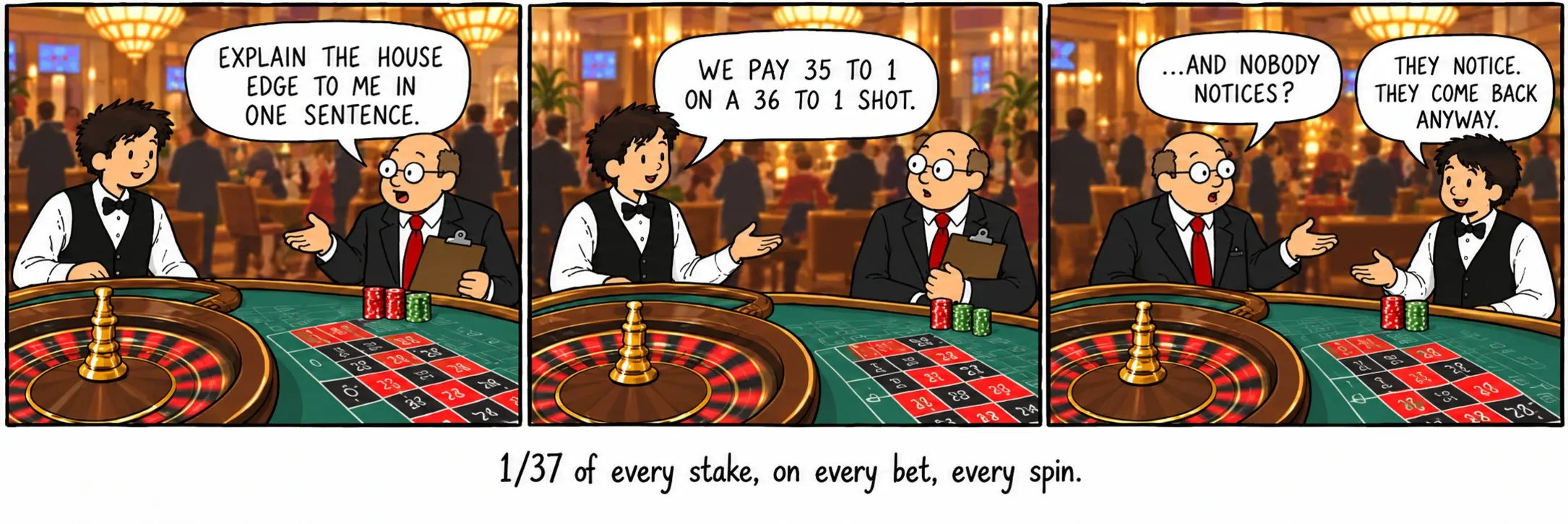
1/37 of every stake, on every bet, every spin.
Sources
- Ethier, S. N. The Doctrine of Chances: Probabilistic Aspects of Gambling.
- Epstein, R. A. The Theory of Gambling and Statistical Logic, 2nd ed.
- Bollman, M. Mathematics of the Big Four Casino Table Games: Blackjack, Baccarat, Craps, & Roulette.
- Hunacek, M. Quantitative Literacy Through Games and Gambling.