Reverse Martingale / Paroli
Double after a win, reset after a loss or after three wins in a row.

It does not beat the wheel; it only changes how the losses arrive. Paroli risks one base bet of your own money per cycle and presses winnings for the rest. The expected lossmathExpected lossExpected value times total amount wagered; the average amount lost over a session or a period.Read full → is unchanged.
Walk the system
A win moves one step on. A loss, or a third win, goes back to the start.
Stakes and results are in units of the base bet.
How does the Paroli system work?
Bet one unitmoneyUnitThe base stake a system or a player works in. Progressions are described in units so they apply at any table.Read full →. Win, and leave it all on the table: the next bet is two. Win again, and it is four. Win a third time, collect seven units of profit and go back to one. Lose at any point and you go back to one as well. That is the whole system. After the first win you are betting winnings, so the most your own bankrollmoneyBankrollThe total amount set aside for play. Bankroll management is deciding how much of it to risk per bet and per session.Read full → loses on any cycle is one unit. Three even-money wins in a row happen with probabilitymathProbabilityChance of an outcome, from 0 to 1 or 0% to 100%. One number: 1/37 = 2.70%.Read full → (18/37)³ = 11.5%, about one cycle in nine.
What does a session look like?
A slow leak with an occasional jump. Think of buying the same small ticket again and again: each costs one unit, most are blanks, and about one in nine pays seven. The probability of finishing a 100-spin session in profit is low (about 30%) because most sessions do not contain enough completed cycles to offset the steady one-unit losses; when a session does finish ahead, it tends to finish well ahead.
- p10 −$500
- p25 −$500
- median −$300
- p75 +$30
- p90 +$320
Does the Paroli system work?
No. It changes the shape of the losses, not their size. Let p = 18/37. Win 7 with probability p³ = 0.115; lose 1 with probability 1 − p³ = 0.885. Expected result per cycle: 7(0.115) − 1(0.885) = 0.805 − 0.885 = −0.08 units. Expected units wagered per cycle: 1 + 2p + 4p² = 1 + 0.973 + 0.947 = 2.92. Divide: −0.08 / 2.92 = −2.7%. Every system gives this number when you do the division.
The tempting thought is that the pressed chipsmoneyChipA token representing a fixed amount, placed on the layout to make a bet. Also: check.Read full → are the casino’s money, so staking them costs nothing. They are yours from the moment they are paid, and each one put back on the table carries the same 2.70%.
What if you wait for four wins in a row?
A ParolistrategyParoliPositive progression: double after a win, reset after a loss or after three wins in a row. Also: reverse Martingale.Read full → to four wins turns one unit into 16, a profit of 15, with probability (18/37)⁴ = 5.6%. Taylor (2021) asks a sharper question: with a bankroll of a few units, what is the chance of landing one such streak before the bankroll is gone? Each failed cycle costs exactly one unit, so with 15 units the answer is 1 − (1 − 0.056)¹⁵ = 58%, better than the 48.6% of putting all 15 on redbetRedEven-money bet on the 18 red numbers. French: rouge.Read full → at once. The catch shows in the other figures. The streak usually comes after several failed cycles, so the gain when it comes averages 9 units, not 15, and because the progressionstrategyProgressionAny rule that changes the stake based on previous results. Negative progressions raise it after losses, positive after wins.Read full → stakes more in total, its average result is worse than the single bet’s.
Does it matter where you stop?
Only to the shape. Paroli to two wins (collect 3) or four wins (collect 15) changes the hit rate and the prize, not the edge. “Parlay” on a straight-up bet (let a 35 to 1 win ride) is the same idea with p = 1/37 and a 1,295 to 1 payoutmoneyPayoutWhat a winning bet returns, quoted as “X to 1” on top of the returned stake.Read full → on two consecutive hits, which is why it is mostly a story and not a practice.
Who chooses it, and why?
Players who want a defined, small maximum loss per cycle and are happy to lose slowly for the chance of a large win. It is the psychological mirror of MartingalestrategyMartingaleProgression that doubles the bet after each loss. See the Strategy section for what it does and does not do.Read full →: Martingale makes you feel like a winner until the night you are not; Paroli makes you feel like a loser until the night you are not. The house takes 2.70% of turnovermoneyTurnoverThe total amount wagered over a session or period, counting re-bet winnings. Also: handle, action.Read full → either way.
Simulator · Paroli
2,000 sessions of even-money bets from a $1,000 bankroll.
Base bet $10 · table limit $500 · 100 spins per session
Questions
Safer in the sense that it cannot produce a catastrophic single loss. Not cheaper: the expected loss per unit wagered is identical.
Any stopping point works the same mathematically. Three is conventional because the prize (7 units) feels worth the wait and the hit rate (11.5%) is not hopeless.
Comic relief
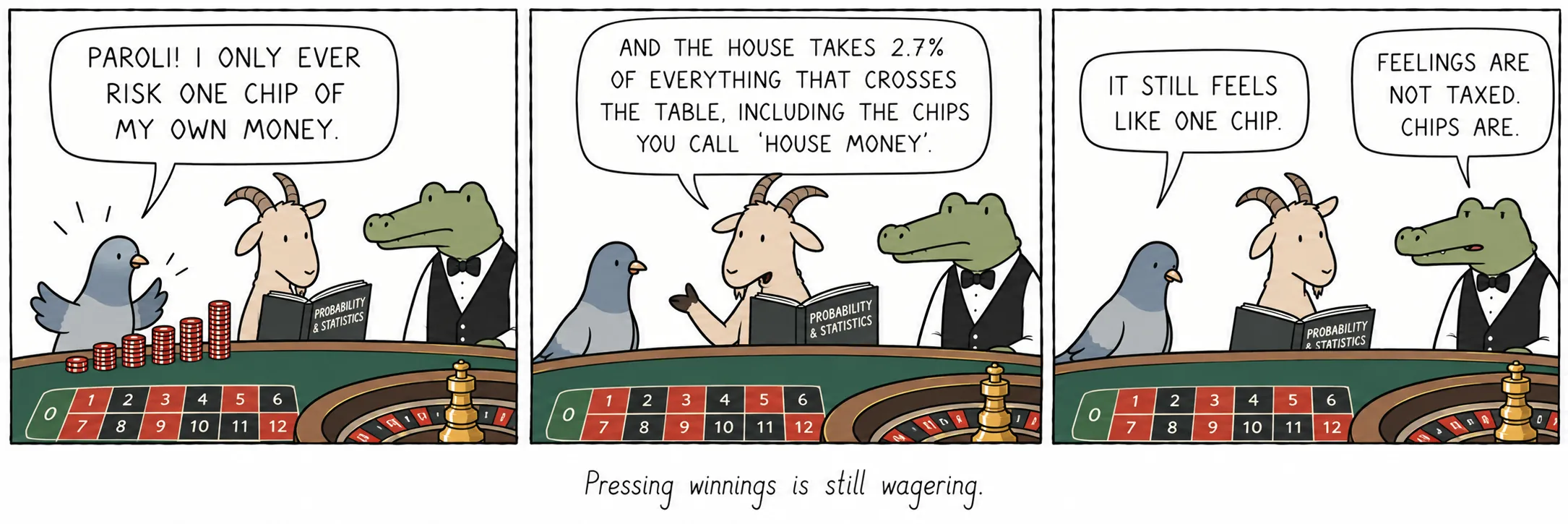
Pressing winnings is still wagering.
Sources
- Ethier, S. N. The Doctrine of Chances: Probabilistic Aspects of Gambling.
- Epstein, R. A. The Theory of Gambling and Statistical Logic, 2nd ed.
- Taylor, D. G. Games, Gambling, and Probability: An Introduction to Mathematics, 2nd ed.