Tiers du Cylindre
“Third of the wheel”: the twelve pockets opposite zero.
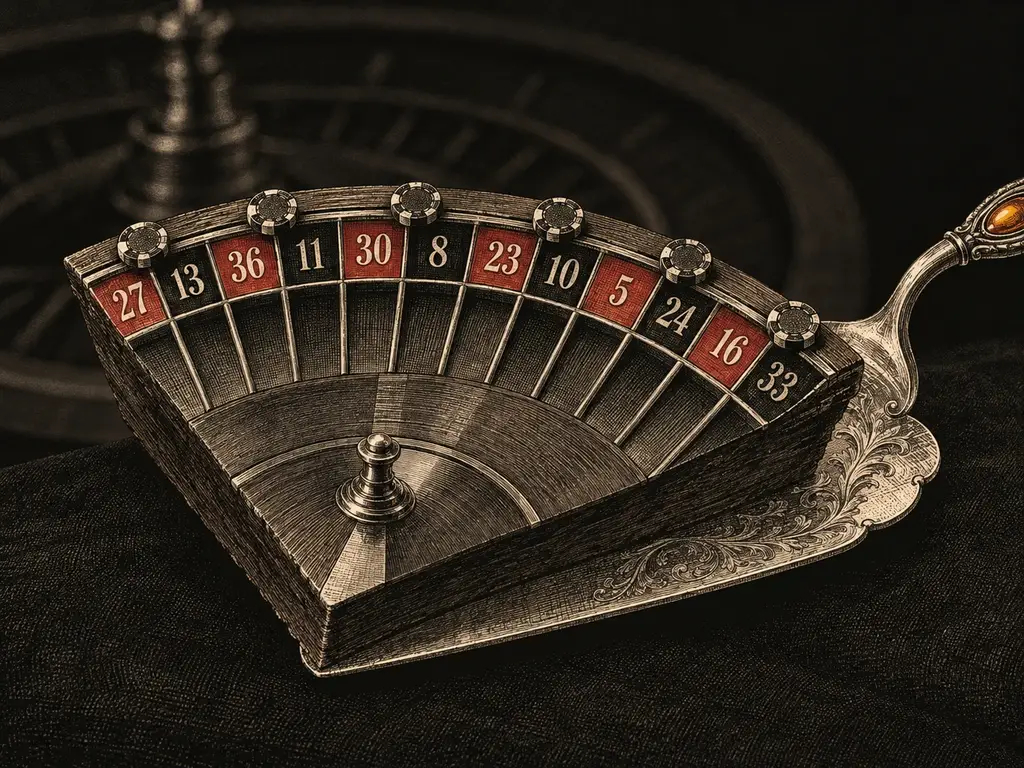
Six splits, six chips, twelve numbers: 27 to 33 on the wheel. Probability 32.43%, net +12 units on any hit.
The splits
5-8, 10-11, 13-16, 23-24, 27-30, 33-36. Six chipsmoneyChipA token representing a fixed amount, placed on the layout to make a bet. Also: check.Read full →, each a splitbetSplitTwo adjacent numbers, pays 17:1.Read full → paying 17 to 1. The twelve numbers run contiguously around the wheel from 27 to 33: 27 13 36 11 30 8 23 10 5 24 16 33. Announced as “tiers” (tiers du cylindreFR · sectorTiers du cylindre“Third of the wheel”: the twelve numbers opposite zero, 27 to 33 on the wheel, bet with six splits.Read full →, sometimes “series 5/8” in German casinos after the first split).
Payout and expectation
Any hit pays 17 unitsmoneyUnitThe base stake a system or a player works in. Progressions are described in units so they apply at any table.Read full → on one split and loses the other five: net +12 on a 6-unit stake. ProbabilitymathProbabilityChance of an outcome, from 0 to 1 or 0% to 100%. One number: 1/37 = 2.70%.Read full → 12/37. EV per spin: (12/37)(12) − (25/37)(6) = (144 − 150)/37 = −6/37, which is 2.70% of six units. Same coverage as a dozenbetDozen1–12, 13–24 or 25–36, pays 2:1.Read full →, on the wheel rather than the layoutequipmentLayoutThe printed betting grid on the table. Also: table, felt, cloth.Read full →, and with a flat payoutmoneyPayoutWhat a winning bet returns, quoted as “X to 1” on top of the returned stake.Read full →: every hit pays the same.
Tiers versus a dozen
Both cover twelve numbers at 32.43%. A $30 dozen pays +$60 on a hit, exactly like six $5 splits. They are the same bet in payout and probability; they differ only in which twelve numbers and in whether the numbers form an arc. For a bias player that is everything; for a system player it is nothing.
Why opposite zero
The French sectorwheelSectorA contiguous arc of pockets on the wheel, as distinct from a group on the layout.Read full → bets tile the wheel: voisins du zéroFR · sectorVoisins du zéro“Neighbors of zero”: the seventeen numbers from 22 to 25 on the wheel, bet with nine chips.Read full → takes the 17 pocketsequipmentPocketOne of the 37 numbered compartments on the rotor. Also: slot, cup.Read full → around zerowheelZeroThe single green pocket that no even-money, dozen or column bet covers; the source of the house edge. Also: single zero, 0.Read full →, tiers the 12 directly opposite, orphelinsFR · sectorOrphelins“Orphans”: the eight numbers left over by voisins and tiers: 17, 34, 6 and 1, 20, 14, 31, 9.Read full → the 8 that are left in two small arcs. Together they cover all 37 exactly once. The three were standardized at Monte Carlo and are printed on the racetracktableRacetrackThe oval strip on live and electronic layouts showing the numbers in wheel order, used to place neighbors and sector bets in one tap.Read full → of every live table.
At the table
A physical dealer places six chips in a few seconds and repeats the call back (“tiers, cinq pièces” for five units on each). Online, one tap on the racetrack button places all six. Minimums apply to the total of the call, so a $5 inside minimum is met by six $1 chips.
Questions
No. It is the third of the wheel furthest from zero.
You can place the six splits by hand with any weights; the call bettableCall betA bet announced to the dealer rather than placed by hand, usually a wheel-sector bet such as voisins or tiers. Also “announced bet”.Read full → itself is six equal chips.
Comic relief
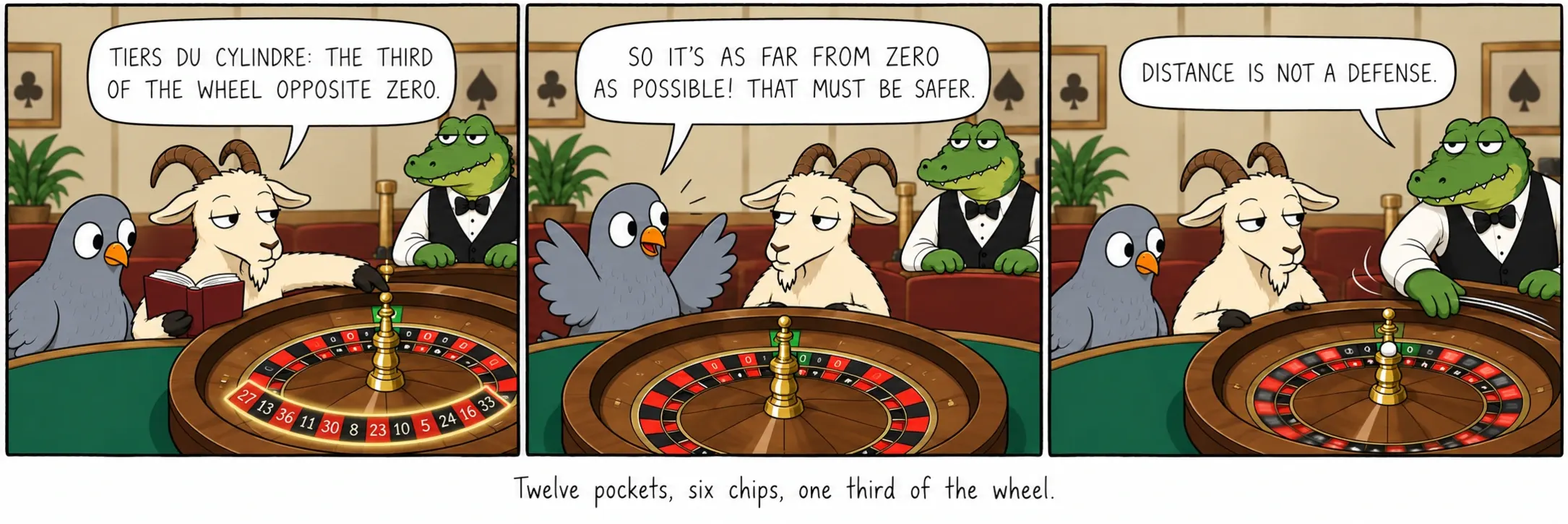
Twelve pockets, six chips, one third of the wheel.
Sources
- Ethier, S. N. The Doctrine of Chances: Probabilistic Aspects of Gambling.
- Wykes, A. The Complete Illustrated Guide to Gambling.