Fibonacci
Stakes follow 1, 1, 2, 3, 5, 8, 13… Move forward one step after a loss, back two after a win.
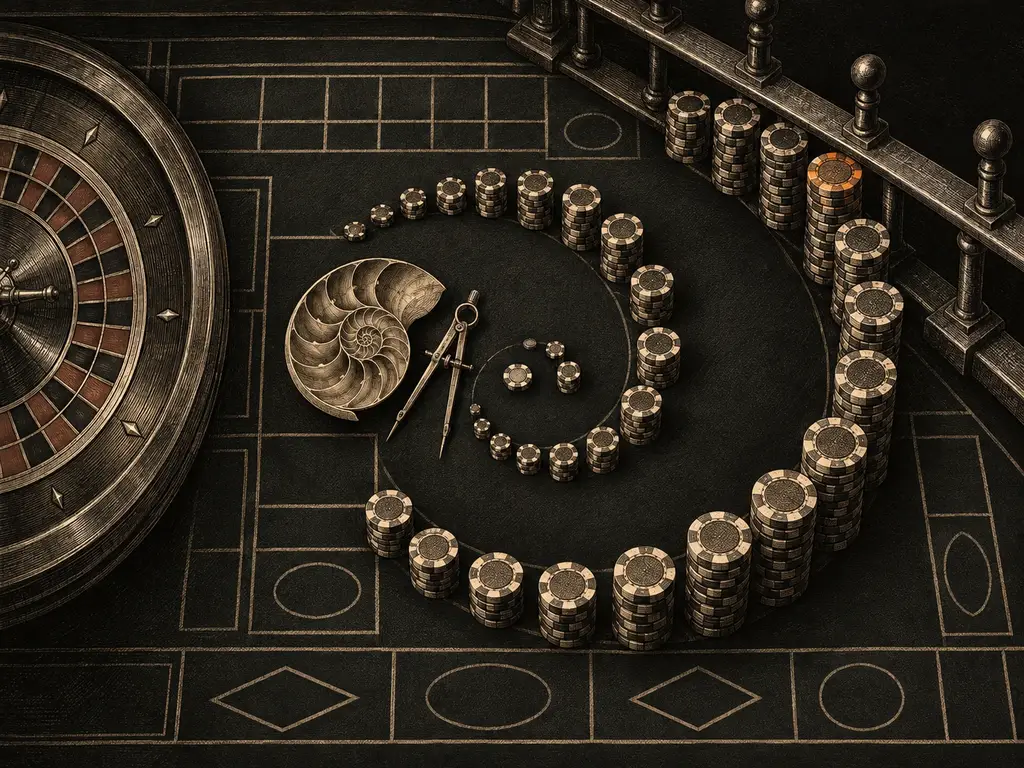
It does not beat the wheel; no staking plan does. It is gentler than Martingale, so it survives longer losing runs before hitting the limit, and recovers more slowly. The expected loss is the same 2.70% of turnovermoneyTurnoverThe total amount wagered over a session or period, counting re-bet winnings. Also: handle, action.Read full →.
How the sequence is built
Each number is the sum of the two before it.
So after 8 and 13 comes 21.
Draw each number as a square and the squares fit together: every new one is as long as the two before it laid side by side. A quarter circle across each square joins up into a spiral.
Walk the sequence
A loss moves one step to the right. A win moves two steps back.
Stakes and results are in units of the base bet.
How does the Fibonacci system work?
Write out the FibonaccistrategyFibonacciProgression that follows the sequence 1, 1, 2, 3, 5, 8, 13…: one step forward after a loss, two steps back after a win.Read full → numbers: 1, 1, 2, 3, 5, 8, 13, 21, 34, 55, 89, 144. Each one is the sum of the two before it. Start at the first and bet that many unitsmoneyUnitThe base stake a system or a player works in. Progressions are described in units so they apply at any table.Read full →. Lose, and you move one step right. Win, and you move two steps left, or back to the start if there is no room. That is the whole system. The table shows what each step costs: a run of losses cut off by the table limittableTable limitMinimum and maximum bet allowed. The maximum is what stops doubling progressions.Read full → or your bankrollmoneyBankrollThe total amount set aside for play. Bankroll management is deciding how much of it to risk per bet and per session.Read full → loses the sum of everything staked so far.
What does a session look like?
Take a $10 base and eight spins: L L W L L L W W. The stakes run 10, 10, 20 (win, back two, to step 1), 10, 10, 20, 30 (win, back two, to step 2), 10 (win, back to the start). Lost: 10 + 10 + 10 + 10 + 20 = 60. Won: 20 + 30 + 10 = 60. Five losses, three wins, and you are level. That is the appeal of the system. The cost is on the same line: it took $120 of bets to get there, and every dollar staked carries the house edgemathHouse edgeThe share of each stake the casino keeps on average: 2.70% in European roulette.Read full →.
Why step back two, and not one?
Because one win pays for exactly two losses. Each number is the sum of the two before it, so a win at 5 units returns the 2 and the 3 lost just before. Think of a staircase: one step up for every loss, two steps down for every win. The step you stand on is your debt. At step 5 you are 7 units down, at step 8 you are 33 down, and back on the first step you are exactly even. Profit comes only from wins on the first step, one unit at a time.
With almost as many wins as losses, two steps for one sounds like a bargain, and most of the time the staircase does lead back down. The catch is that the steps get taller as you climb. Ten wins on the first step earn 10 units. Three losses at steps 6, 7 and 8 cost 8 + 13 + 21 = 42.
- p10 −$500
- p25 −$500
- median −$500
- p75 +$250
- p90 +$920
Does the Fibonacci system work?
No. Not as a way to come out ahead. The calculation is the same as for every system: each bet loses 1/37 of its stake on average, so the whole sequence loses 1/37 of everything wagered. A famous sequence does not change that, because the wheel pays the same odds whatever the size of the chipmoneyChipA token representing a fixed amount, placed on the layout to make a bet. Also: check.Read full →. Fibonacci stakes drift up, so it wagers more per spin than flat bettingstrategyFlat bettingWagering the same amount every spin. The baseline every progression is compared against.Read full → does, and its expected lossmathExpected lossExpected value times total amount wagered; the average amount lost over a session or a period.Read full → per session is higher. MartingalestrategyMartingaleProgression that doubles the bet after each loss. See the Strategy section for what it does and does not do.Read full → wagers more still, and loses more.
Is it safer than Martingale?
It is slower, which is not the same thing. Fibonacci stakes grow by about 1.6× per step instead of 2×, so a $500 limit is reached after about ten consecutive losses from a $10 base rather than six. That makes the cliff rarer: ten even-money losses in a row is (19/37)¹⁰ ≈ 0.13%, against (19/37)⁶ ≈ 1.8% for six. But the cliff is also higher, because more has been staked on the way there, and a single win does not undo it.
Where do the numbers come from?
From a puzzle about rabbits. Leonardo of Pisa, later nicknamed Fibonacci, set it in his Liber Abaci of 1202: start with one pair, let every pair produce a new pair each month from its second month on, and count the pairs. The answer runs 1, 2, 3, 5, 8, 13. He was not the first to find the rule. Indian scholars of verse rhythm had written it down earlier: Singh (1985) traces it to Virahanka, between 600 and 800, and then to Gopala and Hemachandra.
None of them had a wheel in mind. The sources used here do not say who first staked money by the sequence. What they do show is that its arithmetic and the arithmetic of roulette never meet: one says how the stakes grow, the other says what every stake returns.
How much is lost after a run of losses?
Two identities make the table above easy to check. After n losses in a row the total lost is the (n + 2)th Fibonacci number minus 1, which gives 1, 2, 4, 7, 12, 20 and so on, and the next stake is the (n + 1)th Fibonacci number. Bollman (2021) proves the same result by induction for a sequence that starts 1, 2, 3, which shifts each number one place. At a 500-unit limit from a 1-unit start, Martingale cannot place its 10th bet, 512 units. Fibonacci can place its 14th, 377 units, but not its 15th, 610.
What changes on a dozen or a column?
On a dozenbetDozen1–12, 13–24 or 25–36, pays 2:1.Read full → or a columnbetColumnTwelve numbers in one vertical column of the layout, pays 2:1.Read full →, which pays 2 to 1, the step back is not needed. A win at stake F pays 2F, which is always more than everything lost before it, so every win ends the sequence ahead. The price is that a dozen wins only 12 times in 37, so long losing runs are far more common: fourteen dozen losses in a row happen about once in 242 tries, against about once in 11,000 for redbetRedEven-money bet on the 18 red numbers. French: rouge.Read full →.
What if you stop only after two wins in a row?
Another variant moves one step forward after every spin, win or lose, and stops only after two wins in a row. With n losses before the two wins, the profit is the (n + 1)th Fibonacci number plus 1: small when the wins come early, larger when they come late, and won on stakes that have grown to match. An early pair of wins always comes at small stakes; a late one can need a large bet at exactly the moment the session has gone worst.
Simulator · Fibonacci
2,000 sessions of even-money bets from a $1,000 bankroll.
Base bet $10 · table limit $500 · 100 spins per session
How often a losing streak comes
An even-money bet on a single-zero wheel loses 19 spins in 37. Each row is the chance that a given run of spins all lose, and what a Fibonacci player, who moves one step along the sequence after every loss, has lost by then.
| losses in a row | chance | about 1 in | lost so far | next bet |
|---|---|---|---|---|
| 1 | 51.4% | 2 | $1 | $1 |
| 2 | 26.4% | 4 | $2 | $2 |
| 3 | 13.5% | 7 | $4 | $3 |
| 4 | 7.0% | 14 | $7 | $5 |
| 5 | 3.6% | 28 | $12 | $8 |
| 6 | 1.8% | 55 | $20 | $13 |
| 7 | 0.94% | 106 | $33 | $21 |
| 8 | 0.48% | 207 | $54 | $34 |
| 9 | 0.25% | 403 | $88 | $55 |
| 10 | 0.13% | 784 | $143 | $89 |
| 11 | 0.065% | 1527 | $232 | $144 |
| 12 | 0.034% | 2974 | $376 | $233 |
| 13 | 0.017% | 5792 | $609 | $377 |
| 14 | 0.0089% | 11279 | $986 | $610 |
| 15 | 0.0046% | 21965 | $1,596 | $987 |
The chance is 19/37 multiplied by itself once per loss, counted from one given spin. A long session has many spins where such a run can start, so over an evening it is far more likely than one row suggests.
Questions
Yes: forward after a win, back after a loss. It behaves like a slower ParolistrategyParoliPositive progression: double after a win, reset after a loss or after three wins in a row. Also: reverse Martingale.Read full →.
Fun with Math
Try these yourself first. Each solution is folded; open it when you are ready.
Play the variant that moves one step along the sequence after every spin, win or lose, and stops after two wins in a row: stakes 1, 1, 2, 3, 5, 8 and so on. The first fourteen results are W L W L L L W L L L W L L W. Where do you stand, and what is the next bet?
Show the solution
Answer Down 22 unitsmoneyUnitThe base stake a system or a player works in. Progressions are described in units so they apply at any table.Read full →. The next bet is 610 units, and a win would end the session 588 up.
The stakes are the first fourteen FibonaccistrategyFibonacciProgression that follows the sequence 1, 1, 2, 3, 5, 8, 13…: one step forward after a loss, two steps back after a win.Read full → numbers: 1, 1, 2, 3, 5, 8, 13, 21, 34, 55, 89, 144, 233 and 377. Add the wins and subtract the losses: +1 −1 +2 −3 −5 −8 +13 −21 −34 −55 +89 −144 −233 +377 = −22.
The last result was a win, so one more win ends it. The next stake is 610: a win leaves +588, a loss leaves −632 and a next stake of 987.
The variant always ends ahead, but here it needs a 610-unit bet to do so. Under the usual rules, two steps back after a win, the same fourteen results leave you just 1 unit down with a next bet of 2. Bollman (2021), who starts the sequence at 1, 2, 3, gets 1 down and a next bet of 3. The usual rules lose less here because each win pulls the stakes back down.
spinstakeresultrunning total11W+121L032W+243L−155L−668L−14713W−1821L−22934L−561055L−1111189W−2212144L−16613233L−39914377W−22In the same variant, why do n losses followed by two wins always leave a profit of the (n + 1)th Fibonacci number plus 1?
Show the solution
Answer The n losses add up to the (n + 2)th Fibonacci number minus 1, and the two wins are the next two numbers, which together beat that by the (n + 1)th number plus 1.
Write F₁, F₂, F₃ … for 1, 1, 2, 3, 5 … Each number is the sum of the two before it.
The losses: F₁ + F₂ + … + Fₙ. Add 1 to that sum, written as F₂, and it collapses: F₂ + F₁ = F₃, then F₃ + F₂ = F₄, and so on, until the whole sum is Fₙ₊₂. So the losses total Fₙ₊₂ − 1.
The wins are the next two stakes, Fₙ₊₁ and Fₙ₊₂. Profit: Fₙ₊₁ + Fₙ₊₂ − (Fₙ₊₂ − 1) = Fₙ₊₁ + 1. With four losses, that is F₅ + 1 = 6 units.
Comic relief
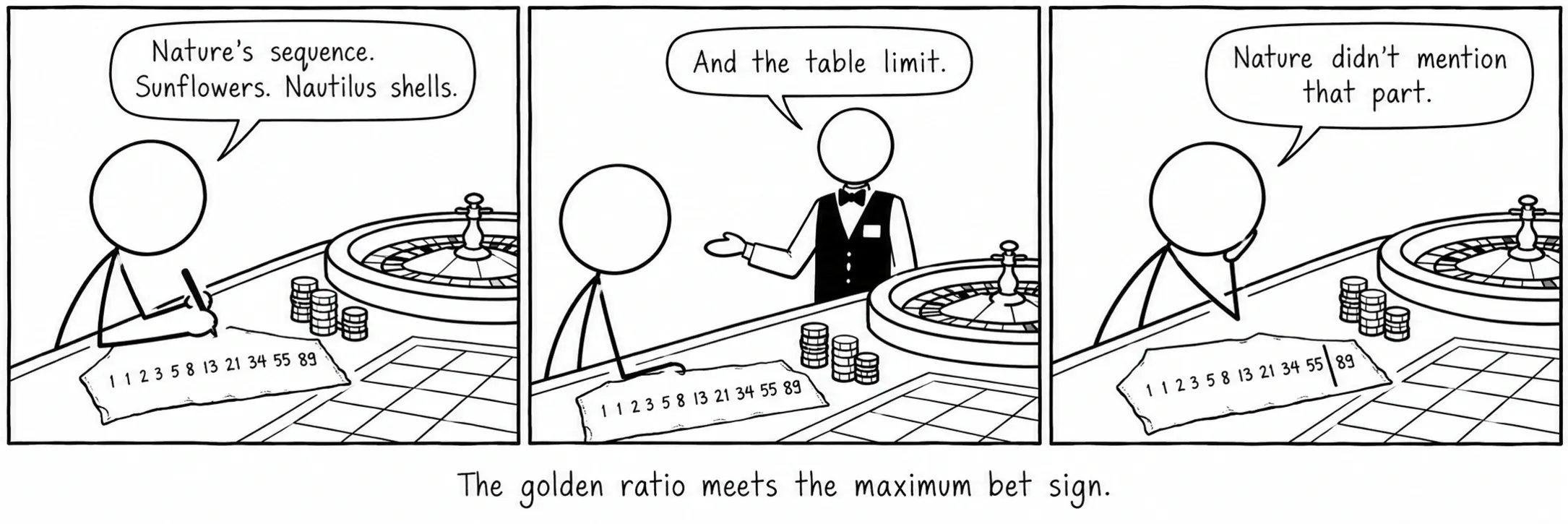
The golden ratio meets the maximum bet sign.
Sources
- Ethier, S. N. The Doctrine of Chances: Probabilistic Aspects of Gambling.
- Epstein, R. A. The Theory of Gambling and Statistical Logic, 2nd ed.
- Bollman, M. Mathematics of the Big Four Casino Table Games: Blackjack, Baccarat, Craps, & Roulette.
- Sigler, L. E. Fibonacci’s Liber Abaci: A Translation into Modern English of Leonardo Pisano’s Book of Calculation.
- Singh, P. The so-called Fibonacci numbers in ancient and medieval India.