Independent Spins
Each spin starts from nothing.

The outcome of one spin has no influence on the next. Every calculation on this site rests on that fact.
What independence means
p(redbetRedEven-money bet on the 18 red numbers. French: rouge.Read full → on spin 2 | red on spin 1) = p(red) = 18/37. Conditioning on history changes nothing. Hot numbersmythHot numberA number that has appeared more often than expected recently. On a fair wheel it predicts nothing.Read full →, cold numbersmythCold numberA number that has not appeared for many spins. Carries no information about future spins on a fair wheel.Read full → and due colors are descriptions of the past, not forecasts. Formally, the joint probabilitymathProbabilityChance of an outcome, from 0 to 1 or 0% to 100%. One number: 1/37 = 2.70%.Read full → of any sequence is the product of the single-spin probabilities, which is the only reason the multiplication rule on the probability page is allowed.
Why it is physically true
The ballequipmentBallThe small ball launched along the track against the rotor. Modern balls are ivorine or Teflon, 18–21 mm.Read full → is launched by hand at a speed that varies by tenths of a meter per second; it circles a track whose friction varies with dust and humidity; it strikes one of eight deflectorsequipmentDeflectorOne of the metal obstacles on the apron that scatter the falling ball. Also: canoe, diamond, pin.Read full → at an angle set by all of that; it bounces across fretsequipmentFretThe metal divider between two pockets on the wheel.Read full → whose effect on a ball at 1 m/s is chaotic in the technical sense. Nothing about the previous result survives into any of those variables. The rotorequipmentRotorThe spinning part of the wheel that carries the pockets.Read full → is the same rotor, which is the one place dependence could hide, and that is the wheel-bias question.
What follows from it
Every betting system is a function of past results. If past results carry no information about the next spin, no such function can improve the expected valuemathExpected valueThe average result per bet over the long run. −1/37 of the stake for every standard European bet.Read full → of the next bet. This is the formal version of the argument against systems, and it is why the strategy pages can be written in advance for systems not yet invented: the proof does not depend on the rule.
When it would fail
Only if the wheel were physically biased or the dealer’s release were predictable. Those are Lab topics. Even there, the dependence is on physics, not on previous results: a biased pocketequipmentPocketOne of the 37 numbered compartments on the rotor. Also: slot, cup.Read full → is more likely every spin, not more likely after it has been “cold”. The data from previous spins would be evidence about the wheel, which is a different thing from a pattern in the outcomes.
Independence is an assumption
Multiplying chances is allowed only when the events are independent, and a roulette wheel earns that right by physics. Elsewhere it has to be checked. In 1999 Sally Clark, an English solicitor, was convicted of murdering her two baby sons. A pediatrician told the jury that the chance of two crib deaths in a family like hers was 1 in 73 million, a figure he had found by squaring 1 in 8,543, the chance of one. Squaring treats the two deaths like two spins of a wheel. But brothers share genes and a home, so after one crib death a second is far more likely than the first was. The Royal Statistical Society said so publicly in 2001, and Clark’s conviction was quashed on a second appeal in 2003, after medical evidence that had not been disclosed came to light. Hunacek (2025) uses the case to teach the rule this page rests on: multiply only what is independent.
Independence and RNG tables
Software tables draw each result from a certified random number generator that is tested for exactly this property: serial independence across millions of draws. The animated wheel is decoration. An RNG table that showed dependence would fail certification, which is a stricter test than any player could run.
Questions
Not to a pocket. Perhaps, with great consistency, to a sectorwheelSectorA contiguous arc of pockets on the wheel, as distinct from a group on the layout.Read full → more often than chance; see dealer signatures in the Lab. Studios vary the release to prevent it.
For bias analysis over thousands of spins, in principle. For the next spin, no.
Fun with Math
Try these yourself first. Each solution is folded; open it when you are ready.
A bet placed before two spins pays even money if the second number is higher than the first. A tie loses, and 0 counts as the lowest number. What does it cost on a European wheel?
Show the solution
Answer Exactly 2.70%, the same as redbetRedEven-money bet on the 18 red numbers. French: rouge.Read full →.
The two spins are independent, so the second number is as likely to be higher than the first as lower. The only other case is a tie, the same number twice, with probabilitymathProbabilityChance of an outcome, from 0 to 1 or 0% to 100%. One number: 1/37 = 2.70%.Read full → 1/37.
So the bet wins with probability (1 − 1/37)/2 = 18/37, exactly the chance of red, and costs the same 2.70%.
If you could place it after seeing the first number it would be a gift: after a 0 it wins 36 times in 37. That is why a bet like this has to close before the first spin.
Comic relief
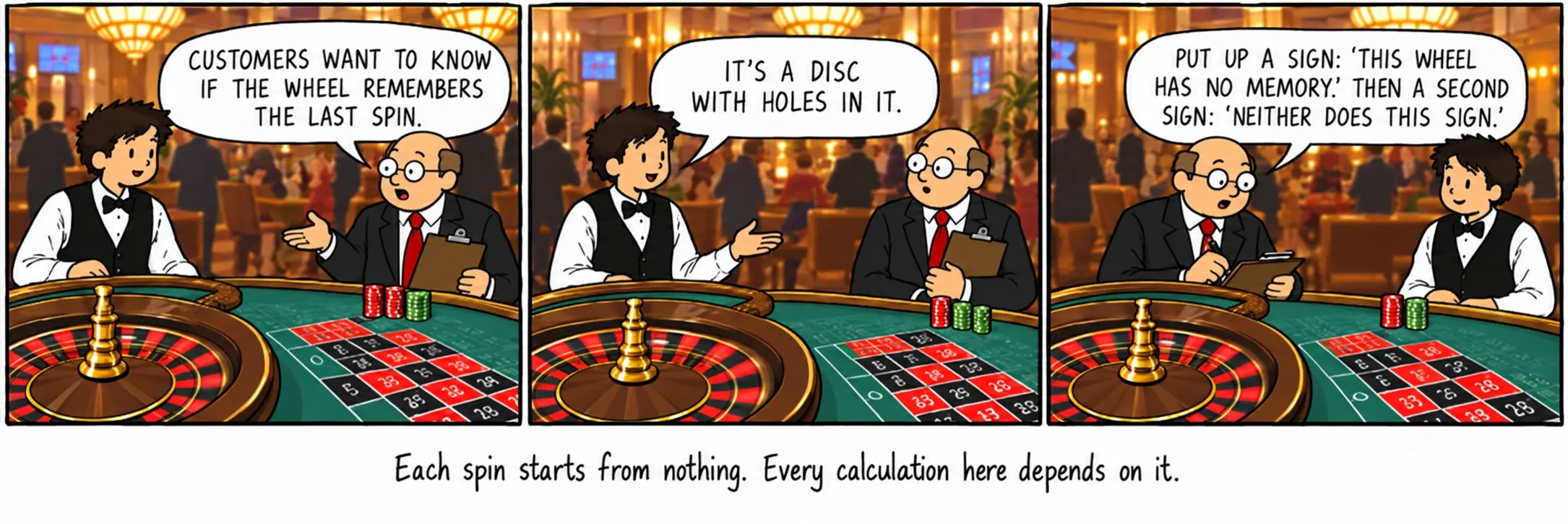
Each spin starts from nothing. Every calculation here depends on it.
Sources
- Feller, W. An Introduction to Probability Theory and Its Applications, Vol. 1.
- Small, M. & Tse, C. K. “Predicting the outcome of roulette.”
- Hunacek, M. Quantitative Literacy Through Games and Gambling.
- Royal Statistical Society. “Statement regarding statistical issues in the Sally Clark case.”