Red / Black Strategy
Most systems are built on red/black because it is the closest thing to a coin flip on the table.
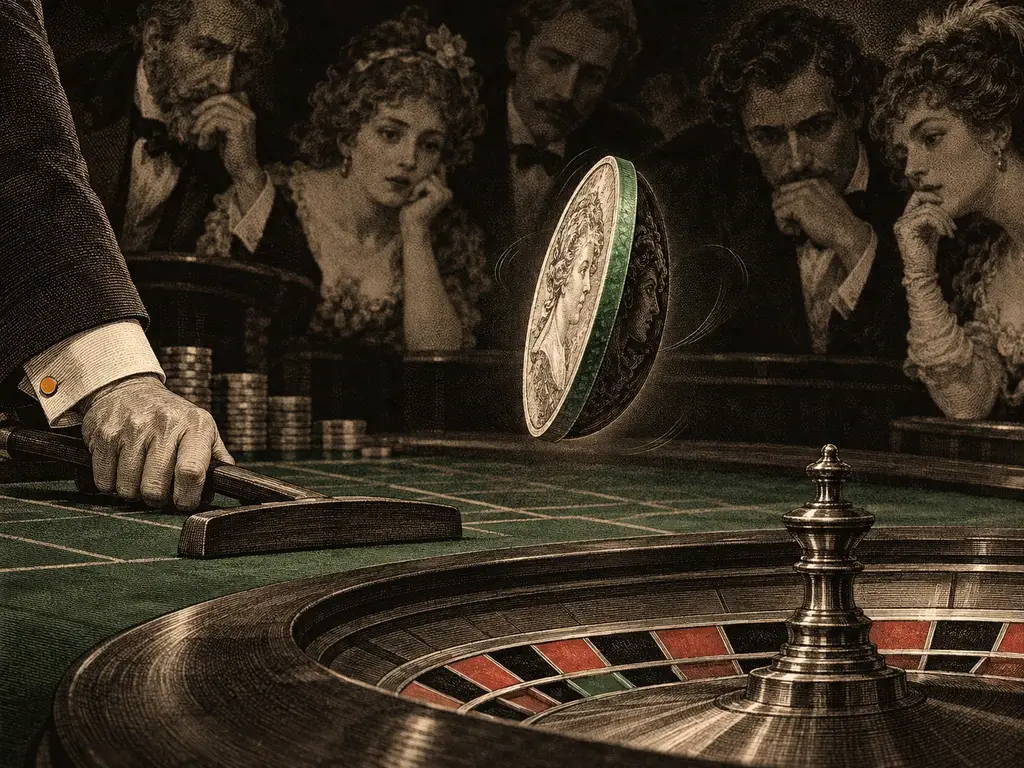
Red wins 48.65% of spins, not 50%. Any system that counts on balance between red and black runs into the 2.70% gap every spin.
Following and opposing streaks
Betting the color that just won (“ride the streak”) or the color that just lost (“it’s due”) have identical expected valuemathExpected valueThe average result per bet over the long run. −1/37 of the stake for every standard European bet.Read full →: −2.70% of the stake. The wheel does not know what it just did. Over a long session a streak-follower and a streak-opposer will have different sequences of wins and losses and the same average result, because every bet either of them placed was 18/37 to win.
What a 200-spin session contains
A run of five or more of one color appears somewhere in a 200-spin session about 95% of the time; a run of eight or more about 40% of the time; ten or more about 12%. Players who bet against streaks meet these runs every night and remember the ones that broke them. Players who bet with streaks remember the ones that paid. Both are describing the same wheel.
Color systems
Everything in the Strategy section can be run on redbetRedEven-money bet on the 18 red numbers. French: rouge.Read full →/blackbetBlackEven-money bet on the 18 black numbers. French: noir.Read full →: MartingalestrategyMartingaleProgression that doubles the bet after each loss. See the Strategy section for what it does and does not do.Read full →, FibonaccistrategyFibonacciProgression that follows the sequence 1, 1, 2, 3, 5, 8, 13…: one step forward after a loss, two steps back after a win.Read full →, D’Alembert, LabouchèrestrategyLabouchèreCancellation system: write a line of numbers, bet the sum of the two ends, cross them off after a win, add the lost stake after a loss.Read full →, ParolistrategyParoliPositive progression: double after a win, reset after a loss or after three wins in a row. Also: reverse Martingale.Read full →. Some systems add color-specific rules such as switching color after two losses or betting the color that has appeared less often in the last twenty spins. The additions are harmless and useless; the progressionstrategyProgressionAny rule that changes the stake based on previous results. Negative progressions raise it after losses, positive after wins.Read full → underneath determines the shape of the session, and the edge determines its mean.
Where to play it
If you intend to play even-money betsbetEven-money betRed/black, odd/even, high/low. 18 numbers, pays 1:1.Read full →, a la partageruleLa partageFrench rule: when zero hits, half of an even-money stake is returned. Halves the house edge on those bets to 1.35%.Read full → or en prisonruleEn prisonFrench rule: when zero hits, an even-money bet is held for the next spin instead of lost. Halves the house edge on those bets.Read full → table halves your expected lossmathExpected lossExpected value times total amount wagered; the average amount lost over a session or a period.Read full → from 2.70% to 1.35% of turnovermoneyTurnoverThe total amount wagered over a session or period, counting re-bet winnings. Also: handle, action.Read full →. That is the only “strategy” on this page that changes a number. On a $10 × 100 spin session it is the difference between an expected −$27 and −$13.50.
Red/black and the Monte Carlo fallacy
The 26 blacks of 1913 are the canonical story, told on the gambler’s fallacy page. The useful part of the story is not that the run happened, which was inevitable somewhere eventually, but that the casino made a fortune from players who were certain it could not continue. Certainty about the next spin is the one thing the wheel never sells.
Simulator · Flat
2,000 sessions of even-money bets from a $1,000 bankroll.
Base bet $10 · table limit $500 · 100 spins per session
Questions
Identical. 18 numbers each.
It changes nothing. Pick one for the evening if it helps you track results.
Yes, and wins nothing otherwise. It is a bet that loses 2.70% of the time and never wins: EV −2.70% of the total, like everything else, with no upside at all.
Comic relief
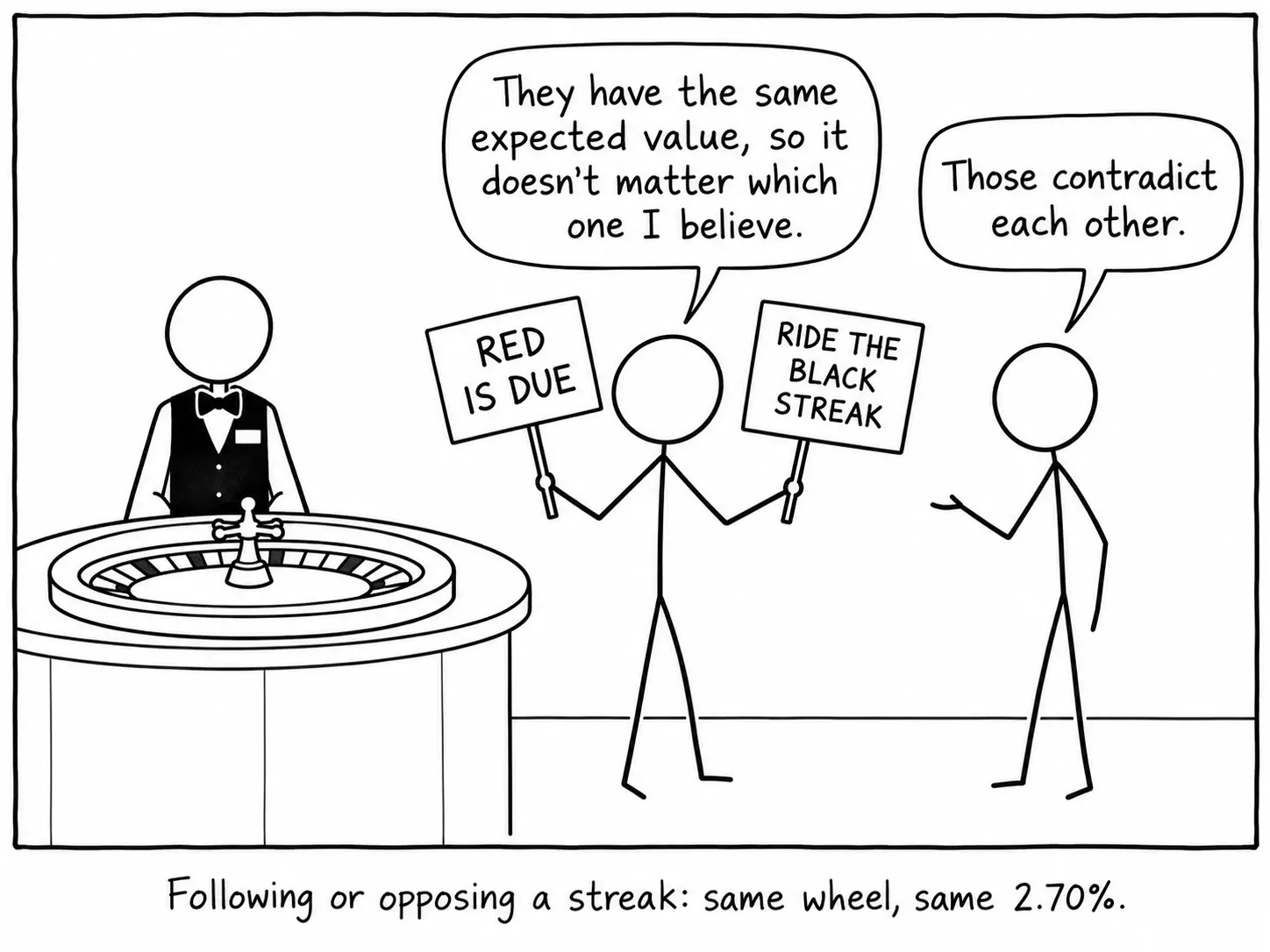
Following or opposing a streak: same wheel, same 2.70%.
Sources
- Ethier, S. N. The Doctrine of Chances: Probabilistic Aspects of Gambling.
- Feller, W. An Introduction to Probability Theory and Its Applications, Vol. 1.