How a Round Works
Sixty seconds, five stages, the same every time.
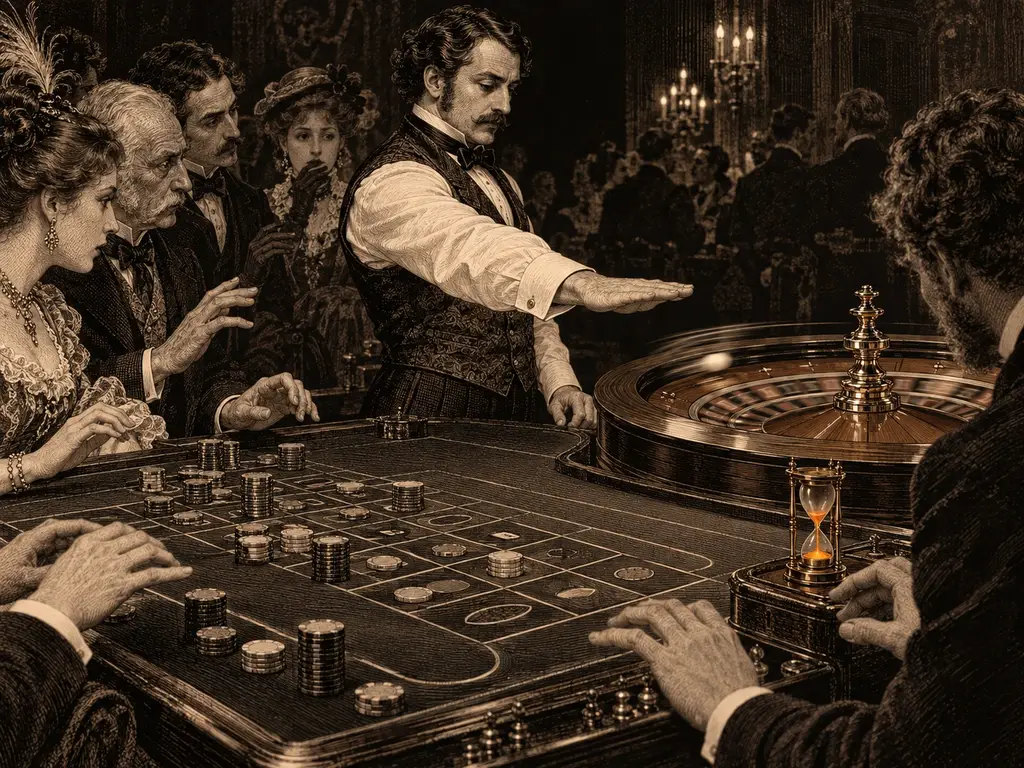
Bets open, the ball is spun, bets close, the ball drops, winners are paid. Nothing you do after “no more bets” affects the result.
1. Bets open
As soon as the previous round is paid the dealer lifts the dollyequipmentDollyThe marker placed on the winning number on the layout while bets are settled.Read full → and the layoutequipmentLayoutThe printed betting grid on the table. Also: table, felt, cloth.Read full → is open. On a physical table this is signaled by the dolly coming off and the dealer saying “place your bets”. On a live table a countdown appears, typically 20 to 30 seconds, and the layout turns active. ChipsmoneyChipA token representing a fixed amount, placed on the layout to make a bet. Also: check.Read full → placed now stand for this round only; a chip left from the previous round is a new bet.
2. Spin and launch
The dealer gives the rotorequipmentRotorThe spinning part of the wheel that carries the pockets.Read full → a push to keep it turning at roughly a third to half a revolution per second, then launches the ballequipmentBallThe small ball launched along the track against the rotor. Modern balls are ivorine or Teflon, 18–21 mm.Read full → along the track in the opposite direction, from the rim above the last winning number. Studios specify a minimum number of ball revolutions, usually four or more, so that no spin is short. The ball circles ten to twenty times, each lap a little slower than the last.
3. No more bets
When the ball has about three or four laps left, the dealer waves a hand over the layout and says “no more betsprocedureNo more betsThe dealer’s call (or the on-screen prompt) that closes betting. Chips may no longer be placed, moved or removed.Read full →” (rien ne va plusFR · procedureRien ne va plus“Nothing goes any more.” The French call for no more bets.Read full →). Online, the server closes betting at a fixed point and the layout grays out. A chip placed after the call is not a bet; the dealer pushes it back. This is the only moment in the round where timing matters, and it is why the Lab pages spend so long on the last few revolutions.
Dolly lifted. Bets open.
Dealer pushes rotor, launches ball against its direction.
“No more bets.” Ball has 3–4 laps left.
Ball leaves the track, hits a deflector, bounces, settles.
Number and color announced. Dolly placed.
Losers swept. Outside bets paid, then inside.
Dolly lifted. Next round.
4. Drop and mark
The ball slows below the speed that holds it on the track, rolls down the apronequipmentApronThe sloped area between the ball track and the pockets, where the deflectors sit.Read full →, strikes a deflectorequipmentDeflectorOne of the metal obstacles on the apron that scatter the falling ball. Also: canoe, diamond, pin.Read full →, bounces across the fretsequipmentFretThe metal divider between two pockets on the wheel.Read full → and settles in a pocketequipmentPocketOne of the 37 numbered compartments on the rotor. Also: slot, cup.Read full →. The dealer announces the number and color (“seventeen, blackbetBlackEven-money bet on the 18 black numbers. French: noir.Read full →”) and places the dolly on the winning cell. A live studio also reads the result optically or by a sensor in the rim, and the dealer confirms it on a screen; the two must agree before anything is paid.
5. Settlement
Losing chips are swept off first so the layout is clear. Outside betsbetOutside betA bet on the boxes surrounding the grid: dozens, columns and even-money bets.Read full → are paid next, usually with stacks placed beside the winning chips. Inside betsbetInside betAny bet placed on or between the numbers of the grid: straight up, split, street, corner, six line.Read full → come last, nearest the dealer last of all. Each payoutmoneyPayoutWhat a winning bet returns, quoted as “X to 1” on top of the returned stake.Read full → is exact: 35 chips for a straight upbetStraight upA single number, pays 35:1.Read full →, 17 for a splitbetSplitTwo adjacent numbers, pays 17:1.Read full →, and so on. When everything is paid the dealer lifts the dolly and the round is over. Online all of this takes two or three seconds and your balance simply updates.
What this means for pace
A full round on a physical table takes 60 to 90 seconds; a standard live table 45 to 60; a speed table 25 to 35. Expected lossmathExpected lossExpected value times total amount wagered; the average amount lost over a session or a period.Read full → per hour is stake × spins per hour / 37, so the clock matters as much as the stake. Two tables with identical odds can cost you twice as much per hour simply because one of them runs faster.
Questions
Yes, until “no more bets”. After the call, nothing moves.
It cannot stay there; it falls one way or the other. If the ball leaves the wheel entirely the spin is void.
To clear the biggest area fast and avoid confusion about whose chips are whose in the grid.
Comic relief
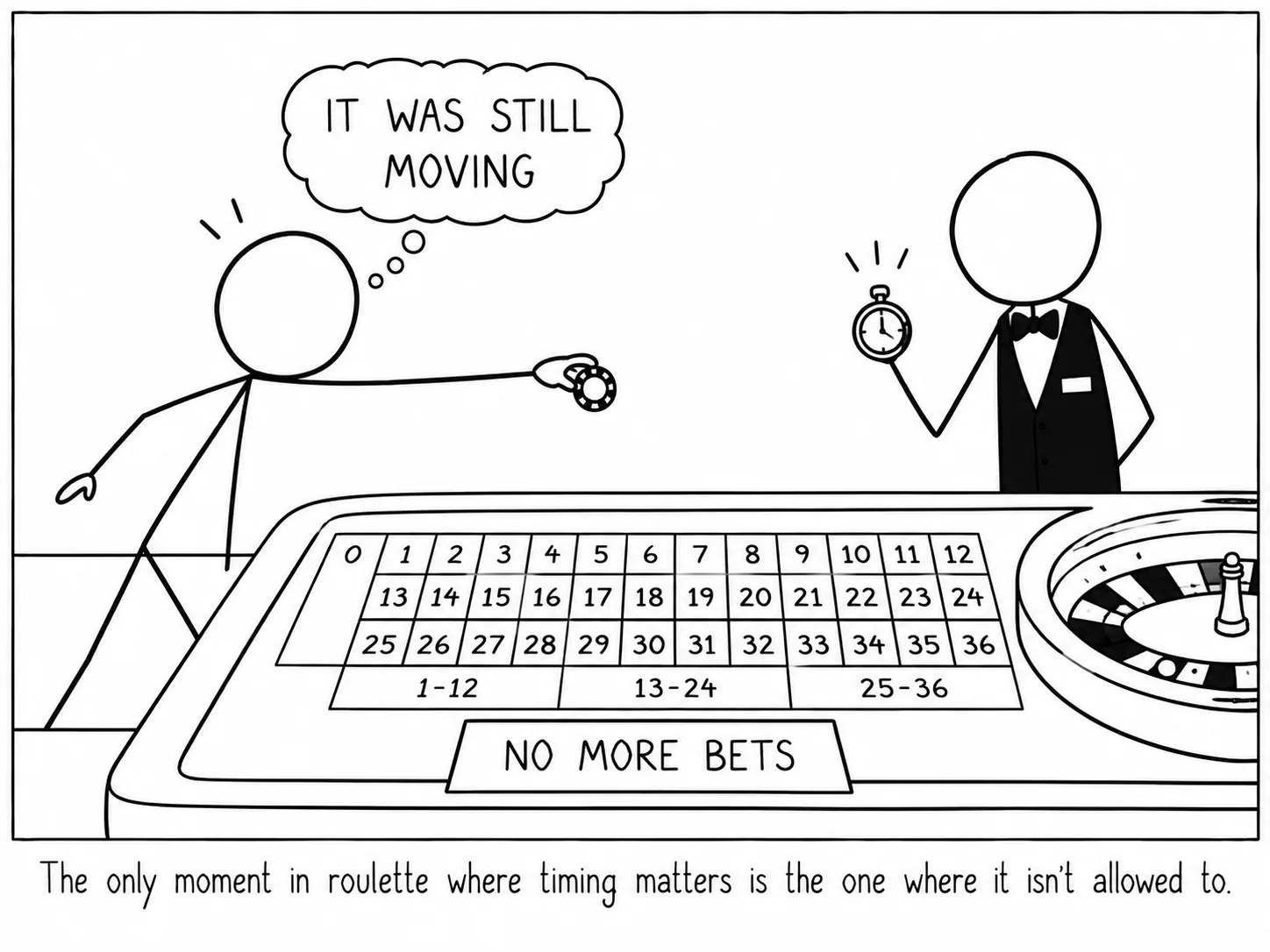
The only moment in roulette where timing matters is the one where it isn’t allowed to.
Sources
- UK Gambling Commission. Remote gambling and software technical standards.
- Malta Gaming Authority. Gaming Devices Regulations and technical directives.