Oscar’s Grind
Raise the stake by one unit after a win, hold it after a loss, and stop each cycle at +1 unit.
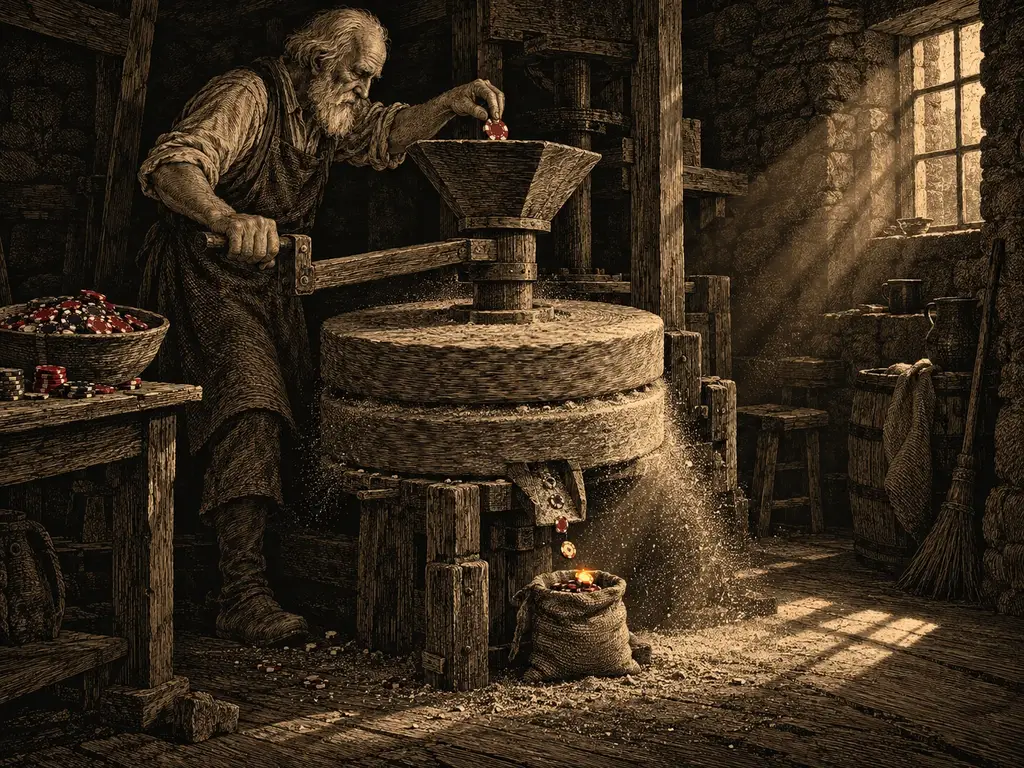
It does not beat the wheel. Oscar’s Grind aims to win one unit per cycle with slow, controlled stakes. Cycles are long, drawdownsmoneyDrawdownThe fall from a bankroll peak to a later low within a session. Maximum drawdown is the largest such fall.Read full → are moderate, and the expected loss per unit wagered is 2.70%, as for every progression.
Walk the system
A loss keeps the stake. A win adds one unit, but never more than the cycle needs to reach +1. At +1 a new cycle starts.
Stakes and results are in units of the base bet.
How does Oscar’s Grind work?
Start a cycle at one unitmoneyUnitThe base stake a system or a player works in. Progressions are described in units so they apply at any table.Read full →. Lose, and bet the same again. Win, and raise the next bet by one unit, but never bet more than it takes to bring the cycle to exactly +1 unit. When the cycle reaches +1, start a new one at one unit. The name is honest: it grinds out one unit at a time. Allan Wilson described it in his Casino Gambler’s Guide in 1965, from a dice player he knew only as Oscar.
What does a cycle look like?
L L L W W W: stakes 1, 1, 1, 1, 2, 1. After −3 + 1 + 2 = 0 the rule caps the last bet at what is needed, 1 (not 3), to reach +1. Results −1 −1 −1 +1 +2 +1 = +1. Cycle complete after six spins with three wins and three losses.
What does a session look like?
Stakes rise only after wins, so a losing run does not escalate the stake. Cycles in losing stretches simply get long: a cycle that falls to −8 needs several wins at rising stakes to climb out, and the stakes never explode. The result is a session that looks like flat bettingstrategyFlat bettingWagering the same amount every spin. The baseline every progression is compared against.Read full → with a slight upward drift in stake and occasional long grinding cycles, hence the name.
- p10 −$500
- p25 −$500
- median −$500
- p75 −$500
- p90 −$500
Does Oscar’s Grind work?
No. Each bet loses 1/37 of its stake on average, so a cycle loses 1/37 of everything wagered in it. Because stakes stay low in losing runs, the turnovermoneyTurnoverThe total amount wagered over a session or period, counting re-bet winnings. Also: handle, action.Read full → per spin is only modestly above flat betting, and the expected lossmathExpected lossExpected value times total amount wagered; the average amount lost over a session or a period.Read full → per session is correspondingly a little above flat. Of the common progressionsstrategyProgressionAny rule that changes the stake based on previous results. Negative progressions raise it after losses, positive after wins.Read full → it is the one closest to flat betting in cost, which is faint praise and accurate.
Who chooses it, and why?
Players who want a structure, dislike cliffs and are content with +1 unit per cycle. It will not produce the MartingalestrategyMartingaleProgression that doubles the bet after each loss. See the Strategy section for what it does and does not do.Read full → feeling of winning most sessions, because long cycles often do not complete within a session. It will also not produce the Martingale cliff.
Simulator · Oscar’s Grind
2,000 sessions of even-money bets from a $1,000 bankroll.
Base bet $10 · table limit $500 · 100 spins per session
Questions
Far safer in the sense of no catastrophic single loss. The expected loss per dollar is the same.
In principle. In practice a long losing cycle is ended by your stop rule or your bankrollmoneyBankrollThe total amount set aside for play. Bankroll management is deciding how much of it to risk per bet and per session.Read full →.
A dice player described by Allan Wilson in 1965. Nothing more is known.
Comic relief
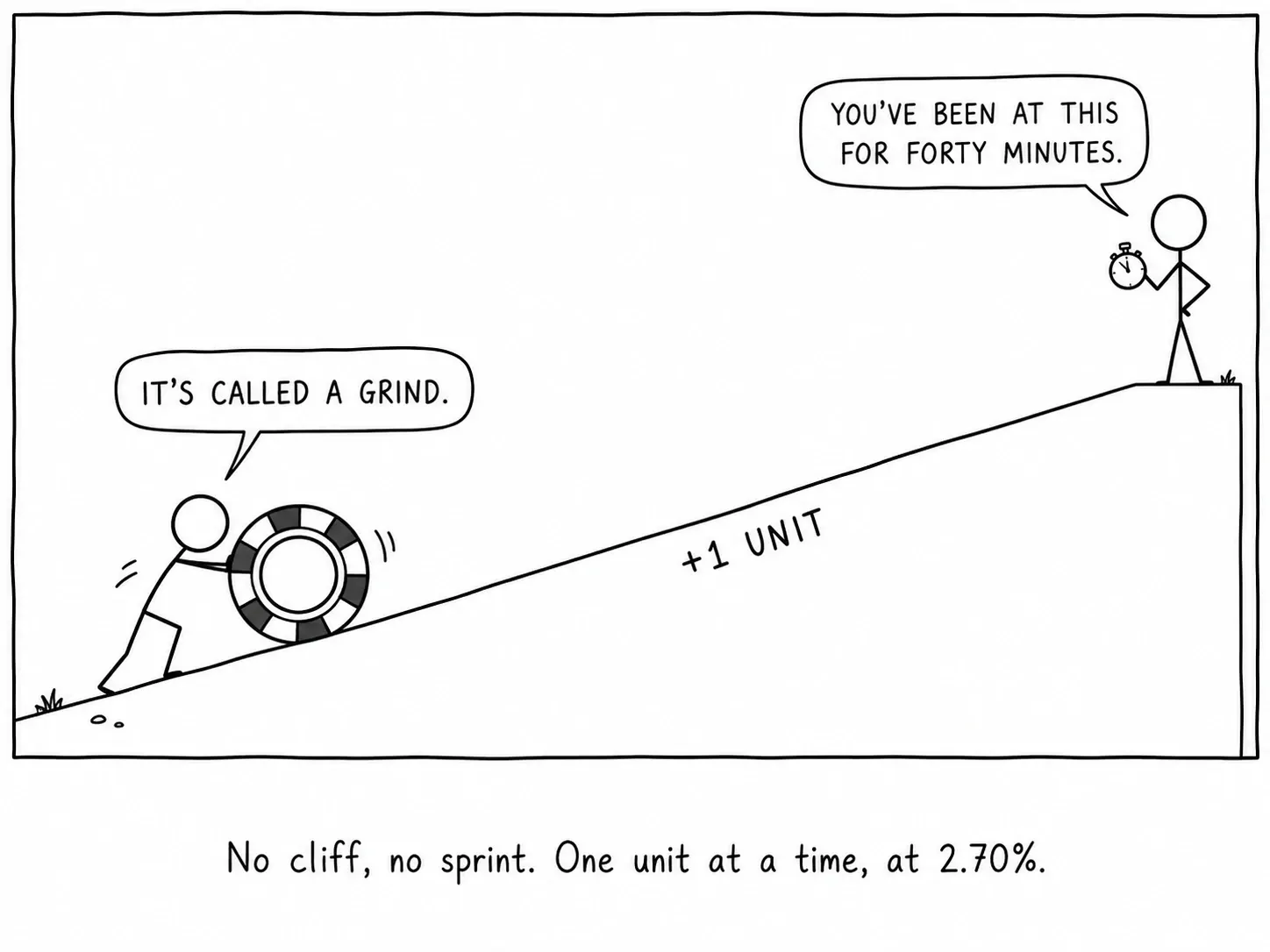
No cliff, no sprint. One unit at a time, at 2.70%.
Sources
- Ethier, S. N. The Doctrine of Chances: Probabilistic Aspects of Gambling.
- Epstein, R. A. The Theory of Gambling and Statistical Logic, 2nd ed.