Myth: Systems Beat the Wheel
“I have a system that wins 80% of the time.” You might. It still loses money.

A system can make winning sessions common. It cannot make the expected value positive, because every bet it places is −1/37 of its stake and expected values add. The systems that win most often lose most when they lose.
The claim
A system of varying stakes based on past results turns roulette into a winning game. Evidence offered: a run of winning sessions, a video, a testimonial, a spreadsheet of a lucky week. The claim is usually honest; the person believes it because it has been working.
Why it is wrong, in one line
Expected valuesmathExpected valueThe average result per bet over the long run. −1/37 of the stake for every standard European bet.Read full → add. If each bet has EV = −1/37 of its stake, any sequence of bets has EV = −1/37 of the total staked, whatever rule chose the stakes. A system is a rule for choosing stakes. Therefore every system has EV = −1/37 of turnovermoneyTurnoverThe total amount wagered over a session or period, counting re-bet winnings. Also: handle, action.Read full →. This is a theorem (Doob and Halmos proved it in the 1930s; Thorp 1969 states the conditions), and it does not have exceptions for clever rules. The one condition worth knowing is a minimum bet: Thorp’s example bets $1,000 on redbetRedEven-money bet on the 18 red numbers. French: rouge.Read full →, then 90 cents, then 9 cents and so on, shrinking forever. With chance 18/37 the first bet wins and the player stays ahead for good, though the expected result is still −1/37 of everything staked. A real table’s minimum stops that, and with it every hope of staying ahead in the long run.
Why it seems to work
Negative progressionsstrategyProgressionAny rule that changes the stake based on previous results. Negative progressions raise it after losses, positive after wins.Read full → make winning sessions common. MartingalestrategyMartingaleProgression that doubles the bet after each loss. See the Strategy section for what it does and does not do.Read full → from $10 at a $500 limit ends about 80% of 100-spin sessions ahead by a few unitsmoneyUnitThe base stake a system or a player works in. Progressions are described in units so they apply at any table.Read full →. A player who runs it for twenty sessions wins sixteen of them and remembers that. The four losing sessions each lose more than ten winning sessions make, and the arithmetic over twenty sessions is negative. The system has not changed the mean; it has moved the losses into fewer, larger sessions where they are easier to call bad luck.
The test anyone can run
The Strategy Simulator on this site runs 10,000 sessions of any system, or your own code, in a second. Set it to the system you believe in and read the mean. If the mean were positive for any setting, this page would say so. Every setting, every system, every table limittableTable limitMinimum and maximum bet allowed. The maximum is what stops doubling progressions.Read full → gives a mean of −2.70% of turnover plus noise. Testimonials are samples of one; the simulator is samples of ten thousand.
A system that cannot lose
In 1997 the poker writer Mike Caro posted a roulette system as a joke, and Gambling Times republished it in 2001. It is a list of bets to avoid: never red or blackbetBlackEven-money bet on the 18 black numbers. French: noir.Read full →, odd or even, or the zeroswheelZeroThe single green pocket that no even-money, dozen or column bet covers; the source of the house edge. Also: single zero, 0.Read full →; no odd red numbers and no even black ones; and nothing on 30, or on the long run of pocketsequipmentPocketOne of the 37 numbered compartments on the rotor. Also: slot, cup.Read full → from 11 clockwise round to 14 on the American wheel. Put the rules together and no number is left. The only pockets outside that run are 0, 28, 9, 26, 30 and 2; 30 is banned by name, and the rest are a zero, even and black, or odd and red. A player who follows the system never bets and never loses. Its edge is zero, and it is the only roulette system honest about how it gets there.
Named systems, one line each
Systems sold under a name are no different. Each is a set of bets, and each bet pays the wheel its 2.70%. Bollman (2024) works through several for an American wheel, where every one costs 5.26%; here they are on a European one.
The honest version
Systems change the shape of a session: how often you win, how big the wins are, how bad the worst case is. Those are real choices and a player may prefer one shape to another. What systems do not change is the price, which is 2.70% of everything wagered, and because progressions wager more than flat bettingstrategyFlat bettingWagering the same amount every spin. The baseline every progression is compared against.Read full →, they pay more of it.
Questions
Six months of weekly sessions is about 25 sessions. Martingale wins 80% of those. The losing sessions are coming, and they are larger.
The stop rule reduces turnover and so reduces expected lossmathExpected lossExpected value times total amount wagered; the average amount lost over a session or a period.Read full →. It does not make it positive.
Not on a fair wheel. On a biased wheellabBiased wheelA wheel whose physical defects make some pockets more likely than 1/37. Rare, detectable only with thousands of recorded spins.Read full →, which is a physics problem, not a system.
Fun with Math
Try these yourself first. Each solution is folded; open it when you are ready.
Mike Caro’s 1997 joke system for the American wheel bans redbetRedEven-money bet on the 18 red numbers. French: rouge.Read full → and blackbetBlackEven-money bet on the 18 black numbers. French: noir.Read full →, odd and even, and the zeroswheelZeroThe single green pocket that no even-money, dozen or column bet covers; the source of the house edge. Also: single zero, 0.Read full →; odd red numbers and even black ones; the number 30; and every pocketequipmentPocketOne of the 37 numbered compartments on the rotor. Also: slot, cup.Read full → in the run from 11 clockwise round to 14. Apply the rules one at a time. Which numbers are left to bet?
Show the solution
Answer None. The system never bets, so its edge is exactly zero.
Banning red, black, odd, even and the zeros leaves single numbers and small groups among 1 to 36.
No odd reds and no even blacks leaves the even reds (12, 14, 16, 18, 30, 32, 34, 36) and the odd blacks (11, 13, 15, 17, 29, 31, 33, 35): sixteen numbers. Banning 30 leaves fifteen.
On the American wheel the run from 11 clockwise to 14 covers 32 of the 38 pockets. The six outside it are 0, 28, 9, 26, 30 and 2. All fifteen survivors are inside the run, so the last rule removes them too. A system that never bets is the only one that never loses, which was Caro’s point.
Kryptos runs three MartingalesstrategyMartingaleProgression that doubles the bet after each loss. See the Strategy section for what it does and does not do.Read full → at once, one on each pair of even-money betsbetEven-money betRed/black, odd/even, high/low. 18 numbers, pays 1:1.Read full → (high or low, odd or even, red or black), with stakes 1, 2, 4, 8, 16, 32 and a stop after six losses. Take one of the three on a European wheel. How often does it lose all six bets, what does one cycle earn on average, and what share of the money staked is that?
Show the solution
Answer It loses all six about once in 55 cycles, 1.83% of the time, and that costs 63 unitsmoneyUnitThe base stake a system or a player works in. Progressions are described in units so they apply at any table.Read full →. On average a cycle loses about 0.17 units out of 6.42 units staked: 2.70%, the price of every bet on the wheel.
A bet loses with chance 19/37, the zero included. Six in a row: (19/37)⁶ = 0.0183, about 1 in 55, and then the stakes 1 + 2 + 4 + 8 + 16 + 32 = 63 are gone. Otherwise the cycle ends with a win and +1 unit.
Average: 1 × (1 − 0.0183) − 63 × 0.0183 = 1 − 64 × 0.0183 = −0.17 units.
Money staked: the first bet is always placed, the second only after a loss, and so on: 1 + 2 × (19/37) + 4 × (19/37)² + … + 32 × (19/37)⁵ = 6.42 units. And −0.17/6.42 = −2.70%.
The six recorded spins only decide which side each bet is on, and the wheel cannot know them. Running all three triples the money staked and the average loss with it. Bollman (2024) works the system on an American wheel, where each of them loses six in a row 2.1% of the time.
Comic relief
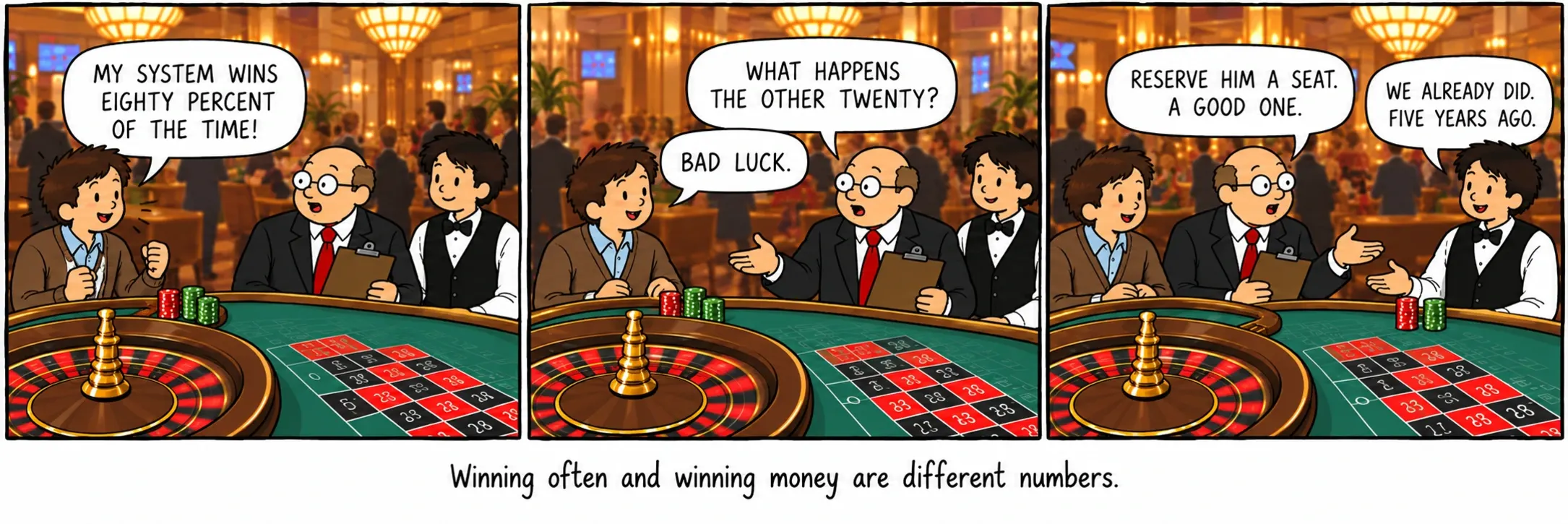
Winning often and winning money are different numbers.
Sources
- Thorp, E. O. “Optimal gambling systems for favorable games.”
- Thorp, E. O. The Mathematics of Gambling.
- Doob, J. L. “Note on probability.”
- Halmos, P. R. “Invariants of certain stochastic transformations: the mathematical theory of gambling systems.”
- Ethier, S. N. The Doctrine of Chances: Probabilistic Aspects of Gambling.
- Bollman, M. Mathematics of the Big Four Casino Table Games: Blackjack, Baccarat, Craps, & Roulette.
- Bollman, M. Basic Gambling Mathematics: The Numbers Behind the Neon, 2nd ed.