High / Low
1–18 (low, manque) or 19–36 (high, passe).
Pays 1:1, probabilitymathProbabilityChance of an outcome, from 0 to 1 or 0% to 100%. One number: 1/37 = 2.70%.Read full → 48.65%.
Placement
The “1–18” and “19–36” boxes at the two ends of the outside row. On a French layoutequipmentLayoutThe printed betting grid on the table. Also: table, felt, cloth.Read full → they read manque (“missing”: the ballequipmentBallThe small ball launched along the track against the rotor. Modern balls are ivorine or Teflon, 18–21 mm.Read full → failed to pass 18) and passe (“passes”: it did). Each must meet the table minimum.
Payout and expectation
Identical to redbetRedEven-money bet on the 18 red numbers. French: rouge.Read full →/blackbetBlackEven-money bet on the 18 black numbers. French: noir.Read full → and odd/even: fair odds 1.056 to 1, table pays 1, edge 2.70%, or 1.35% with la partageruleLa partageFrench rule: when zero hits, half of an even-money stake is returned. Halves the house edge on those bets to 1.35%.Read full →.
On the wheel
High and low numbers alternate around the rim almost perfectly, so this bet covers no sectorwheelSectorA contiguous arc of pockets on the wheel, as distinct from a group on the layout.Read full →; it is purely a layout grouping. Looking at the sequence from zerowheelZeroThe single green pocket that no even-money, dozen or column bet covers; the source of the house edge. Also: single zero, 0.Read full →: 32 (high), 15 (low), 19 (high), 4 (low), 21 (high), 2 (low) and so on.
Over 37 spins
At $10 a spin, a bet on 19–36 wins 18 times in 37 average spins (+$180), loses to the eighteen low numbers (−$180) and loses to zero once (−$10): −$10 on $370 staked. On a double-zero wheel the two zeros cost $20 on $380, 5.26%. Zero is lower than 1 and still loses for the low bet: the box says 1–18.
Combinations
High plus the third dozenbetDozen1–12, 13–24 or 25–36, pays 2:1.Read full → overlaps on all twelve of 25–36, so it is a weighted bet on 19–36 with the top dozen double-covered. Low plus red overlaps on nine numbers. None of these combinations changes the expected valuemathExpected valueThe average result per bet over the long run. −1/37 of the stake for every standard European bet.Read full →; each component is 2.70% on its own.
What is in each half
Each half holds nine red and nine black numbers, and nine odd and nine even. The red numbers are 1, 3, 5, 7, 9, 12, 14, 16 and 18 in the low half and 19, 21, 23, 25, 27, 30, 32, 34 and 36 in the high half. Low is the first dozen and half of the second; high is the other half of the second and the third. No smaller bet covers 1–18 more cheaply: a dozen pays 2 to 1 on twelve numbers, a six linebetSix lineSix numbers in two adjacent rows, pays 5:1. French: sixain.Read full → 5 to 1 on six, and each costs the same 2.70%.
French rules
With la partage, half of a manque or passe bet comes back when zero is spun, and the cost falls to 1.35%. With en prisonruleEn prisonFrench rule: when zero hits, an even-money bet is held for the next spin instead of lost. Halves the house edge on those bets.Read full → the bet is held for one more spin instead: if it wins it is returned without winnings, and if it loses it is taken.
Questions
The ball fell short, “missed” passing 18. Passe means it went past.
No. Every spin is 18/37 for either half.
Comic relief
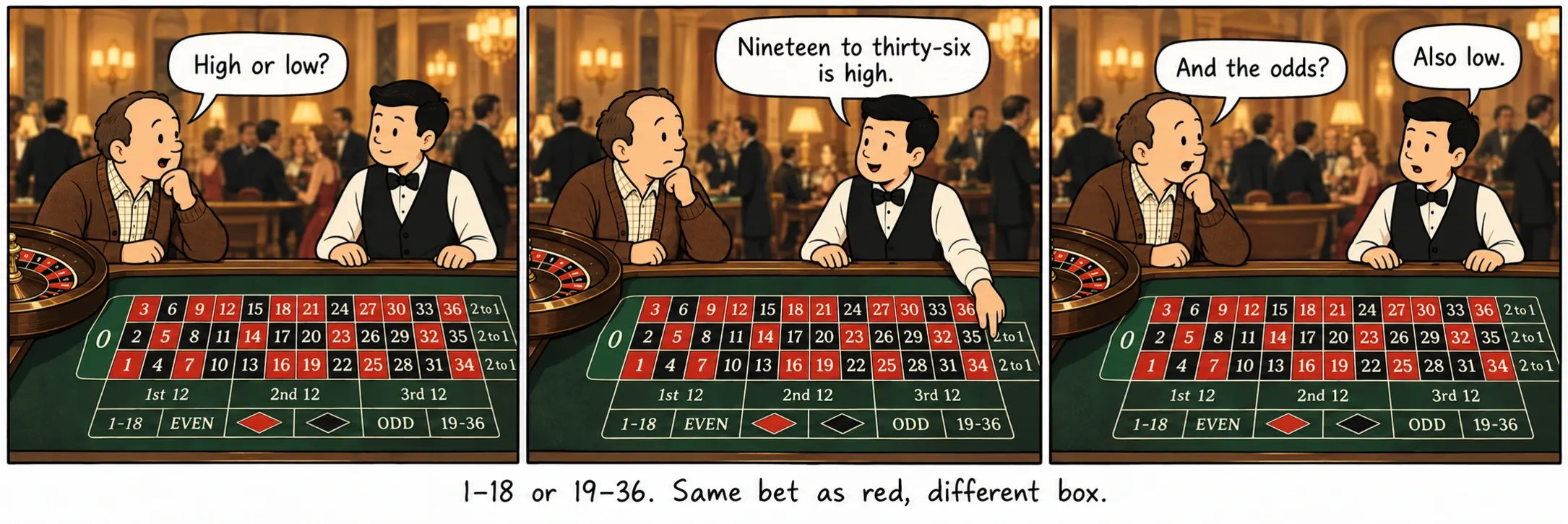
1–18 or 19–36. Same bet as red, different box.
Sources
- Ethier, S. N. The Doctrine of Chances: Probabilistic Aspects of Gambling.