Roulette Online PRO
Extras · Reading list · 8 min

Roulette Reading List

Twenty-two books and papers, from a 1657 treatise on expectation to a 2025 textbook, with a sentence on why each matters.
Short answer

The mathematics (Huygens, Bernoulli, Halmos, Feller, Thorp, Epstein, Ethier, and the recent textbooks of Bollman, Taylor and Hunacek), the history (Lablée, Barnhart, Schwartz, Kavanagh, Marcus, Goldman), the physics (Bass, Small & Tse) and the one novel that is better than all of them (Dostoevsky). Everything on this site rests on this shelf.

oldest
Huygens, 1657
newest
Hunacek, 2025
best single book
Ethier, 2010
best novel
The Gambler, 1866

Mathematics

workyearwhy read it
Huygens, De Ratiociniis in Ludo Aleae1657the first printed treatment of expectation; where EV comes from
Bernoulli, Ars Conjectandi1713the law of large numbers, which systems misunderstand
Halmos, “Invariants of certain stochastic transformations”1939the first general proof that no betting system changes the expected result
Feller, An Introduction to Probability Theory, vol. 11968gambler’s ruin, random walks, streaks; the standard reference
Thorp, “Optimal gambling systems for favorable games”1969when betting systems can help (only in a favorable game) and the conditions behind the no-system result
Thorp, The Mathematics of Gambling1984the roulette computer told by its inventor, with the arithmetic of how much to bet on an edge
Epstein, The Theory of Gambling and Statistical Logic2013 (2nd ed.)every casino game analyzed; roulette in context
Ethier, The Doctrine of Chances2010the most complete mathematical treatment of roulette in print
Bollman, Mathematics of the Big Four Casino Table Games2021side bets, unusual wheels and card roulette priced one by one, with exercises
Taylor, Games, Gambling, and Probability2021 (2nd ed.)streaks, Kelly betting and gambler’s ruin worked as a course
Bollman, Basic Gambling Mathematics2024 (2nd ed.)casino promotions and rebates, and how fast a results board pays for itself for the casino
Hunacek, Quantitative Literacy Through Games and Gambling2025a gentle first course; check its claim that every bet has the same expected value, which the five-number bet breaks

History

workyearwhy read it
Lablée, La Roulette, ou le Jour1801the first full description of the game, in a novel
Barnhart, Beating the Wheel1983the bias-play history: Jagger, the Pelayos’ predecessors, methods
Schwartz, Roll the Bones2006gambling’s general history; roulette’s place in it
Kavanagh, Dice, Cards, Wheels2005French gambling culture; the Palais-Royal and the spas
Marcus, American Roulette2003past-posting described from the inside by its best-known practitioner
Goldman, Great Gambling Scams2007Leigh in Nice, Marcus and the Ritz retold; lively, and wrong on several facts (see Cheating at Roulette)

Physics and advantage play

workyearwhy read it
Bass, The Eudaemonic Pie1985the shoe-computer story; the best popular book on roulette physics
Small & Tse, “Predicting the outcome of roulette”2012the physics of prediction, measured; what an edge requires
Pearson, “On the criterion…”1900the chi-square test, demonstrated on roulette spins

Roulette Wheel Physics

The novel

Dostoevsky, The Gambler (1866). Written in 26 days to meet a publisher’s contract deadline, by an author deep in debt from roulette; the gambler’s fallacy, the system, the compulsion and the spa casino from the inside. Shorter than any book above and truer than most.

Bad Homburg and the Spa CasinosDostoevsky’s Roulettenburg

How to use the list

For the arithmetic, Ethier and then Feller. For the stories, Barnhart and Bass. For why people play anyway, Dostoevsky. For the proof that ends every system argument, Halmos, and for the same result in plain words, Thorp’s 1984 book. For exercises, Taylor or Bollman. The Sources box on each article on this site cites from this shelf.

Questions

Is there a good book on systems?

Not one that sells a system. Thorp’s 1984 book has a short chapter on why they fail; Epstein and Ethier cover the shape of each one.

Where can I read Pearson or Huygens?

Both are out of copyright and online. Pearson is dense; Huygens is short and surprisingly readable in translation.

Comic relief
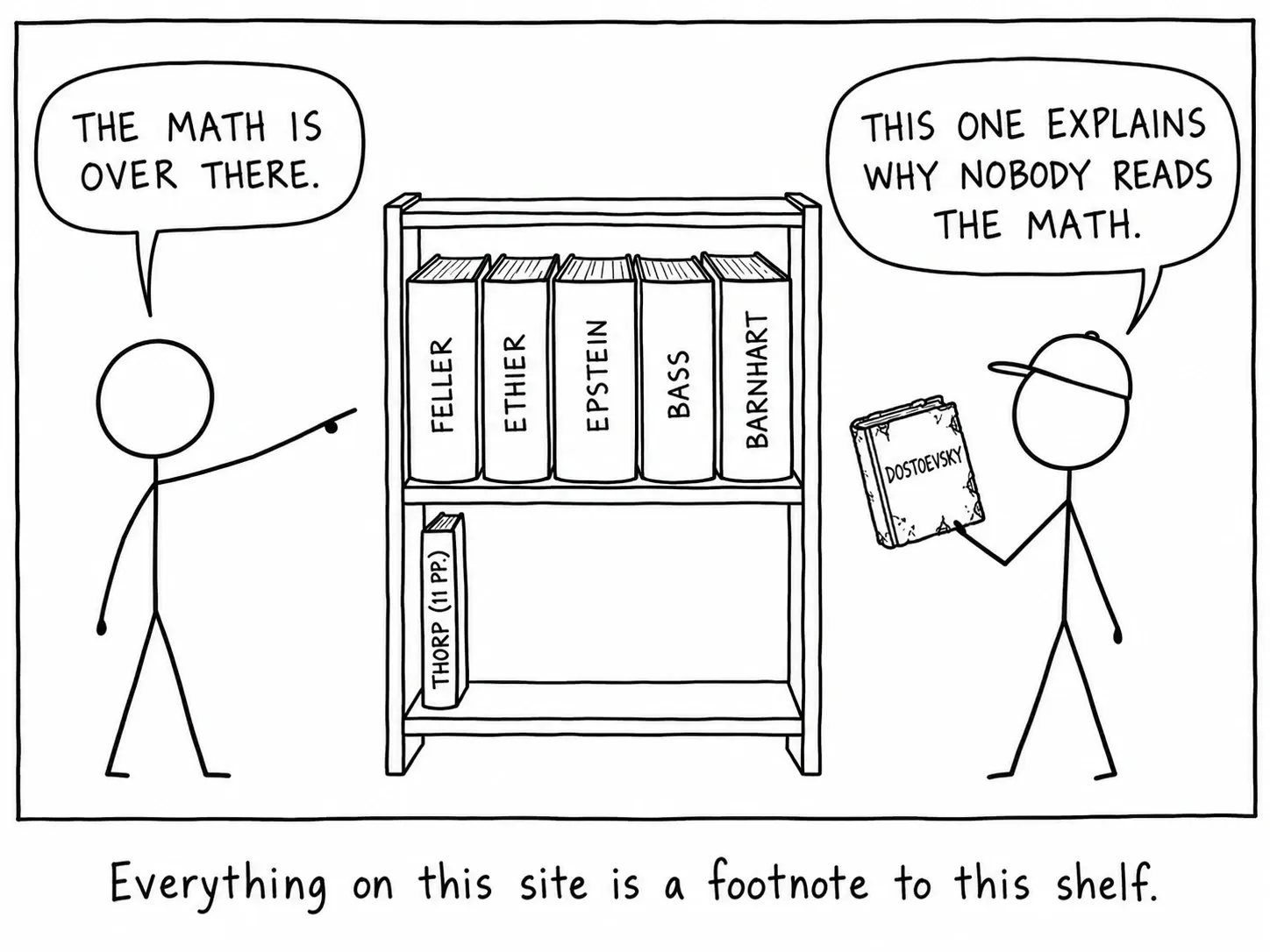
Everything on this site is a footnote to this shelf.

Everything on this site is a footnote to this shelf.

Sources

  1. Ethier, S. N. The Doctrine of Chances: Probabilistic Aspects of Gambling. Springer, 2010. Chapter 13, roulette.
  2. Feller, W. An Introduction to Probability Theory and Its Applications, Vol. 1. Wiley, 3rd ed., 1968. Gambler’s ruin, chapter XIV.
  3. Halmos, P. R. “Invariants of certain stochastic transformations: the mathematical theory of gambling systems.” Duke Mathematical Journal 5(2), 1939.
  4. Thorp, E. O. “Optimal gambling systems for favorable games.” Review of the International Statistical Institute 37(3), 1969.
  5. Thorp, E. O. The Mathematics of Gambling. Gambling Times / Lyle Stuart, 1984.
  6. Bass, T. A. The Eudaemonic Pie. Houghton Mifflin, 1985.
  7. Barnhart, R. T. Beating the Wheel. Lyle Stuart, 1983.
  8. Bollman, M. Mathematics of the Big Four Casino Table Games: Blackjack, Baccarat, Craps, & Roulette. CRC Press, 2021. Chapter 2, roulette.
  9. Bollman, M. Basic Gambling Mathematics: The Numbers Behind the Neon, 2nd ed. CRC Press, 2024.
  10. Taylor, D. G. Games, Gambling, and Probability: An Introduction to Mathematics, 2nd ed. CRC Press, 2021.
  11. Hunacek, M. Quantitative Literacy Through Games and Gambling. Chapman & Hall/CRC, 2025.
  12. Marcus, R. American Roulette: How I Turned the Odds Upside Down. St. Martin’s Press, 2003.
  13. Goldman, N. Great Gambling Scams. John Blake, 2007.
reviewed 2026-09-28model: European, single zeromethodology ↗sources ↗