Joseph Jagger
A Yorkshire textile man, wheels that favored some numbers, and a story first printed twenty years late.
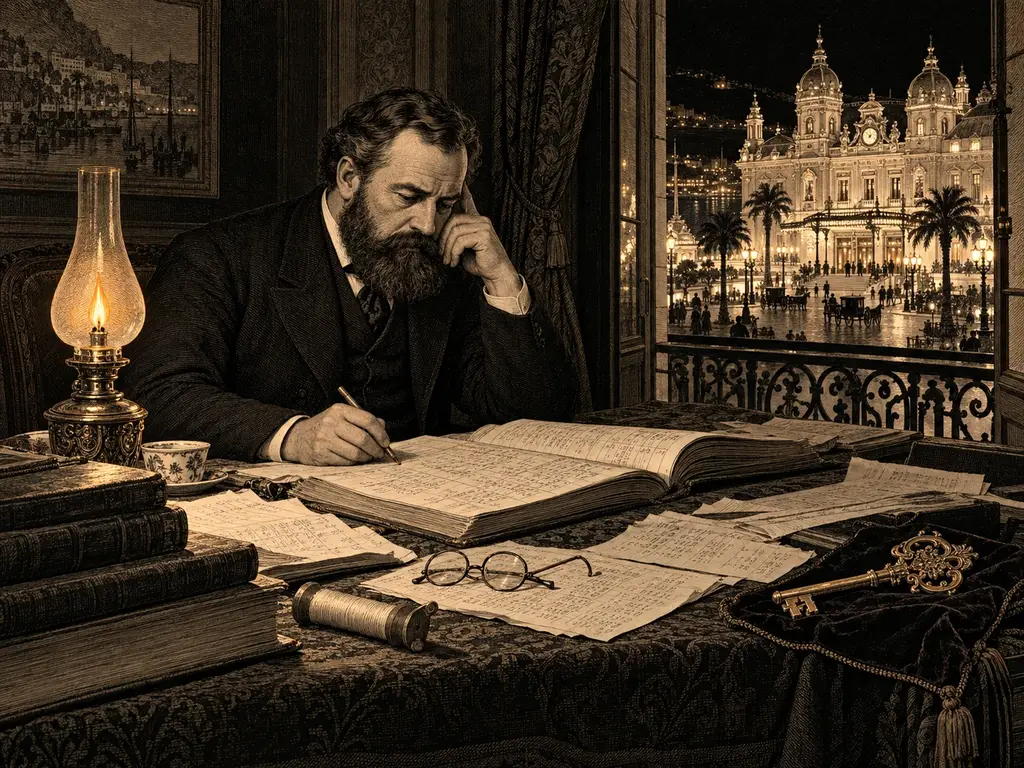
Joseph Hobson Jagger (1830–1892), a textile businessman from near Bradford, is said to have won about £80,000 at Monte Carlo around 1880 by having the wheels recorded and betting the numbers that came up too often. No newspaper or casino record of the win survives. The story rests on a book of 1901, on family tradition and on a presentation key dated 1884.
What the records show
Joseph Hobson Jagger was born on 2 September 1830 at Shelf, between Bradford and Halifax. He married Matilda Townend at twenty and they had four children. He worked in the cloth trade all his life: as a warehouseman, as a partner in a works that sized warp yarn, as a cloth finisher in Manchester. The 1861 census calls him a cotton and stuff agent and his will of 1881 a manufacturer. No document calls him an engineer. That word, and “mechanic”, come from the books about Monte Carlo.
In April 1860 his Manchester business failed, and the London Gazette listed him among the insolvent debtors to be heard at Lancaster Castle. His youngest child was two. His biographer Anne Fletcher, his great-great-great-niece and a heritage historian, found the notices and found the family still paying off debts fifteen years later. She found no bankruptcy in 1880 or 1881, although several newspapers have since put one there.
The story as first printed
The earliest account is Victor Bethell’s Monte Carlo Anecdotes and Systems of Play (1901). Bethell calls him “Jaggers”, a Yorkshireman and a mechanic by trade, and gives no first name and no year. In his telling Jaggers hired six clerks, sat them at different tables to write down every number all day, and after a month had found a weak spot in every wheel. He and his men won £120,000. The casino began to move the wheels from table to table each night, and Jaggers told them apart by small marks, a scratch or a speck in the paint. He lost £40,000 of the winnings and left with about £80,000, which at the 25 francs to the pound of the time is two million francs. Bethell’s only date is that all this happened “over twenty years ago”.
Bethell was writing two decades after the event and names no witness. Fletcher searched the local, national and foreign press and found no report of the win, and when her father wrote to the casino he was told that its papers for the period had been destroyed.
How the story grew
Each later writer added something, and the additions are what most people know.
When he was there
Fletcher dates the first visit to 1880 or 1881 from four pieces of evidence. Jagger is missing from his own household in the census of April 1881, where his wife is entered as its head. A deed of August 1881 names him at 6 Greaves Street, Bradford, a house he bought that year, and in October he made the will of a man with assets. The fourth is the one object that survives, a commemorative key in a presentation box, kept in the family. Its inscription, from his “friends and admirers”, speaks of his success at roulette against the bank at Monte Carlo “extending over a period of four years”, and is dated 1 May 1884.
Fletcher reads this as several stays between about 1880 and 1884, not one week. How long he watched, and how long he played, is not recorded anywhere.
Who went with him
Bethell’s six clerks have no support, and Fletcher notes that the room had only four or five roulette tables at the time. One family tradition, written down by a friend who had seen letters since destroyed, is that his eldest son Alfred went with him. Fletcher adds a nephew, Oates Jagger, a railway engine driver, on the strength of his later unexplained wealth; that is her inference. Another branch of the family always said he went with his foreman. The money for the trip was borrowed from relatives, one of whom, a cousin, is named as having been repaid.
What the casino did
Here too Bethell is the first source. He says the casino began by changing the wheels about from table to table every night, and when that failed sent a man to the Paris firm that made them. The firm built a new set of wheels with movable partitions, so that a pocketequipmentPocketOne of the 37 numbered compartments on the rotor. Also: slot, cup.Read full → that stood opposite the zerowheelZeroThe single green pocket that no even-money, dozen or column bet covers; the source of the house edge. Also: single zero, 0.Read full → one day could stand somewhere else the next. Polovtsoff, who presided over the International Sporting Club at Monte Carlo in the 1930s, says the same: new wheels with interchangeable parts, shuffled daily. The old wheels were replaced, not repaired.
A morning check of every wheel with a spirit level is well attested. Adolphe Smith watched it around 1912, and Polovtsoff describes it in 1937. Neither says it began with Jagger, and no casino document ties any of these measures to him.
How big a bias has to be
A straight upbetStraight upA single number, pays 35:1.Read full → pays 35 to 1, so a number has to win more often than once in 36 spins before a bet on it earns anything. On a fair single-zero wheel it wins once in 37.
Suppose the clerks had recorded one wheel for a month at 500 spins a day: 15,000 spins. A fair number would come up about 405 times, give or take 20. A number that came up 465 times would be three of those “give or takes” ahead, which luck alone almost never produces. Such a number wins about once in 32 spins, and a bet on it earns 11.6%: 36 chipsmoneyChipA token representing a fixed amount, placed on the layout to make a bet. Also: check.Read full → back for every 32.3 staked. A month of patient counting is enough to find a fault of that size, and too little to find one much smaller. The 500 spins a day is an assumption for the sum; nobody recorded how fast those tables ran.
Afterwards
Jagger did not buy a mansion. In 1881 he bought 6 Greaves Street in Little Horton, Bradford, and over the next ten years or so, by Fletcher’s count, at least thirty-two terraced houses nearby, let for rent or lived in by relatives. She believes he gave about a third of the money to the two men who went with him. There is no sign that he ever made the win public. He died at 25 Greaves Street on 25 April 1892, aged 61; the death certificate gives diabetes. He is buried at Bethel Chapel in Shelf, near where he was born. The net value of his estate was £1,710.
The song
“The Man Who Broke the Bank at Monte Carlo” was first sung in 1892, the year Jagger died, and his family long believed it was about him. It was not. Fred Gilbert wrote it after Charles Wells’s run of 1891, which filled the newspapers (see The Man Who Broke the Bank). Charles Kingston made the same point in 1925: the honor went to the swindler who came after the Yorkshireman.
Questions
Probably he won a large sum: the family’s key of 1884, his sudden property buying and Bethell’s account all point that way. The sums, the six clerks and the nine numbers cannot be confirmed.
Fletcher says only that genealogists have suggested a distant link. No pedigree has been published.
His estate was £1,710 net. By then, on Fletcher’s account, the money had gone into houses and gifts to his family.
Comic relief
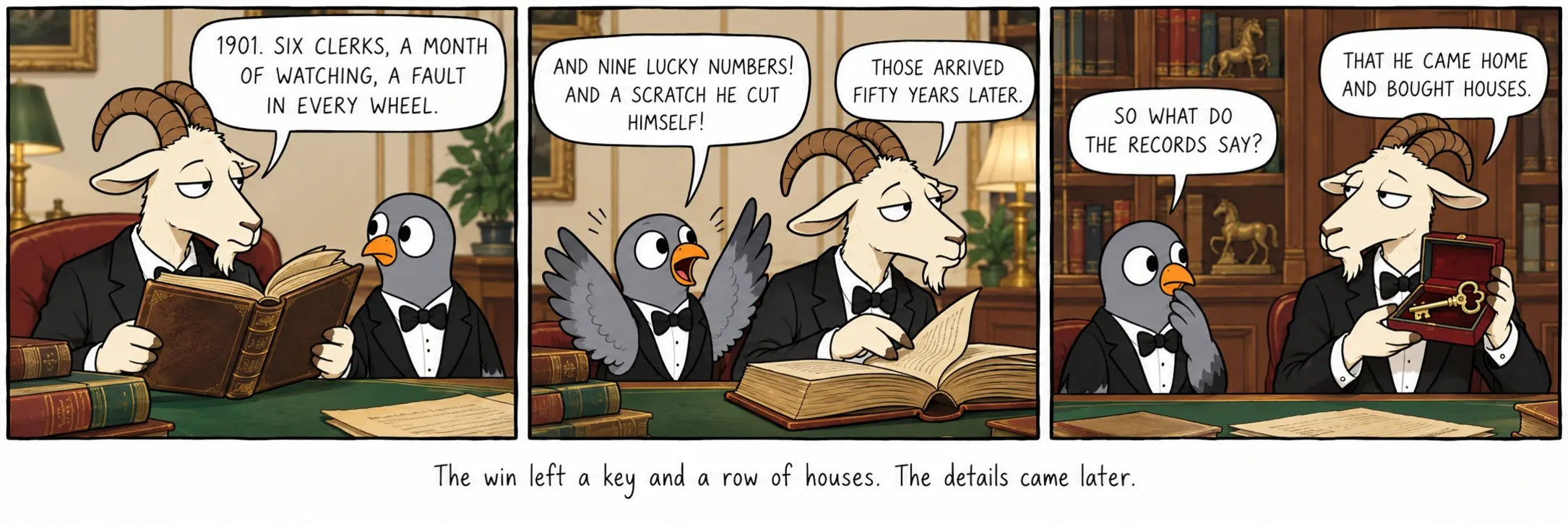
The win left a key and a row of houses. The details came later.
Sources
- Fletcher, A. From the Mill to Monte Carlo.
- Fletcher, A. “The true story of the man who broke the Monte Carlo bank: Joseph Hobson Jagger.”
- Bethell, V. Monte Carlo Anecdotes and Systems of Play.
- Kingston, C. The Romance of Monte Carlo.
- Polovtsoff, P. Monte Carlo Casino.
- Smith, A. Monaco and Monte Carlo.
- Quinn, R. The Man Who Broke the Bank at Monte Carlo.