Training to Deal Roulette
Six to twelve weeks of chip handling, mental arithmetic and procedure before the first live spin.
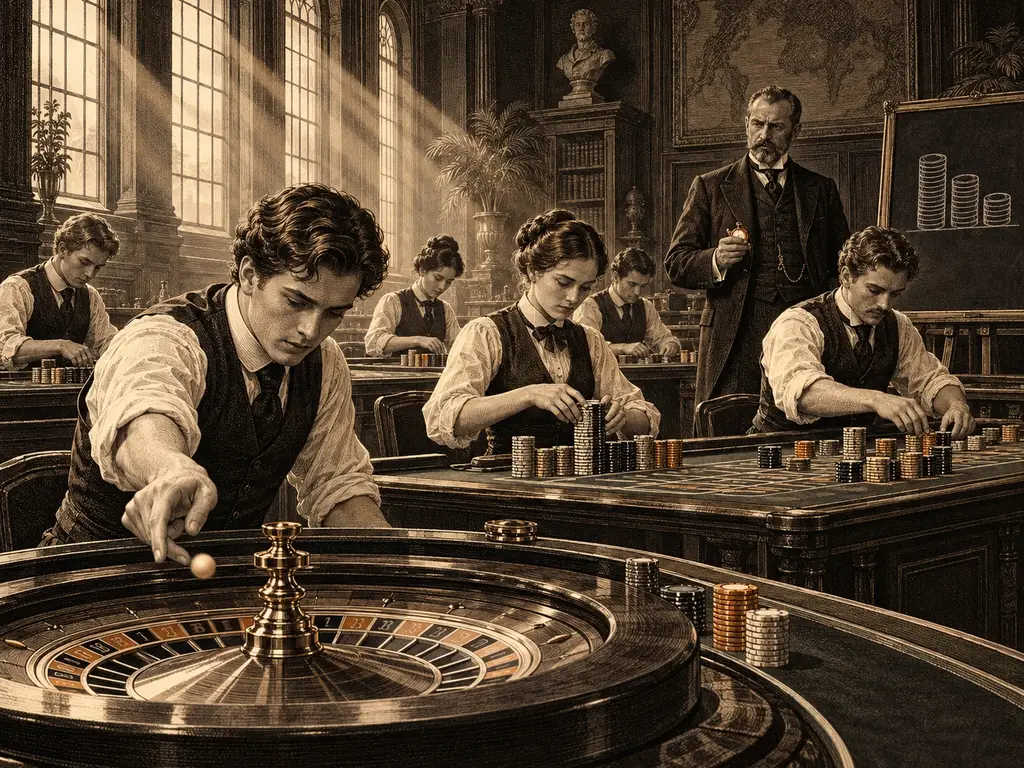
Dealer schools and casino academies teach roulette as a physical skill: cutting chips by sight, paying 35:1 without arithmetic, reading a layout of forty chips in two seconds, launching the ball to a minimum revolution count, and saying “no more bets” as if you mean it.
The school
Casinos run their own academies or hire from dealer schools, which teach roulette first because it is the most mechanical of the table games. Classes are small, days are long, and most of the time is spent with chipsmoneyChipA token representing a fixed amount, placed on the layout to make a bet. Also: check.Read full →, not with a wheel. In regulated markets a trainee also needs a personal license, which involves a background check and, in some places, a short exam on procedure and responsible gambling.
Chip handling
The first weeks are hands. Cutting a stack of twenty chips into fives by feel; “chipping up” a pile of mixed colors into stacks at speed; pushing a payoutmoneyPayoutWhat a winning bet returns, quoted as “X to 1” on top of the returned stake.Read full → across the felt without toppling it; picking up a winning bet’s neighborsbetNeighborsA number and the two pockets on either side of it on the wheel, five straight-up chips.Read full → without disturbing the winner. A dealer must pay a 35:1 straight upbetStraight upA single number, pays 35:1.Read full → on a $5 chip as a $175 stack without counting, which means knowing by sight what 35 chips look like and cutting them from a stack of 40. Trainees practice until their hands do it while they talk.
Payout patterns
Dealers do not multiply. They learn picture payouts: a 35:1 win on three chips is paid as a “picture” of stacks (five stacks of twenty plus one of five) that the eye recognizes. Complex layoutsequipmentLayoutThe printed betting grid on the table. Also: table, felt, cloth.Read full → with a winning number carrying a straight up, two splitsbetSplitTwo adjacent numbers, pays 17:1.Read full →, a cornerbetCornerFour numbers sharing a corner on the layout, pays 8:1.Read full → and a streetbetStreetThree numbers in a row of the layout, pays 11:1. French: transversale.Read full → are read as a pattern and paid as a sum of pictures. The math is done once, in training, and then stored in the hands.
The wheel
Launching the ballequipmentBallThe small ball launched along the track against the rotor. Modern balls are ivorine or Teflon, 18–21 mm.Read full → is taught last, because it is the easiest part. Trainees learn to spin the rotorequipmentRotorThe spinning part of the wheel that carries the pockets.Read full → to a house speed, launch from above the last winning number against the rotor, and achieve the minimum revolutions reliably. They are told, explicitly, to vary their launch, and why: the house does not want a dealer who is consistent, because consistency is what a dealer-signature player hopes for.
Chips: cutting, stacking, pushing, chipping up. Hours a day.
Payouts by picture. Reading layouts. Mock rounds with no wheel.
The wheel: rotor speed, launch, minimum revolutions, varying the release.
Full mock games with instructors as players. Disputes, late chips, drunk players, cheats.
Procedure and compliance: the sequence, the dolly, the camera, responsible gambling, licensing.
Audition on the floor or in the studio under supervision. Then a real table, with a pit boss watching.
Studio training
Live-dealer studios add camera awareness (where to stand, where to look, what the overhead camera must see), the touchscreen workflow (open, close, confirm result), chat etiquette in several languages, and the server’s timing: the dealer learns to say “no more betsprocedureNo more betsThe dealer’s call (or the on-screen prompt) that closes betting. Chips may no longer be placed, moved or removed.Read full →” when the screen says so, not when the ball says so. Studio dealers also train to deal for hours with no physical players, which is its own skill.
What they are told about the game
That the house edgemathHouse edgeThe share of each stake the casino keeps on average: 2.70% in European roulette.Read full → is 2.70%, that it does not depend on anything the dealer does, that systems do not work and that players will explain theirs anyway. Dealers are trained to decline strategy questions politely and to recognize signs of problem gambling, which in most regulated markets is a licensing requirement. The best dealers know more about roulette than the players and say less.
Questions
You need to learn the payout pictures. The arithmetic was done for you a century ago.
Competent at graduation; fast after a few months of real tables.
No. Training explicitly teaches variation in the launch, and the scatter does the rest.
Comic relief
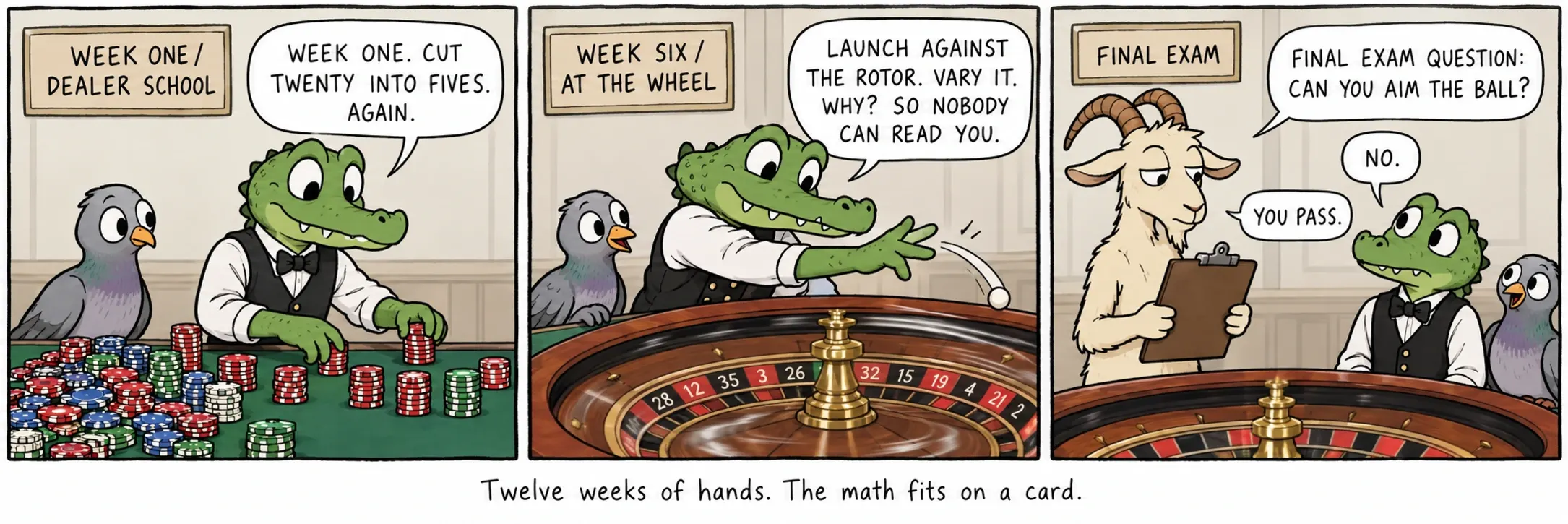
Twelve weeks of hands. The math fits on a card.
Sources
- UK Gambling Commission. Remote gambling and software technical standards.
- Wykes, A. The Complete Illustrated Guide to Gambling.