Red / Black
Eighteen numbers of one color. The reference even-money bet.
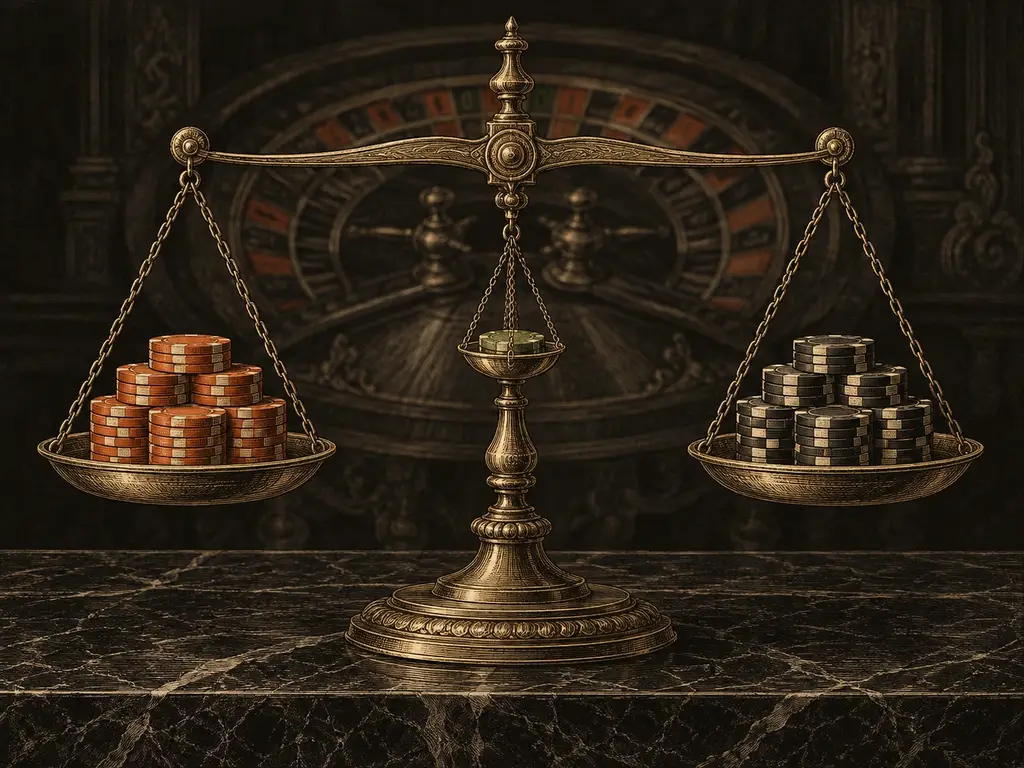
Eighteen numbers, pays 1:1. Probability 48.65%, not 50%: zero is the difference.
Placement
The redbetRedEven-money bet on the 18 red numbers. French: rouge.Read full → diamond and blackbetBlackEven-money bet on the 18 black numbers. French: noir.Read full → diamond boxes among the outside betsbetOutside betA bet on the boxes surrounding the grid: dozens, columns and even-money bets.Read full →, or the words rouge and noir on a French layoutequipmentLayoutThe printed betting grid on the table. Also: table, felt, cloth.Read full →. Each must meet the table minimum. Red numbers: 1 3 5 7 9 12 14 16 18 19 21 23 25 27 30 32 34 36. Black: the other eighteen. ZerowheelZeroThe single green pocket that no even-money, dozen or column bet covers; the source of the house edge. Also: single zero, 0.Read full → is green and belongs to neither.
Payout and expectation
Fair odds against 18 in 37 are 1.056 to 1; the table pays 1. A $10 red bet that hits returns $10. Over 37 average spins: 18 wins (+$180), 18 losses (−$180), one zero (−$10). Net −$10 on $370.
Streaks
Red and black alternate on the wheel but not in time. Ten reds in a row has probabilitymathProbabilityChance of an outcome, from 0 to 1 or 0% to 100%. One number: 1/37 = 2.70%.Read full → (18/37)¹⁰ = 0.074%, about once every 1,350 ten-spin windows; in a casino with twenty tables running 50 spins an hour it happens somewhere most days. None of it says anything about spin eleven, which is 18/37 red like every spin before it.
Why systems live here
Red/black is as close as the table comes to a coin flip, which makes it the natural base for progressionsstrategyProgressionAny rule that changes the stake based on previous results. Negative progressions raise it after losses, positive after wins.Read full →: MartingalestrategyMartingaleProgression that doubles the bet after each loss. See the Strategy section for what it does and does not do.Read full →, D’Alembert, FibonaccistrategyFibonacciProgression that follows the sequence 1, 1, 2, 3, 5, 8, 13…: one step forward after a loss, two steps back after a win.Read full →, LabouchèrestrategyLabouchèreCancellation system: write a line of numbers, bet the sum of the two ends, cross them off after a win, add the lost stake after a loss.Read full → and ParolistrategyParoliPositive progression: double after a win, reset after a loss or after three wins in a row. Also: reverse Martingale.Read full → all assume an even-money betbetEven-money betRed/black, odd/even, high/low. 18 numbers, pays 1:1.Read full →. Every one of them has an expected lossmathExpected lossExpected value times total amount wagered; the average amount lost over a session or a period.Read full → of 2.70% of total turnovermoneyTurnoverThe total amount wagered over a session or period, counting re-bet winnings. Also: handle, action.Read full → on this bet, 1.35% on a la partageruleLa partageFrench rule: when zero hits, half of an even-money stake is returned. Halves the house edge on those bets to 1.35%.Read full → table. The strategy pages show what each does to the shape of a session.
- p10 −$420
- p25 −$280
- median −$140
- p75 +$20
- p90 +$140
French rules
With la partage or en prisonruleEn prisonFrench rule: when zero hits, an even-money bet is held for the next spin instead of lost. Halves the house edge on those bets.Read full → the edge on this bet halves to 1.35%. That is the single most valuable fact on this page: if you are going to bet red, find a French table.
The 1913 run
On 18 August 1913 at Monte Carlo black came up 26 times in a row. Players crowded the table from about the fifteenth black onward, betting red because it was “due”, and lost millions of francs. The probability of 26 blacks is (18/37)²⁶, about one in 137 million; the probability that someone, somewhere, would eventually see it was one.
Questions
No. 18 each.
Red, by a small margin, in most published studies of table behavior. It changes nothing.
Yes, perfectly. On the layout they look scattered because the layout is in counting order.
Comic relief
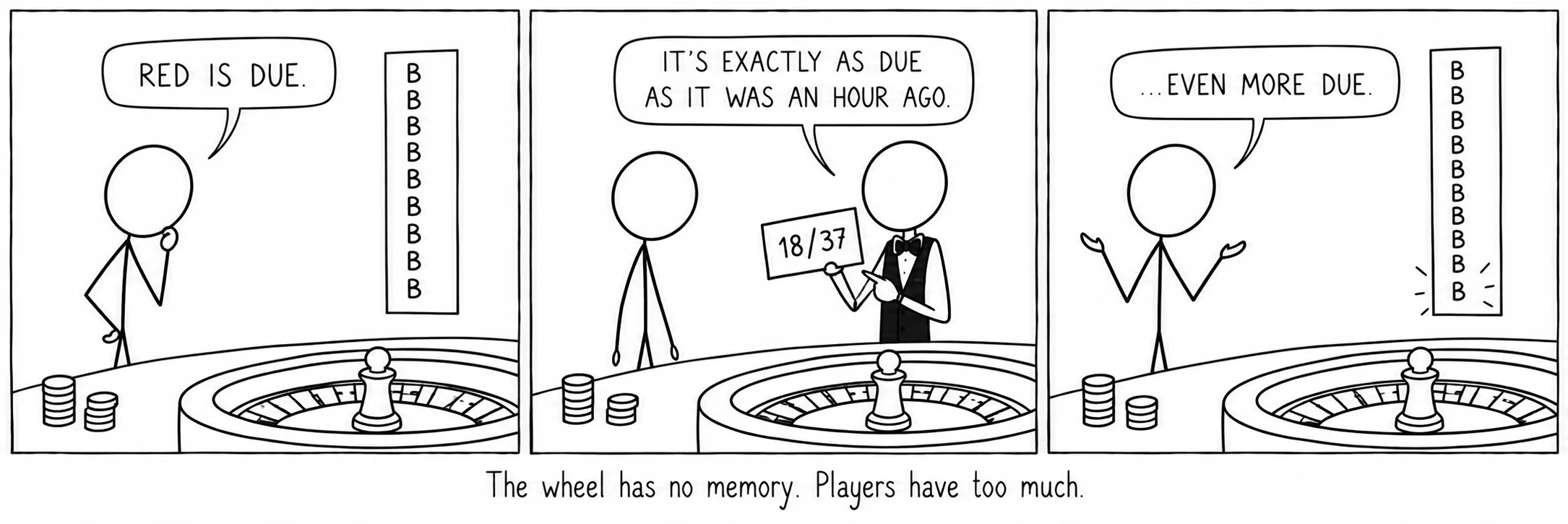
The wheel has no memory. Players have too much.
Sources
- Ethier, S. N. The Doctrine of Chances: Probabilistic Aspects of Gambling.
- Feller, W. An Introduction to Probability Theory and Its Applications, Vol. 1.
- Schwartz, D. G. Roll the Bones: The History of Gambling.