Long-Run Convergence
How the average settles toward −2.70%, and why that takes longer than intuition suggests.
The average loss per spin converges to −1/37 as spins accumulate, with a spread that shrinks like 1/√N. After 1,000 red spins the average is typically within ±3% of its expectation.
Law of large numbers
The running average of independent bets tends to the expected valuemathExpected valueThe average result per bet over the long run. −1/37 of the stake for every standard European bet.Read full →. After N even-money spins at one unitmoneyUnitThe base stake a system or a player works in. Progressions are described in units so they apply at any table.Read full →, the average result per spin has expectation −1/37 and standard deviationmathStandard deviationSquare root of variance; the typical distance of a result from the expected value.Read full → 1/√N. At N = 100 that spread is 10% of the stake, nearly four times the 2.7% signal. At N = 1,000 it is 3.2%, about the same as the signal. At N = 10,000 it is 1%, and the edge is clearly visible. The edge is invisible in a session and unmistakable in a year.
What converges and what does not
The average per spin converges. The total does not: it drifts further from zero as N grows, by about 2.7% of N in expectation, with a spread of √N around that. A player who has played 10,000 spins at $10 is expected to be down $2,700, give or take $1,000. The running proportion of redsbetRedEven-money bet on the 18 red numbers. French: rouge.Read full → has long since settled near 48.65%; the running balance has not settled anywhere.
- p10 −$440
- p25 −$280
- median −$140
- p75 +$0
- p90 +$140
Why intuition fails
People expect the edge to show up quickly because 2.70% sounds like a lot, and expect long runs to “even out” because the law of large numbersmathLaw of large numbersThe average of independent results converges to the expected value as the number of trials grows.Read full → says averages converge. Both intuitions misjudge the scale: the edge is small relative to a single spin’s variancemathVarianceA measure of how widely results spread around the expected value. High for straight up, low for even-money bets.Read full → (σ = 1 unit against EV = 0.027), so it takes (1/0.027)² ≈ 1,400 spins to become one-sigma visible. And the convergence of the average does nothing to pull the total back; it only dilutes past fluctuations.
Convergence for other bets
For straight upsbetStraight upA single number, pays 35:1.Read full → σ = 5.84, so the same calculation gives (5.84/0.027)² ≈ 47,000 spins for the edge to reach one sigma. A straight-up player can play for years without the edge being distinguishable from luck in their own records, while paying exactly the same 2.70% as the red player who sees it within weeks.
Implication for testing systems
Anyone claiming a system works should be able to show it over 10,000 or more spins with a documented positive average. At 1,000 spins a positive average on even money is a one-in-five event under the null; at 100 spins it is nearly a coin flip. The simulators on this site run 2,000 sessions of your chosen length in a second, which is more evidence than any testimonial.
Formula
Questions
The probabilitymathProbabilityChance of an outcome, from 0 to 1 or 0% to 100%. One number: 1/37 = 2.70%.Read full → of ever being ahead again falls toward zero as you play. The total drifts down without bound.
No. It means past fluctuations become a smaller fraction of a bigger sample.
For even money, about 10,000 before the edge is clearly visible. For straight ups, about 50,000.
Fun with Math
Try these yourself first. Each solution is folded; open it when you are ready.
Two friends play 20 rounds of a fair gamemathFair gameA game in which neither side has an edge: every bet has an expected value of zero.Read full →, a coin toss or redbetRedEven-money bet on the 18 red numbers. French: rouge.Read full → against blackbetBlackEven-money bet on the 18 black numbers. French: noir.Read full → with zeroswheelZeroThe single green pocket that no even-money, dozen or column bet covers; the source of the house edge. Also: single zero, 0.Read full → returned, and keep a running score. Count the rounds during which each one is ahead (a tie counts for whoever led just before). Which is more likely: that the lead is shared 10 rounds to 10, or that one friend leads all 20?
Show the solution
Answer One friend leading all 20 rounds is far more likely: 35.2%, counting either friend, against 6.1% for an even 10 to 10.
The chance that a fair running score is level after 2k rounds is u = C(2k, k)/2²ᵏ: 0.246 after 10 rounds and 0.176 after 20. A classic result, the arc-sine law, says the chance that one named friend leads for exactly 2k of 2n rounds is u(2k) × u(2n − 2k).
Leading all 20: u(20) × u(0) = 0.176 for each friend, 35.2% for either. An even share: u(10) × u(10) = 0.246² = 6.1%, the least likely share of all.
So in a fair game the lead rarely changes hands. A player who has been ahead all evening, or behind all evening, has seen nothing unusual, and it says nothing about the wheel or about skill. Epstein (2013) gives the same law for longer games: half the time the luckier side leads for more than 85% of the play.
Comic relief
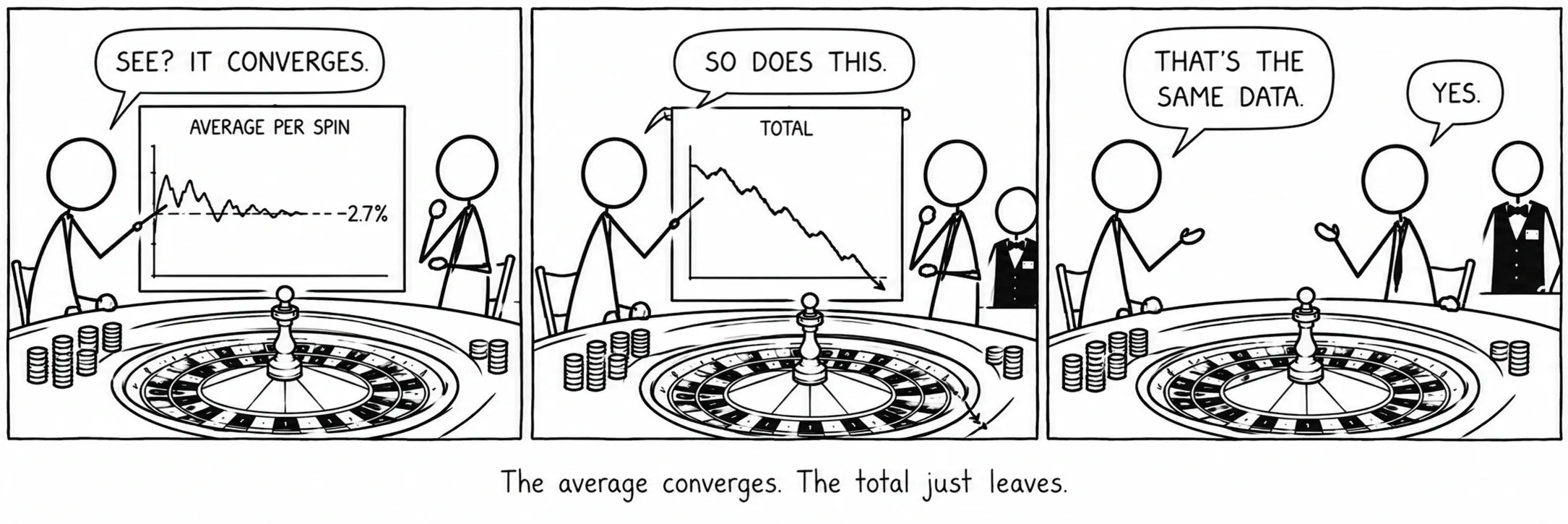
The average converges. The total just leaves.
Sources
- Bernoulli, J. Ars Conjectandi.
- Feller, W. An Introduction to Probability Theory and Its Applications, Vol. 1.