Inside vs Outside Bets
Two families of bets, one house edgemathHouse edgeThe share of each stake the casino keeps on average: 2.70% in European roulette.Read full →.
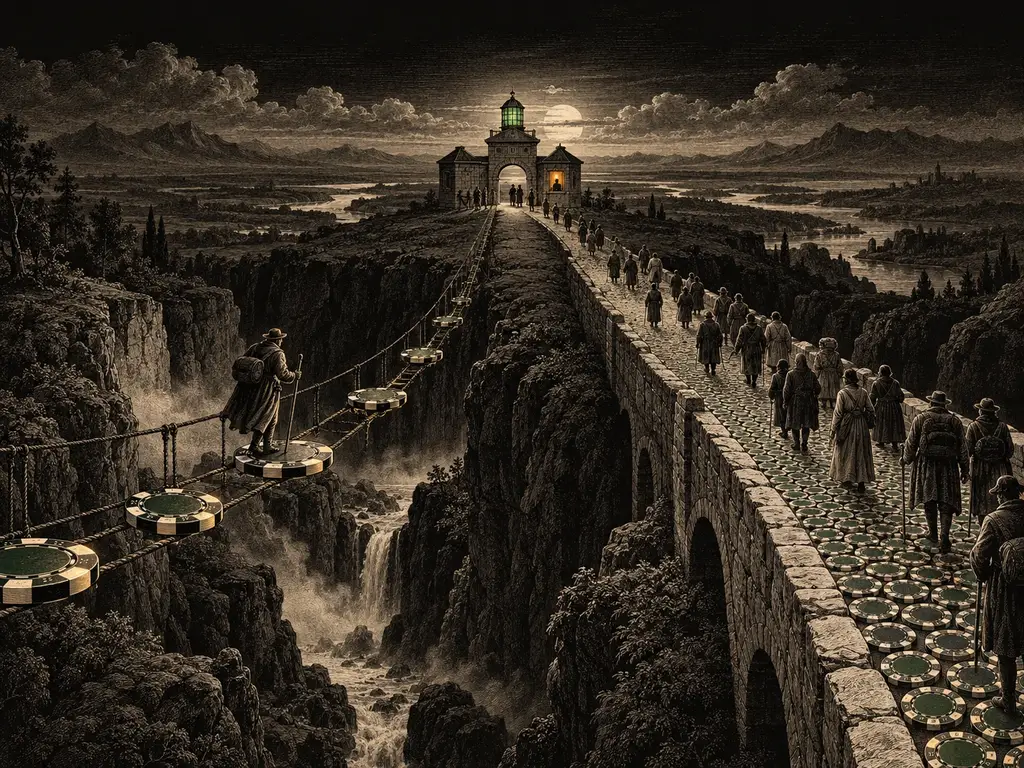
Inside bets cover one to six numbers and pay 5:1 to 35:1. Outside bets cover twelve or eighteen numbers and pay 2:1 or 1:1.
Inside bets
Straight upbetStraight upA single number, pays 35:1.Read full →, splitbetSplitTwo adjacent numbers, pays 17:1.Read full →, streetbetStreetThree numbers in a row of the layout, pays 11:1. French: transversale.Read full →, cornerbetCornerFour numbers sharing a corner on the layout, pays 8:1.Read full → and six linebetSix lineSix numbers in two adjacent rows, pays 5:1. French: sixain.Read full → all live inside the number grid. They win rarely and pay a lot. A straight up wins one spin in 37 on average and pays 35 to 1; a six line wins one in six and pays 5 to 1. Table minimums usually apply to the total of your inside chipsmoneyChipA token representing a fixed amount, placed on the layout to make a bet. Also: check.Read full →, so five $1 chips on five numbers satisfy a $5 minimum.
The experience is streaky. A straight-up player can go 70 spins without a hit (probabilitymathProbabilityChance of an outcome, from 0 to 1 or 0% to 100%. One number: 1/37 = 2.70%.Read full → about 15%) and then collect $350 on a $10 chip. The expected lossmathExpected lossExpected value times total amount wagered; the average amount lost over a session or a period.Read full → over those 70 spins is $19; the actual result is anywhere from −$700 to +$1,000.
Outside bets
DozensbetDozen1–12, 13–24 or 25–36, pays 2:1.Read full →, columnsbetColumnTwelve numbers in one vertical column of the layout, pays 2:1.Read full →, redbetRedEven-money bet on the 18 red numbers. French: rouge.Read full →, blackbetBlackEven-money bet on the 18 black numbers. French: noir.Read full →, odd, even, high and low sit in the boxes around the grid. They win often and pay little: 2 to 1 for a dozen, even money for the rest. Each must meet the table minimum on its own. The experience is smooth: a session of red bets drifts up and down by a few stakes and ends, on average, 2.70% of turnovermoneyTurnoverThe total amount wagered over a session or period, counting re-bet winnings. Also: handle, action.Read full → down.
What changes, what does not
The spread of outcomes changes completely between the two families. The average does not. Both are short of fair odds by exactly 1/37 of the stake, so over many spins both lose 2.70% of everything wagered. The table below shows the same $10, 100-spin session under both; the expected result is identical and the typical range is six times wider for the straight up.
Choosing by experience, not by edge
If you want a long session with small swings, outside betsbetOutside betA bet on the boxes surrounding the grid: dozens, columns and even-money bets.Read full → at a low stake deliver it. If you want the chance of a big win and accept a high chance of losing the whole budget, inside betsbetInside betAny bet placed on or between the numbers of the grid: straight up, split, street, corner, six line.Read full → deliver that. Neither is smarter. The only decisions that change your expected loss are stake, spins and whether the table offers la partageruleLa partageFrench rule: when zero hits, half of an even-money stake is returned. Halves the house edge on those bets to 1.35%.Read full →.
- p10 −$420
- p25 −$280
- median −$120
- p75 +$20
- p90 +$140
Mixing families
Many players spread chips across both: a few straight ups for the lottery ticket and red for the ride. Because expected valuesmathExpected valueThe average result per bet over the long run. −1/37 of the stake for every standard European bet.Read full → add, the mix has an expected loss of 2.70% of the total and a variancemathVarianceA measure of how widely results spread around the expected value. High for straight up, low for even-money bets.Read full → somewhere between the two. The Bet Builder tool computes both for any combination.
- p10 −$500
- p25 −$500
- median −$500
- p75 +$40
- p90 +$1,480
Questions
Outside bets, because the budget lasts long enough to see how the game works. Not because they lose less per dollar.
Casinos prefer turnover. Fast outside betting generates more of it, which is why speed tables emphasize it.
Usually not. Inside total and each outside bet are checked separately.
Fun with Math
Try these yourself first. Each solution is folded; open it when you are ready.
You put $10 on redbetRedEven-money bet on the 18 red numbers. French: rouge.Read full → and $1 on 17, which is blackbetBlackEven-money bet on the 18 black numbers. French: noir.Read full →, for one spin of a European wheel. List what can happen and what the pair of bets costs on average. Then do the same for $10 on red and $10 on black.
Show the solution
Answer Red: +$9. The 17: +$25. Any other number: −$11. On average −$11/37, about 30¢, which is 2.70% of the $11 staked. Red and black together lose $20 on the zerowheelZeroThe single green pocket that no even-money, dozen or column bet covers; the source of the house edge. Also: single zero, 0.Read full → and nothing otherwise: −$20/37, 2.70% of $20.
Red comes up 18 times in 37: the $10 wins $10 and the $1 on 17 is lost, +$9. The 17 comes up once: the red bet loses $10 and the $1 wins $35, +$25. The other 17 black numbers and the zero, 18 pocketsequipmentPocketOne of the 37 numbered compartments on the rotor. Also: slot, cup.Read full → in all: both bets lose, −$11.
Average: (18 × 9 + 25 − 18 × 11)/37 = (162 + 25 − 198)/37 = −11/37.
Each bet keeps its own price when it is combined with another: the $10 on red costs 10/37 on average, the $1 on 17 costs 1/37, and together 11/37. Mixing bets changes how the results are spread, not what they cost. Red and black together make every result but the zero a wash and still pay 2.70% of everything staked, all of it on the zero. Hunacek (2025) sets the same exercises on a double-zero wheel, where the price is 5.26%.
Comic relief
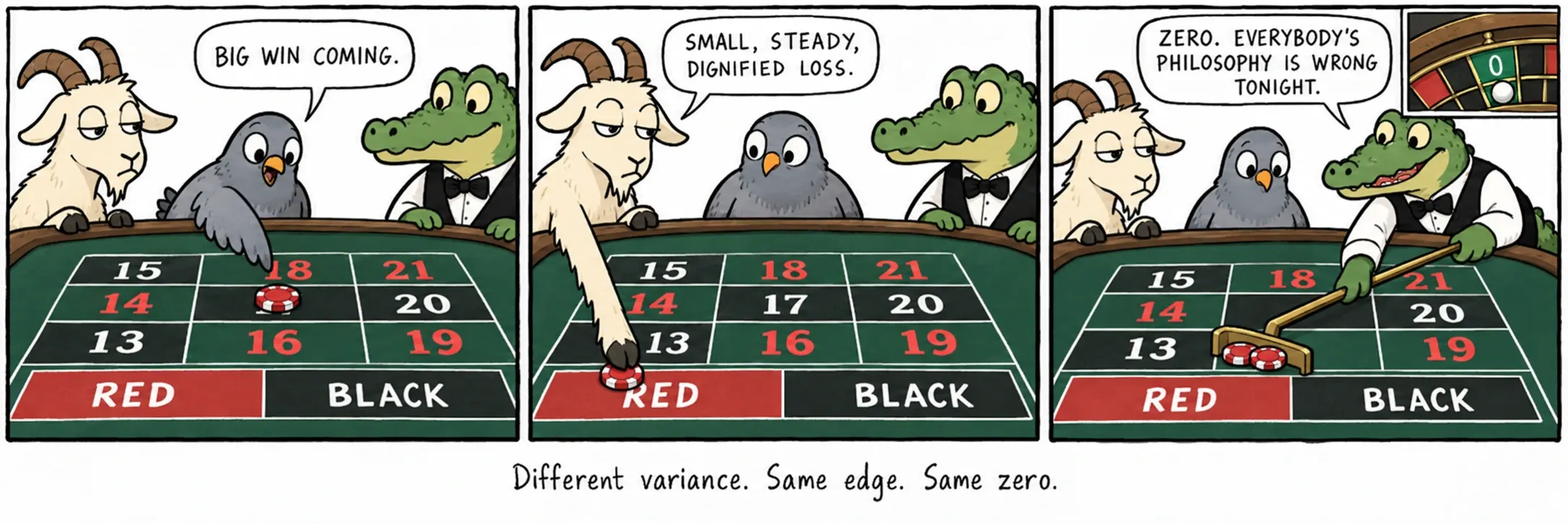
Different variance. Same edge. Same zero.
Sources
- Ethier, S. N. The Doctrine of Chances: Probabilistic Aspects of Gambling.
- Epstein, R. A. The Theory of Gambling and Statistical Logic, 2nd ed.