Flat Betting
The same stake every spin. The baseline every progression should be compared against.
Flat betting has the lowest variancemathVarianceA measure of how widely results spread around the expected value. High for straight up, low for even-money bets.Read full → per unitmoneyUnitThe base stake a system or a player works in. Progressions are described in units so they apply at any table.Read full → of expected loss, and the expected loss per session is simply stake × spins / 37.
Why it is the baseline
With no progressionstrategyProgressionAny rule that changes the stake based on previous results. Negative progressions raise it after losses, positive after wins.Read full → the amount you will wager is fixed before you sit down: stake times spins. The expected lossmathExpected lossExpected value times total amount wagered; the average amount lost over a session or a period.Read full → is therefore fixed too, at 1/37 of that. Every progression wagers more on average, because stakes rise during losing stretches, and so loses more on average. Flat bettingstrategyFlat bettingWagering the same amount every spin. The baseline every progression is compared against.Read full → is the cheapest way to play any given number of spins at any given base stake.
Shape
Even-money flat betting over 100 spins: about 42% of sessions end ahead, the median is a small loss, and extremes beyond ±$200 at $10 are rare (about 5% of sessions). The distribution is a bell curve centered on −$27 with a standard deviationmathStandard deviationSquare root of variance; the typical distance of a result from the expected value.Read full → of $100. Straight-up flat betting over the same spins has the same center and a standard deviation of $584: fewer winning sessions (about 31%) and much bigger winners.
- p10 −$420
- p25 −$280
- median −$140
- p75 +$20
- p90 +$160
Choosing the stake
Expected loss per hour is stake × spins per hour / 37. Decide what an hour of play is worth to you as entertainment, divide by the spins per hour of the table you intend to play, and multiply by 37. At a 50-spin live table, a $10 hourly budget supports a $7.40 stake. Most people find this calculation clarifying and slightly deflating.
Flat betting with a stop rule
Adding a stop-lossstrategyStop-lossA pre-set amount of loss at which you end the session.Read full → and a stop-winstrategyStop-winA pre-set profit target at which you end the session.Read full → turns flat betting into the closest thing roulette has to a controlled purchase: you know the maximum cost, you know when you will leave, and the house edgemathHouse edgeThe share of each stake the casino keeps on average: 2.70% in European roulette.Read full → applies only to the spins you actually play. It is less exciting than a progression, which is rather the point.
What flat betting cannot do
It cannot make the expected valuemathExpected valueThe average result per bet over the long run. −1/37 of the stake for every standard European bet.Read full → positive, and it cannot make a 100-spin session more than about 42% likely to end ahead on even money. Players who need the feeling of winning most nights will drift toward MartingalestrategyMartingaleProgression that doubles the bet after each loss. See the Strategy section for what it does and does not do.Read full →, and should read that page first.
Simulator · Flat
2,000 sessions of even-money bets from a $1,000 bankroll.
Base bet $10 · table limit $500 · 100 spins per session
Questions
It is the absence of one, which is why it is the cheapest.
Whichever variance you enjoy. Even money for a long smooth session, straight upsbetStraight upA single number, pays 35:1.Read full → for the lottery feel. The cost is the same.
Everything works better on French tables: the even-money edge halves.
Comic relief
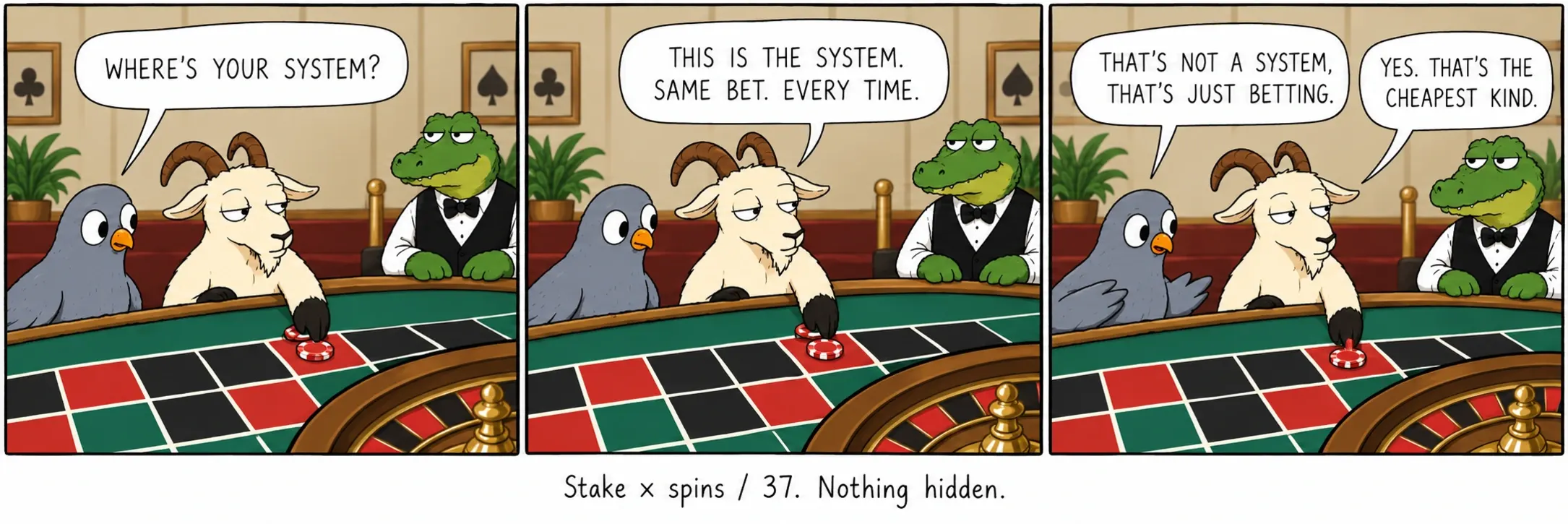
Stake × spins / 37. Nothing hidden.
Sources
- Ethier, S. N. The Doctrine of Chances: Probabilistic Aspects of Gambling.