Game Show Multipliers
Lightning-style roulette pays up to 499 to 1 on a lucky number. It pays for this by paying 29 to 1 on every other straight up. Here is the arithmetic.

Multiplier roulette keeps the wheel and the outside bets exactly as they are and changes one thing: straight-up bets pay 29 to 1 instead of 35, and each round a few random numbers get a multiplier of 50× to 500×. The outside bets stay at 2.70%. The straight ups go to about 2.9%, averaged over the multipliers.
How the round works
Bets close; the dealer pulls a lever; one to five “lucky numbers” are drawn with multipliers from 50× to 500×; the ballequipmentBallThe small ball launched along the track against the rotor. Modern balls are ivorine or Teflon, 18–21 mm.Read full → spins. A straight-up bet on a lucky number that wins pays the multiplier. A straight-up bet on any other winning number pays 29 to 1. SplitsbetSplitTwo adjacent numbers, pays 17:1.Read full →, streetsbetStreetThree numbers in a row of the layout, pays 11:1. French: transversale.Read full →, cornersbetCornerFour numbers sharing a corner on the layout, pays 8:1.Read full →, lines, dozensbetDozen1–12, 13–24 or 25–36, pays 2:1.Read full →, columnsbetColumnTwelve numbers in one vertical column of the layout, pays 2:1.Read full → and even-money betsbetEven-money betRed/black, odd/even, high/low. 18 numbers, pays 1:1.Read full → pay as normal and are unaffected by the lightning.
Where the money goes
On a standard table a straight upbetStraight upA single number, pays 35:1.Read full → pays 35 for a 1/37 chance: EV −2.70%. On the multiplier table the base payoutmoneyPayoutWhat a winning bet returns, quoted as “X to 1” on top of the returned stake.Read full → is 29, which alone would be an EV of (29 − 36)/37 = −18.9%. The multipliers give back most of that: the published return for straight-up bets is about 97.1%, so the edge on straight ups averages about 2.9%, but only when the multiplier distribution is included and only on average over many rounds. A straight-up bettor in any single round who is not struck is playing at 29 to 1, which is 18.9% against. The variancemathVarianceA measure of how widely results spread around the expected value. High for straight up, low for even-money bets.Read full → is the product.
What this means for a player
If you play outside betsbetOutside betA bet on the boxes surrounding the grid: dozens, columns and even-money bets.Read full → on a multiplier table you are playing standard roulette with a light show; the edge is 2.70% and the round is slower. If you play straight ups you are buying lottery tickets: a small chance at 500× funded by six unitsmoneyUnitThe base stake a system or a player works in. Progressions are described in units so they apply at any table.Read full → taken off every ordinary win. The averaged edge is close to standard; the distribution is nothing like it. Most of the straight-up money on these tables is wagered by players who have not noticed the 29.
Other game-show variants
Double-ball roulette (two balls, one spin: straight ups near 2.8%, outside bets 5.33% because both balls must win), roulette with a bonus wheel after certain results, and “mega” variants that add bonus rounds all follow the same pattern: the outside bets are standard, one bet type carries the feature, and that bet type pays for it. Read the paytable for the bet you intend to make, not the headline multiplier.
Questions
No. The multipliers are drawn by a certified RNG and the wheel is a real wheel. The edge is in the 29.
Yes. You will be playing standard roulette at a slower pace with better lighting.
Because the figure averages the multipliers in. Over thousands of rounds it is correct. In any one round you are either struck or at 29 to 1.
Comic relief
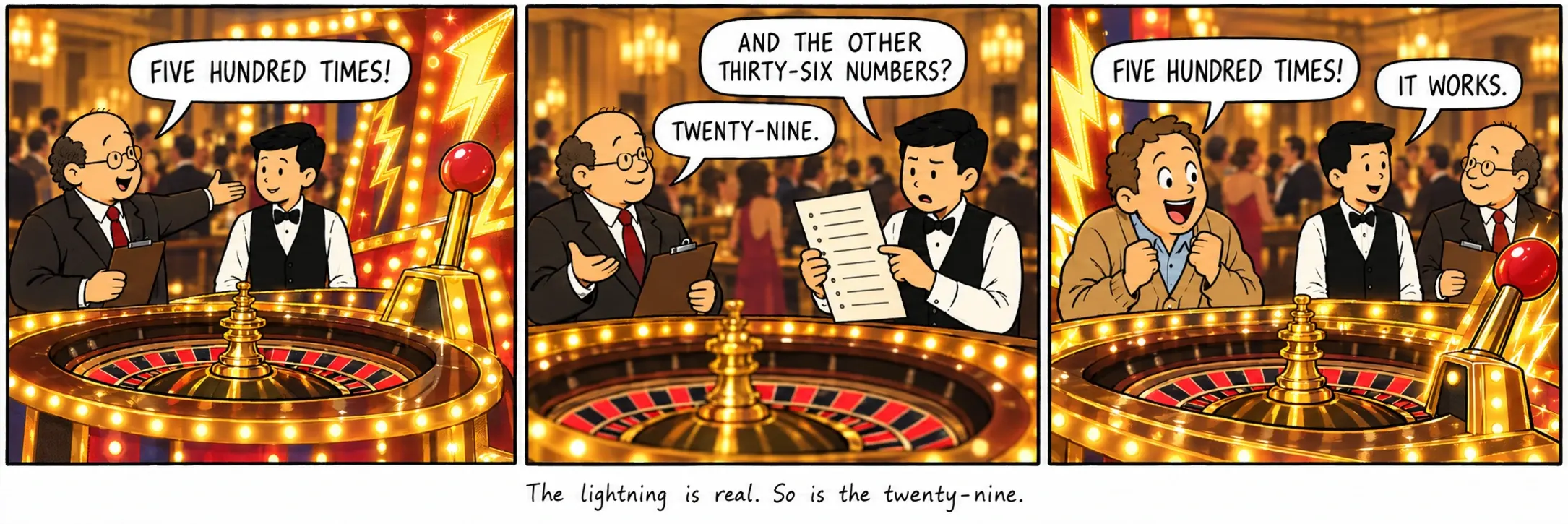
The lightning is real. So is the twenty-nine.
Sources
- Malta Gaming Authority. Gaming Devices Regulations and technical directives.
- Published game rules and RTP statements for multiplier roulette products.