Dozen
Twelve consecutive numbers: 1–12, 13–24 or 25–36.
Twelve numbers, pays 2:1. ProbabilitymathProbabilityChance of an outcome, from 0 to 1 or 0% to 100%. One number: 1/37 = 2.70%.Read full → 32.43%. Zero loses.
Placement
The three boxes along the long side of the layoutequipmentLayoutThe printed betting grid on the table. Also: table, felt, cloth.Read full →, marked 1st 12, 2nd 12, 3rd 12 or, on French tables, P12 (première), M12 (moyenne), D12 (dernière). Each must meet the table minimum on its own. ZerowheelZeroThe single green pocket that no even-money, dozen or column bet covers; the source of the house edge. Also: single zero, 0.Read full → is in no dozenbetDozen1–12, 13–24 or 25–36, pays 2:1.Read full →.
Payout and expectation
Fair odds against twelve numbers in 37 are 2.083 to 1; the table pays 2. A $10 dozen that hits returns $20. Over 37 average spins: 12 hits (+$240), 25 misses (−$250), net −$10.
Two dozens at once
Covering two dozens with equal chipsmoneyChipA token representing a fixed amount, placed on the layout to make a bet. Also: check.Read full → wins 24 of 37 spins (64.9%) but nets only one unitmoneyUnitThe base stake a system or a player works in. Progressions are described in units so they apply at any table.Read full →: you win 2 on one and lose 1 on the other. The 13 losing spins cost two units each. (24 × 1 − 13 × 2)/37 = −2/37 per two units, the usual 2.70%. The shape is attractive, a win nearly two spins in three, and the edge is unchanged.
Dozens and progressions
Doubling after a loss on a dozen does not recover the way it does on even money: a 2 to 1 payoutmoneyPayoutWhat a winning bet returns, quoted as “X to 1” on top of the returned stake.Read full → after doubling recovers two losses, not all of them, so the standard “dozens MartingalestrategyMartingaleProgression that doubles the bet after each loss. See the Strategy section for what it does and does not do.Read full →” triples instead. Tripling reaches a $500 table limittableTable limitMinimum and maximum bet allowed. The maximum is what stops doubling progressions.Read full → from $5 in five steps, against seven for doubling on redbetRedEven-money bet on the 18 red numbers. French: rouge.Read full →. Systems that rotate which dozen to skip change nothing, because spins are independent.
On the wheel
The twelve numbers of a dozen are scattered around the rim; the first dozen occupies pocketsequipmentPocketOne of the 37 numbered compartments on the rotor. Also: slot, cup.Read full → at 1, 2, 3, 4, 5, 6, 7, 8, 9, 10, 11, 12 which sit at positions spread across the whole wheel. A dozen is a layout bet with no physical sectorwheelSectorA contiguous arc of pockets on the wheel, as distinct from a group on the layout.Read full →, which is why bias players never use it.
Questions
No. Each is 12 of 37. The second dozen contains 17, the most-bet number, which affects nothing.
Yes, and you will win one and lose two on 36 of 37 spins, and lose all three on zero.
Both cover twelve numbers. The payout rule only counts coverage.
Comic relief
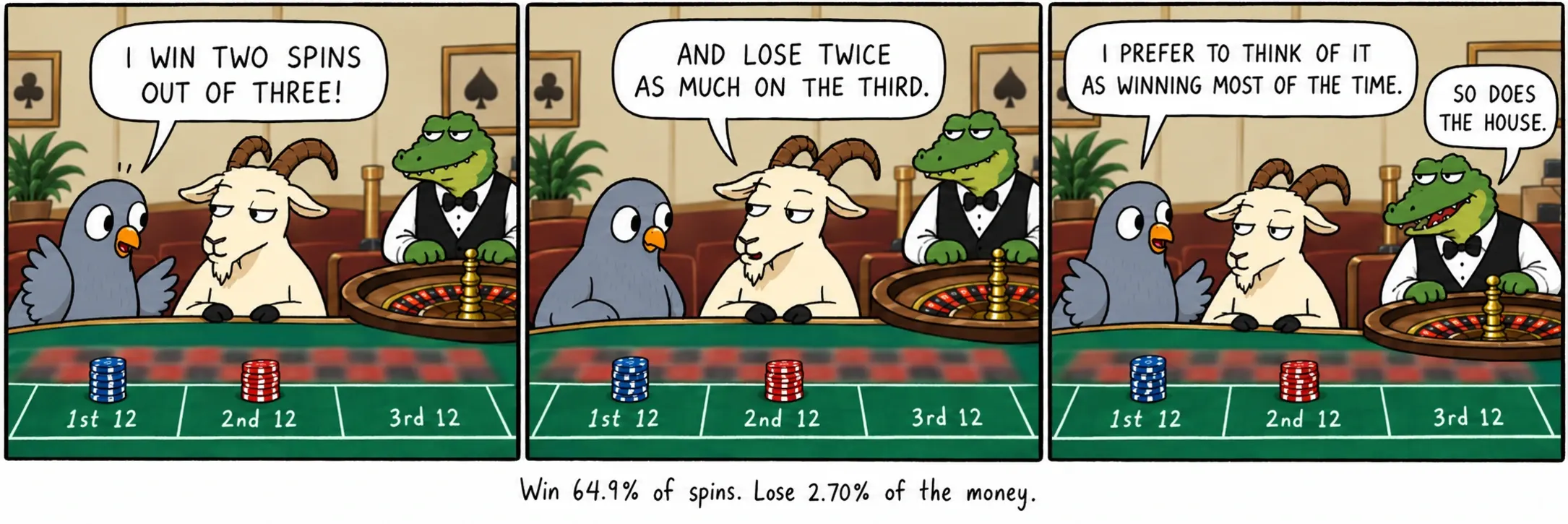
Win 64.9% of spins. Lose 2.70% of the money.
Sources
- Ethier, S. N. The Doctrine of Chances: Probabilistic Aspects of Gambling.