Unusual Wheels
Wheels with 18, 25, 26, 31, 40, 49, 62, 73 or 105 pockets. One rule prices nearly all of them: the share of pockets the payouts ignore.
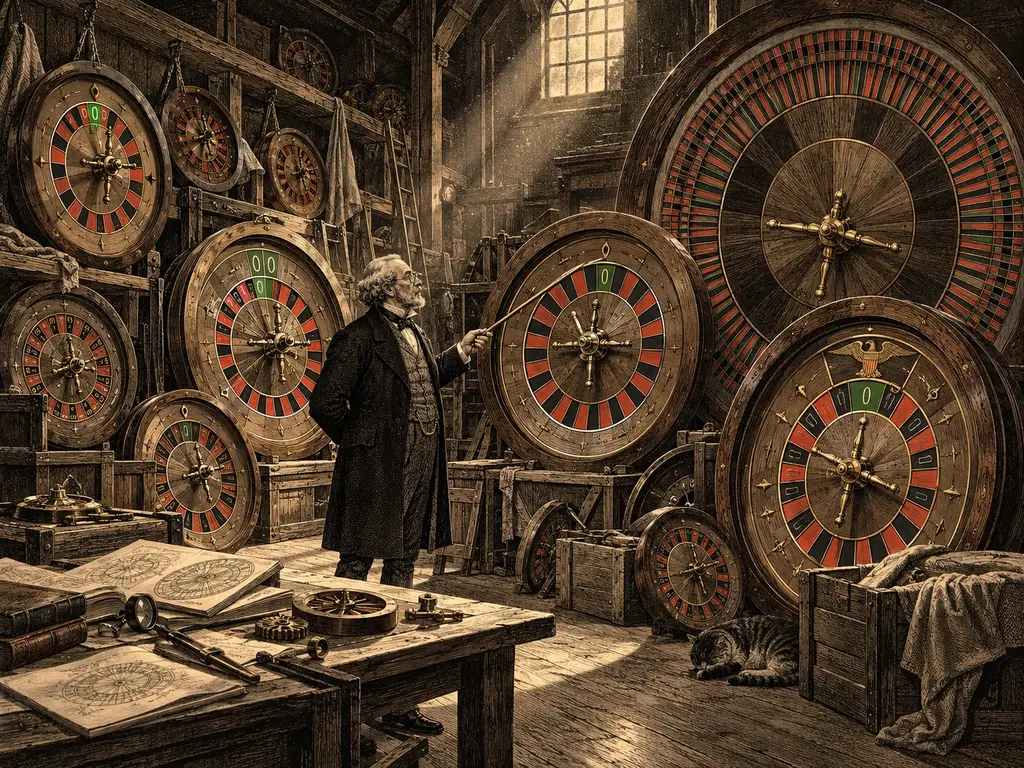
When payouts are set as if the house pockets were not there, the house edgemathHouse edgeThe share of each stake the casino keeps on average: 2.70% in European roulette.Read full → is house pockets divided by total pockets, whatever the size of the wheel. Most unusual wheels follow that rule. The interesting ones break it: a rounded payout, a bonus round, or a bet that stays up for several spins.
One rule for every wheel
European roulettevariantEuropean rouletteSingle-zero wheel, 37 pockets, house edge 2.70%. The canonical model on this site.Read full → pays 35 to 1 as if the wheel had 36 pocketsequipmentPocketOne of the 37 numbered compartments on the rotor. Also: slot, cup.Read full →. It has 37, and the missing pocket is the 2.70% edge. The same rule works on any wheel: with N numbers and Z house pockets, a bet on n numbers that pays (N − n)/n to 1 has an edge of Z/(N + Z). Wheels of every size have been built or proposed on this rule, and the table puts them in order of price.
Bigger can be cheaper
Players read a 62-pocket wheel as a longer shot and assume a worse game. The edge depends only on the share of house pockets. Super 62 has two zeroswheelZeroThe single green pocket that no even-money, dozen or column bet covers; the source of the house edge. Also: single zero, 0.Read full →, like the American wheel, but they are 2 of 62 pockets rather than 2 of 38, so it costs 3.23% against 5.26%. Roulette 73, with 72 numbers and one zero, would cost 1.37%, about the same as French even money. The rule works the other way on a small wheel. Bollman pictures an antique wheel of 18 pockets, 1 to 16 plus 0 and 00. On the rule every bet would cost 2/18, 11.11%: two house pockets are a large share of a small wheel.
Where the rule breaks: rounding
A payoutmoneyPayoutWhat a winning bet returns, quoted as “X to 1” on top of the returned stake.Read full → has to be a sensible chipmoneyChipA token representing a fixed amount, placed on the layout to make a bet. Also: check.Read full → amount, and when the rule gives a fraction the casino rounds down. 100 To 1 Roulette’s Avenue bet covers 15 pockets and should pay 5⅔ to 1; it pays 11 to 2, which raises its edge from 4.76% to 7.14%. On Super 62, seven numbers contain the digit 6 (6, 16, 26, 36, 46, 56, 60) and the bet on that digit pays 7 to 1, which makes it 9.68%, three times the rest of the layoutequipmentLayoutThe printed betting grid on the table. Also: table, felt, cloth.Read full →. Riverboat Roulette’s White bet covers 8 numbers at 7 to 2; at a table without 50-cent chips, a $5 winner is paid $17 rather than $17.50, which raises the edge from 5.26% to 7.37%. The American five-number bet, at 7.89%, is the familiar case of the same thing.
Where the rule breaks: bonuses
Fast Action Roulette, launched at Marina Bay Sands in 2020, runs a real wheel with four zeros, which on its own would cost 10%. Ten Bonus numbers light up at random on every spin. A straight upbetStraight upA single number, pays 35:1.Read full → pays 35 to 1, 40 to 1 if its number is a Bonus number, and 80 to 1 if its whole row of four is Bonus, which brings it to 6.65%. The game’s other three bets cost far more. IGT’s Double Bonus Spin adds a yellow Bonus pocket, one and a half pockets wide, to an American wheel; when the ballequipmentBallThe small ball launched along the track against the rotor. Modern balls are ivorine or Teflon, 18–21 mm.Read full → lands there, every bet gets two free spins. By our calculation that lowers the edge to between 1.94% (a straight up) and 2.73% (even money), below the plain American wheel. Bollman (2021) prints 3% to 16% for this game; his simplified formula has an algebra slip, and for even-money betsbetEven-money betRed/black, odd/even, high/low. 18 numbers, pays 1:1.Read full → it implies that the free spins lose more than the stake, which they cannot.
Where the rule breaks: bets that stay up
Riverboat Roulette (2012) gave 32 numbers of an American wheel a second color. White marks the four pockets around each zero (1, 2, 9, 10, 13, 14, 27, 28). A bet on a color group wins if one of its numbers comes up before one of the eight White numbers. A White number is a “White Out” that clears every color bet. Every other number is a push: the bet stays up, and between spins it can be taken down or raised. Teal covers three numbers and pays 2 to 1. Per resolved bet it loses 2/11 of the stake, 18.18%. Per spin it loses 2/38, the familiar 5.26%, because the average bet stays up 38/11, about 3.5 spins.
A wheel Thorp could predict: Big Six
The Big Six, or wheel of fortune, is a large upright wheel with 54 slots: 24 pay 1 to 1, 15 pay 2 to 1, seven 5 to 1, four 10 to 1, two 20 to 1, and two logo slots pay 40 to 1. There is no zero; the house takes its share by paying short, and the edge runs from 11.1% on the slots that pay 1 to 1 to 24.1% on the logos. In 1961 Thorp built a matchbox-sized predictor for it, worked by a toe switch, and in 1981, timing one turn of a casino wheel with a wristwatch, he found he could usually name the stopping point to within five slots. Betting only the high-paying slots near the prediction would have returned about +211%, if bets were taken after the wheel was spun. They are not, and the wheel turns slowly and in full view, so a late bet would be obvious; Thorp wrote that the game had too little action to hide one.
Why so few catch on
A professional wheel costs thousands of dollars, and a wheel with an unusual number of pockets has to be made to order. Most new roulette games therefore keep the standard wheel and add bets, which is why the side-bet page is longer than this one. The 31-pocket eagle wheel of 19th-century America, at 12.90% on a single number and 9.68% on everything else, died of its own price. The idea of a third house pocket came back in 2016 on a 39-pocket wheel, where it costs 7.69%.
Questions
Not by itself. The edge is the share of house pockets: 1 in 73 is cheaper than 1 in 37.
Roulette 73, at 1.37%, but it is a published design rather than a table you are likely to find. Among wheels that have been offered to players, Super 62 at 3.23% comes next after European and French.
A bonus has to be paid for, usually by a cut in the base payout or by a separate bet with a high edge.
Fun with Math
Try these yourself first. Each solution is folded; open it when you are ready.
Royal Roulette, developed in Australia, has 50 pocketsequipmentPocketOne of the 37 numbered compartments on the rotor. Also: slot, cup.Read full →: the 48 cards from 2 to king, plus one ace and one joker. A single card pays 47 to 1, two cards 23 to 1, three 15 to 1, four 11 to 1, six 7 to 1, eight 5 to 1, twelve 3 to 1, sixteen 2 to 1 and twenty-four 1 to 1. What rule makes these payoutsmoneyPayoutWhat a winning bet returns, quoted as “X to 1” on top of the returned stake.Read full →, and what does every bet cost?
Show the solution
Answer Each bet on n cards pays (48 − n)/n to 1, so every bet costs 2/50 = 4%.
Try the rule on a few bets: 47/1 = 47, 36/12 = 3, 32/16 = 2, 24/24 = 1. It fits all nine. The rule prices the wheel as if it had 48 pockets, so the ace and the joker are the two house pockets, exactly as 0 and 00 are on an American wheel.
Two house pockets out of 50 give an edge of 4%. A “European” version takes the joker out and keeps the payouts: one house pocket in 49, an edge of 2.04%.
Super 62 has a bet that a chosen digit appears in the winning number. Design the same bet for an ordinary American wheel. How many of the numbers 1 to 36 contain each digit, and what payouts would keep the usual 5.26%?
Show the solution
Answer Only digits with 3 or 4 numbers get clean payouts (11 to 1 and 8 to 1). The digits 1, 2 and 3 cannot be paid fairly in whole chipsmoneyChipA token representing a fixed amount, placed on the layout to make a bet. Also: check.Read full →.
Count the numbers. Digit 1 appears in 1, 10 to 19, 21 and 31: 13 numbers. Digit 2 is also in 13 numbers and digit 3 in 10. The digits 4, 5 and 6 are in four numbers each (4, 14, 24, 34), and 7, 8 and 9 in three each.
A bet on n numbers keeps the American edge if it pays (36 − n)/n to 1. That gives 8 to 1 for four numbers and 11 to 1 for three, both whole. For 13 numbers it gives 23/13, about 1.77 to 1, and for 10 numbers 2.6 to 1. Round 1.77 down to 7 to 4 and the bet costs 5.92%; round it up to 2 to 1 and the player has a 2.63% edge. Rounding 2.6 down to 5 to 2 makes 7.89%.
The digit 0 is a choice: 10, 20 and 30 alone pay 11 to 1 at 5.26%; add 0 and 00 and it is a five-number bet, 6 to 1 at 7.89%, like the basketbetBasketOn a single-zero wheel: 0, 1, 2, 3 with one chip, pays 8:1. Also: first four, quatre premiers.Read full →.
digitnumbersrule sayscould payhouse edge1, 2131.77 to 17 to 45.92%3102.6 to 15 to 27.89%4, 5, 648 to 18 to 15.26%7, 8, 9311 to 111 to 15.26%100 To 1 Roulette pays (100 − n)/n to 1 on most bets, on a wheel of 100 numbers and 5 house symbols. Its bets cover 1, 2, 3, 4, 5, 10, 15, 20 or 50 pockets and pay 100, 49, 32, 24, 19, 9, 11 to 2, 4 and 1 to 1. The straight upbetStraight upA single number, pays 35:1.Read full → and the 15-pocket Avenue break the rule. Which other bet does, and what does it cost?
Show the solution
Answer The three-pocket bet: the rule says 32⅓ to 1, it pays 32 to 1, and costs 5.71% instead of 4.76%.
Check each payout against the rule: 98/2 = 49, 96/4 = 24, 95/5 = 19, 90/10 = 9, 80/20 = 4 and 50/50 = 1 all fit. For three pockets the rule gives 97/3 = 32⅓, which no chip can pay, so it is rounded down to 32.
The bet wins 3 times in 105 spins and then returns 33 unitsmoneyUnitThe base stake a system or a player works in. Progressions are described in units so they apply at any table.Read full → including the stake: 3 × 33 = 99 units back for every 105 staked, a loss of 6/105 = 5.71%.
Roulette 73, a published design, has 72 numbers and one zerowheelZeroThe single green pocket that no even-money, dozen or column bet covers; the source of the house edge. Also: single zero, 0.Read full →, and every bet pays (72 − n)/n to 1. Its 24 gray numbers can be covered with 14 chips: 4 straight ups and 10 splitsbetSplitTwo adjacent numbers, pays 17:1.Read full →. What does that 14-chip bet cost?
Show the solution
Answer 1.37% of the 14 chips, like every other bet on that wheel.
The long way: a straight up pays 71 to 1 and a split 35 to 1. If one of the 4 straight-up numbers comes in, you win 71 and lose the other 13 chips: +58. If one of the 20 split numbers comes in: +35 − 13 = +22. On the other 49 pockets you lose all 14. On average over 73 spins: 4 × 58 + 20 × 22 − 49 × 14 = 232 + 440 − 686 = −14 units, which is 1/73 of each chip.
The short way: expected valuesmathExpected valueThe average result per bet over the long run. −1/37 of the stake for every standard European bet.Read full → add. Each chip is an ordinary bet that loses 1/73 of itself, so 14 chips lose 14/73. Combining bets changes how the results are spread, never what they cost.
Super 62 has 60 numbers, 0 and 00, and pays (60 − n)/n to 1. Its designers also drew it with one, three and four house pockets. Alphabetic Roulette pays (24 − n)/n to 1 on 25 pockets, and has a variant with Y and Z in pockets of their own. Price all five.
Show the solution
Answer With one to four zeros: 1.64%, 3.23%, 4.76% and 6.25%. Alphabetic with Y and Z apart: 7.69%.
Each of these keeps its payouts and changes only the number of house pockets, so the edge is house pockets ÷ all pockets.
One zero, 61 pockets: 1/61 = 1.64%. Two, 62 pockets: 2/62 = 3.23%. Three, 63 pockets: 3/63 = 4.76%. Four, 64 pockets: 4/64 = 6.25%. Each zero added costs about a point and a half.
Alphabetic pays as if it had 24 letters. With Y and Z sharing a pocket the house has 1 in 25, 4%. With Y and Z apart it has 2 in 26, 7.69%, as much as a triple-zero wheel. Splitting one pocket in two nearly doubled the price.
wheelpocketshouse pocketshouse edge60 numbers, one zero6111.64%Super 626223.23%60 numbers, three zeros6334.76%Super 646446.25%Alphabetic2514.00%Alphabetic, Y and Z apart2627.69%An antique wheel has 18 pockets: 1 to 16, 0 and 00. Odd numbers and 0 are redbetRedEven-money bet on the 18 red numbers. French: rouge.Read full →, even numbers and 00 blackbetBlackEven-money bet on the 18 black numbers. French: noir.Read full →, and the 16 numbers sit on a 4-by-4 layoutequipmentLayoutThe printed betting grid on the table. Also: table, felt, cloth.Read full →. Design a pay tablemoneyPay tableThe list of what each bet or result pays. On machines and side bets, it is where the house edge is set.Read full → that gives every bet the same edge. And why must 0 lose a bet on red, though it is red?
Show the solution
Answer Pay (16 − n)/n to 1: 15 to 1 on one number, 7 on two, 3 on four, 1 on eight. Every bet costs 11.11%. If 0 won the red bet, red would be a fair bet.
Price the wheel as if 0 and 00 were not there. A bet on n numbers wins n times in 18 and pays (16 − n)/n to 1, so it brings back 16 units, stake included, for every 18 staked. Every bet costs 2/18, 11.11%.
The layout’s natural bets come out whole: one number 15 to 1, two side by side 7 to 1, a row or a columnbetColumnTwelve numbers in one vertical column of the layout, pays 2:1.Read full → of four 3 to 1, and two rows, or the odd, even, low or high eight, 1 to 1. A three-number bet would need 4⅓ to 1; rounded down to 4 to 1, it costs 16.67%.
Red covers the eight odd numbers. If 0, being red, also won the red bet, red would cover 9 of the 18 pockets at 1 to 1: a fair gamemathFair gameA game in which neither side has an edge: every bet has an expected value of zero.Read full → with no edge at all. The house pockets earn their edge only by losing every bet except a bet on themselves.
Comic relief
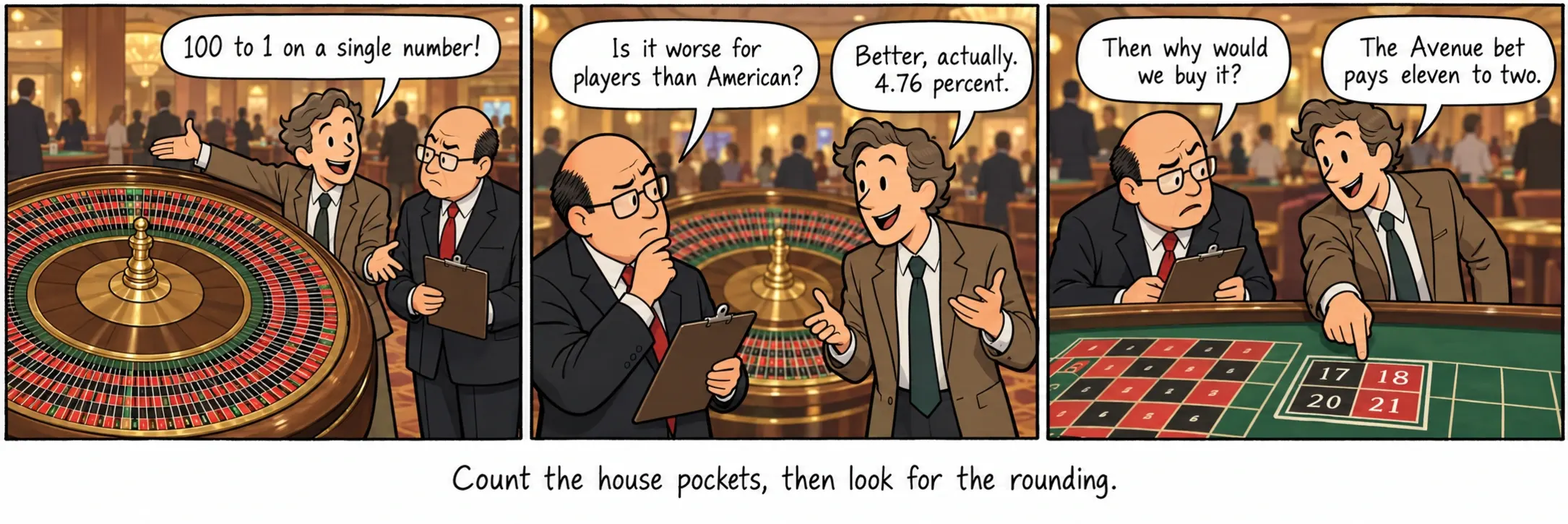
Count the house pockets, then look for the rounding.
Sources
- Bollman, M. Mathematics of the Big Four Casino Table Games: Blackjack, Baccarat, Craps, & Roulette.
- Ethier, S. N. The Doctrine of Chances: Probabilistic Aspects of Gambling.
- Thorp, E. O. The Mathematics of Gambling.
- Thorp, E. O. “The invention of the first wearable computer.”