Dealer Signatures
The idea that a dealer’s release is consistent enough to predict the drop sector.

Dealers do develop consistent launch habits. Whether that consistency survives the scatter phase well enough to beat 2.70% has never been convincingly demonstrated in public data.
The hypothesis
A dealer launches the ballequipmentBallThe small ball launched along the track against the rotor. Modern balls are ivorine or Teflon, 18–21 mm.Read full → from above the last winning number with a habitual force while the rotorequipmentRotorThe spinning part of the wheel that carries the pockets.Read full → turns at a habitual speed. If both are consistent, the ball will tend to travel a consistent number of rotor-pocketsequipmentPocketOne of the 37 numbered compartments on the rotor. Also: slot, cup.Read full → before dropping, and the final pocket will tend to be a consistent distance ahead of the launch pocket. A player who knows a dealer’s “signature” would bet a sectorwheelSectorA contiguous arc of pockets on the wheel, as distinct from a group on the layout.Read full → that distance ahead of the last winning number.
Why it is doubtful
Four things vary. Rotor speed varies by push. Launch speed varies by hand. The launch position is the last winning number, which is random. And the scatter after the drop spans 10 to 15 pockets either side. For the signature to be usable, the first two must be consistent to within a tenth of a second and the scatter distribution must be peaked enough that a sector bet beats 2.70%. Published attempts to measure dealer signatures in real casino data have found effects indistinguishable from noise.
Thorp’s objection
In December 1979 Stephen Kimmel argued in Gambling Times that a full-time dealer spins so habitually that a bet on ten pockets would win about half the time. Thorp (1984) answered that habit is not enough. Three things must stay nearly constant: the rotor’s speed, the number of turns the ball makes, and where the rotor is when the ball leaves the hand. If a ball always makes 8 turns while the rotor makes 4 the other way, the ball travels 12 turns against the rotor and drops near the pocket that was beside the ball when it was let go; if the dealer lets go without regard to the rotor, that pocket is random however steady the hand. The version on this page meets the third condition by measuring from the last winning number, the pocket the dealer releases above. The first two remain, and Thorp found that the number of turns the ball makes varied by about 20 pockets’ worth even for consistent dealers, beyond the 16 or 17 pockets at which a prediction stops paying (see Advantage Play).
How to test it
Record the launch pocket (the last winner) and the result for several hundred spins by one named dealer on one wheel. Compute the offset in pockets around the wheel and plot its distribution. A fair process gives a flat histogram over the 37 offsets; a signature gives a hump. The sector z-test on the sector analysis page applies. Then do it again for the same dealer on a different day, because a hump in one sample is expected by chance about as often as in bias testing.
Countermeasures
Houses and studios instruct dealers to vary launch force, alternate rotor direction, rotate dealers every 20 to 40 minutes, and close bets before the ball slows. Even if signatures existed, the betting windowliveBetting windowThe period in a live round during which bets are accepted, timed by the game server and shown as a countdown.Read full → would make them unusable online, because the launch pocket for this spin is the result of the last spin, which you know, but the ball is launched after bets close, so you cannot see this spin’s launch speed.
Treat it as a Lab exercise
It is a well-posed hypothesis with a clean test, which is more than can be said for most roulette lore. The Demo Game on this site has no dealer signature by construction (the result is drawn before the animation), which makes it a useful null case: run the offset analysis on its history and see what a flat distribution looks like with real sample noise.
Questions
Casinos monitor for it; public reports of a confirmed, exploitable signature are anecdotal.
You can ask. Rotation schedules make it moot within half an hour.
No. Bias is about pockets; signature is about offsets from the launch point. Both inflate chi-square; only one is about the equipment.
Comic relief
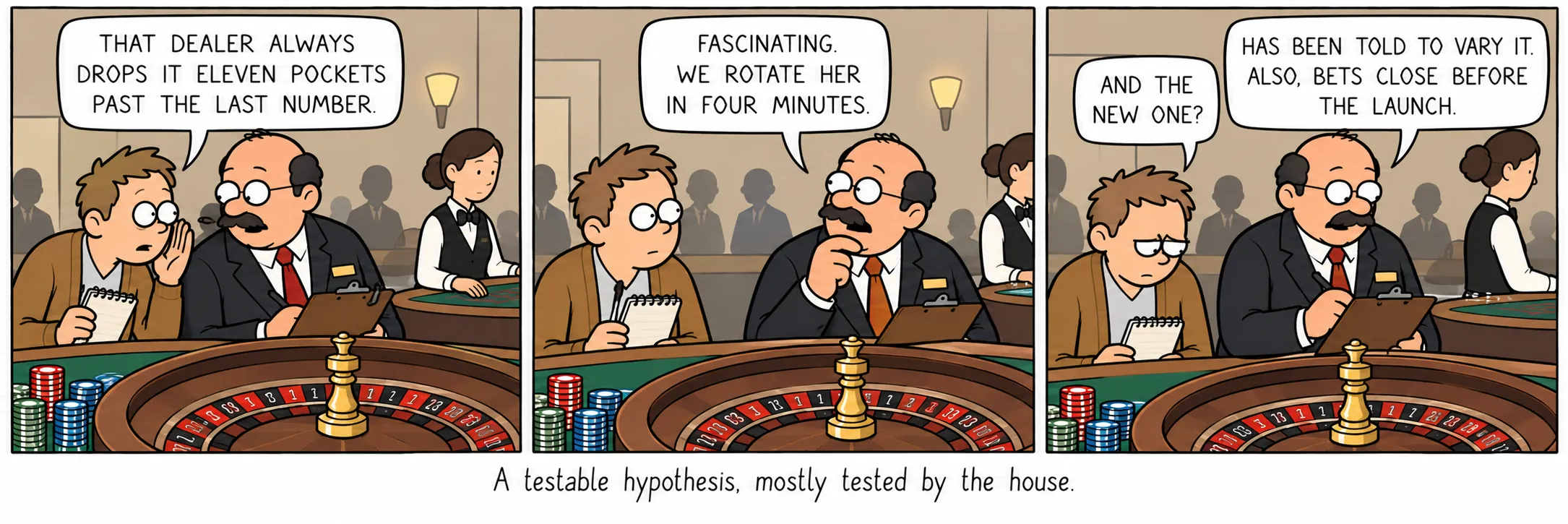
A testable hypothesis, mostly tested by the house.
Sources
- Barnhart, R. T. Beating the Wheel.
- Small, M. & Tse, C. K. “Predicting the outcome of roulette.”
- Thorp, E. O. The Mathematics of Gambling.