Why Roulette Is Addictive
Fast rounds, near misses, intermittent rewards and the illusion of control. Roulette is built, by accident of history, to be hard to stop.
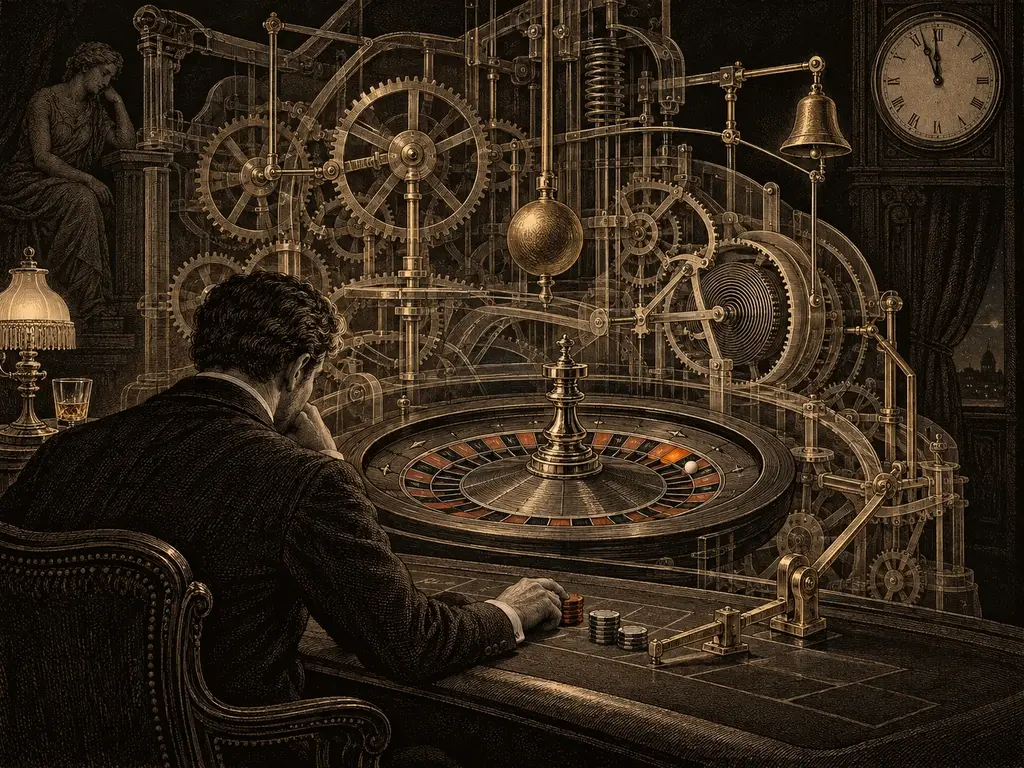
The game’s structure matches what behavioral research identifies as the strongest drivers of persistence: variable-ratio reinforcement, short event cycles, near misses, personal choice over outcomes that choice cannot affect, and a loss schedule gentle enough to feel like luck.
Variable-ratio reinforcement
A reward that arrives unpredictably, after a varying number of attempts, produces the most persistent behavior in every species tested. Roulette is a variable-ratio schedule by construction: redbetRedEven-money bet on the 18 red numbers. French: rouge.Read full → pays about every second spin, a straight upbetStraight upA single number, pays 35:1.Read full → about every 37th, with no pattern. Slot machines were engineered to exploit this; roulette arrived at it in 1796 by trying to be a fair-looking wager.
Short cycles
A round takes about a minute at a live table and seconds on an RNG table. Short cycles mean many reinforcement events per hour and little time for reflection between them. Speed roulette and auto wheels shorten the cycle further. The expected-loss arithmetic (stake × spins / 37) is also a measure of how many reinforcement events you are buying per hour.
Near misses
When the ballequipmentBallThe small ball launched along the track against the rotor. Modern balls are ivorine or Teflon, 18–21 mm.Read full → lands in the pocketequipmentPocketOne of the 37 numbered compartments on the rotor. Also: slot, cup.Read full → beside your number, the brain’s reward circuitry responds partly as it does to a win. Studies of slot players show near misses increase persistence; roulette produces them constantly, because every number has two neighborsbetNeighborsA number and the two pockets on either side of it on the wheel, five straight-up chips.Read full → and the layoutequipmentLayoutThe printed betting grid on the table. Also: table, felt, cloth.Read full → makes “almost” visible (the ball on 17 when you had 18, the red that was one pocket from blackbetBlackEven-money bet on the 18 black numbers. French: noir.Read full →). A miss by one pocket is exactly as much a miss as a miss by eighteen, and does not feel like it.
Illusion of control
Players choose numbers, place chipsmoneyChipA token representing a fixed amount, placed on the layout to make a bet. Also: check.Read full → with care, follow systems and feel that their choices matter. The outcome is independent of all of it. Experiments by Langer and others show that letting people choose a lottery ticket makes them value it more than an assigned one with identical odds. Roulette offers more choice per round than almost any casino game and the same complete irrelevance of the choice.
Why knowing helps, a little
Understanding the mechanisms does not switch them off, but it changes what you do about them. A stop rule set before the first spin is a decision made outside the reinforcement loop. A smaller stake and a slower table reduce the events per hour. Playing with a budget converted to money rather than chips keeps the distance smaller. And naming a near miss as a miss, aloud, is a small habit that measurably reduces its pull.
When it is a problem
Playing longer or with more than intended, hiding play, chasing losses, believing a system is due to work, or feeling that stopping is not a choice. The Responsible Gambling page lists help lines by country, free and confidential. Dealers and licensed operators are trained to notice; you are allowed to notice first.
Questions
Slots have faster cycles and more engineered near misses. Roulette has more illusion of control. Both are variable-ratio games; the risk is real in each.
Somewhat. Knowledge reduces false beliefs; it does not remove the reinforcement.
Deciding the budget and the stop before you start, and making it hard to change during play.
Comic relief
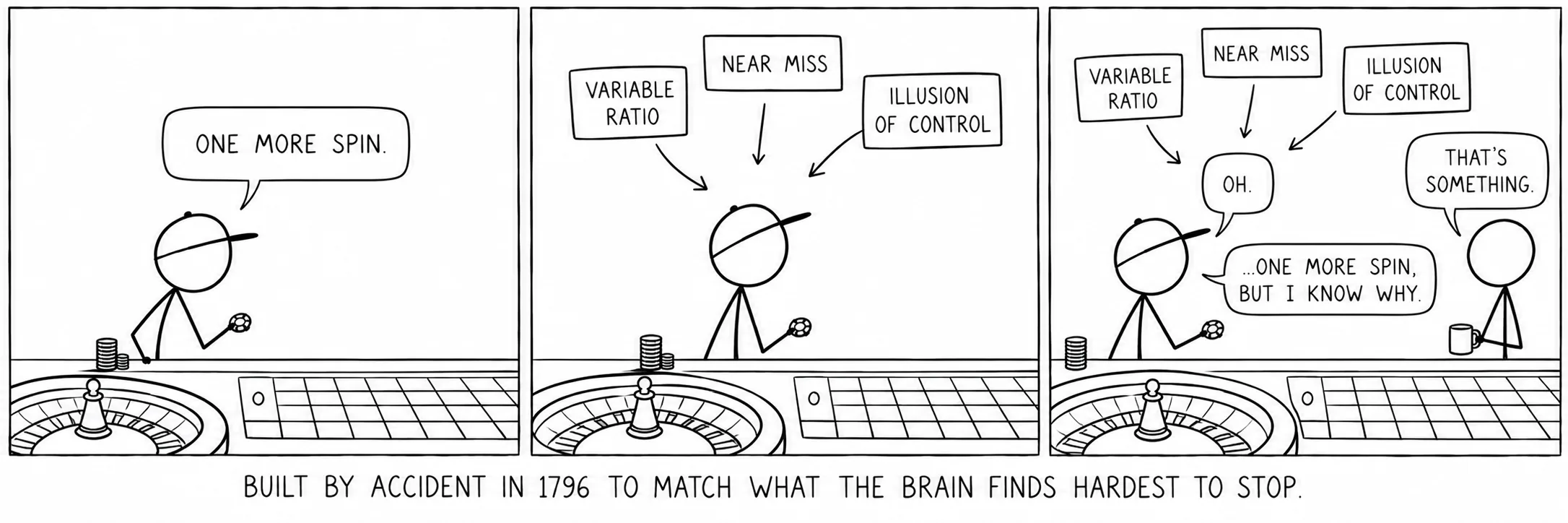
Built by accident in 1796 to match what the brain finds hardest to stop.
Sources
- Langer, E. J. “The illusion of control.”
- Clark, L. et al. “Gambling near-misses enhance motivation to gamble and recruit win-related brain circuitry.”
- Schüll, N. D. Addiction by Design.