Labouchère
Write a line of numbers. Bet the sum of the ends. Cross them off after a win, add the lost bet after a loss.
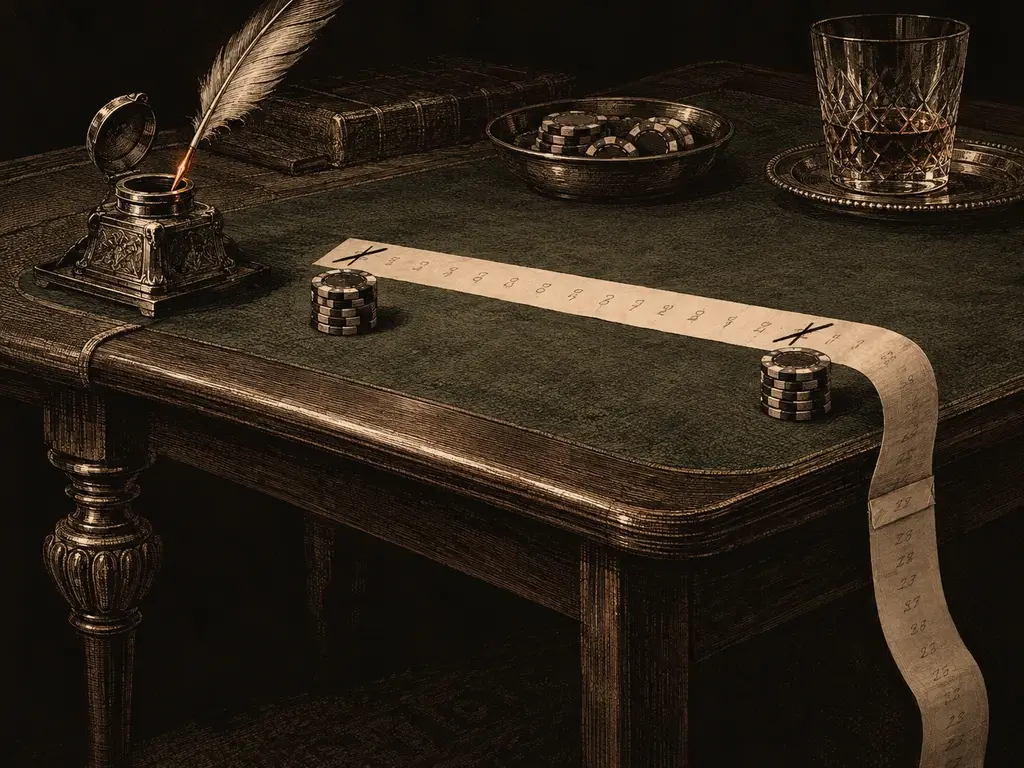
It does not beat the wheel. Completing the line wins its total. The line grows in losing stretches, and the stakes with it. Expected loss: 2.70% of everything wagered.
Walk the system
The stake is the first number plus the last. A win crosses both off. A loss writes the stake at the end.
Stakes and results are in units of the base bet.
How does the Labouchère system work?
Decide how much you want to win, say 10 unitsmoneyUnitThe base stake a system or a player works in. Progressions are described in units so they apply at any table.Read full →, and write it as a line of numbers that add up to it: 1 2 3 4. Each bet is the first number plus the last: 1 + 4 = 5. Win, and cross off both ends; the line is now 2 3. Lose, and write the stake at the end: 1 2 3 4 5. Keep going until the line is empty, which means you have won 10 units, or until you cannot afford the next bet. It works like a to-do list on which every job done removes two items and every job failed adds a bigger one at the bottom.
Why does the line usually clear?
Each win removes two numbers; each loss adds one. The line shrinks whenever wins are more than half as frequent as losses, which on even money (48.6%) they usually are. Most lines clear. That is the appeal and the trap: the sessions in which the line does not clear are the ones in which losses have outnumbered wins by two to one for a while, and by then the numbers on the line, and the stakes, have grown large.
- p10 −$500
- p25 −$500
- median −$500
- p75 −$500
- p90 +$1,570
Does the Labouchère system work?
No. Most lines clear, and the ones that do not cost more than the cleared ones won. Starting from 1 2 3 4, a run of eight losses produces the line 1 2 3 4 5 6 7 8 9 10 11 12 and a next bet of 13 units, with 68 units already lost. At $10 a unit that is a $130 bet and $680 down. Eight even-money losses in a row has probabilitymathProbabilityChance of an outcome, from 0 to 1 or 0% to 100%. One number: 1/37 = 2.70%.Read full → (19/37)⁸ ≈ 0.5% from any starting point, and a 200-spin session offers many starting points. Unlike MartingalestrategyMartingaleProgression that doubles the bet after each loss. See the Strategy section for what it does and does not do.Read full →, a single win does not fix it; you need the line to clear, which takes several more wins than losses.
How much money does a short line need behind it?
The shortest common line, 1 2 3, wins 6 units. We simulated two million such lines on redbetRedEven-money bet on the 18 red numbers. French: rouge.Read full → on a European wheel with no table maximum and recorded the most money each line ever needed: the losses so far plus the next bet. Half the lines never needed more than 9 units. One in ten needed more than 79 and one in fifty more than 490, and to finish 99 lines in 100 a player needs about 1,050 units behind a 6-unit target. Even with no zerowheelZeroThe single green pocket that no even-money, dozen or column bet covers; the source of the house edge. Also: single zero, 0.Read full →, in a fair gamemathFair gameA game in which neither side has an edge: every bet has an expected value of zero.Read full →, it would take about 700. With less behind it the line is sometimes lost, and one lost line costs more than many finished lines have won.
Are there other versions?
Reverse LabouchèrestrategyLabouchèreCancellation system: write a line of numbers, bet the sum of the two ends, cross them off after a win, add the lost stake after a loss.Read full → adds after a win and crosses off after a loss, turning it into a positive progressionstrategyProgressionAny rule that changes the stake based on previous results. Negative progressions raise it after losses, positive after wins.Read full → with a built-in stop. Splitting a long line into two shorter ones (“1 2 3 4 5 6” into “1 2 3” and “4 5 6”) lowers the stakes and doubles the number of lines to clear. Starting with a single number is just flat bettingstrategyFlat bettingWagering the same amount every spin. The baseline every progression is compared against.Read full → with a target.
Did the reverse Labouchère beat the casino at Nice?
In the reverse version a win adds the stake to the end of the line and a loss crosses off both ends. A line that empties has cost its total, 10 units for 1 2 3 4; a line that keeps winning grows its bets until the next one would pass the table maximum, and then the player banks the profit and starts again. It is the Labouchère turned inside out: many small losing lines and a rare large win. Norman Leigh’s book Thirteen Against the Bank (1976) tells how his team used it on all six even chances at Nice in 1966, and a later retelling claims that 96 of 100 practice sessions won (Goldman, 2007). That is backwards. In our simulation most sessions lose and a few win big, and the higher the maximum, the rarer and larger the wins. The cost is the same 1.35% of turnovermoneyTurnoverThe total amount wagered over a session or period, counting re-bet winnings. Also: handle, action.Read full → with la partageruleLa partageFrench rule: when zero hits, half of an even-money stake is returned. Halves the house edge on those bets to 1.35%.Read full → whatever the maximum.
Who was Labouchère?
Henry Labouchère (1831–1912), journalist, theater owner and Liberal MP, popularized the system in London society and is said to have used it at Monte Carlo. The cancellation method predates him. It has never been shown to change the expected lossmathExpected lossExpected value times total amount wagered; the average amount lost over a session or a period.Read full →, which is the sum of the stakes divided by 37.
Simulator · Labouchère
2,000 sessions of even-money bets from a $1,000 bankroll.
Base bet $10 · table limit $500 · 100 spins per session
How often a losing streak comes
An even-money bet on a single-zero wheel loses 19 spins in 37. Each row is the chance that a given run of spins all lose, and what a Labouchère player, who starts with the line 1 2 3 4 and writes every lost stake at its end, has lost by then.
| losses in a row | chance | about 1 in | lost so far | next bet |
|---|---|---|---|---|
| 1 | 51.4% | 2 | $5 | $6 |
| 2 | 26.4% | 4 | $11 | $7 |
| 3 | 13.5% | 7 | $18 | $8 |
| 4 | 7.0% | 14 | $26 | $9 |
| 5 | 3.6% | 28 | $35 | $10 |
| 6 | 1.8% | 55 | $45 | $11 |
| 7 | 0.94% | 106 | $56 | $12 |
| 8 | 0.48% | 207 | $68 | $13 |
| 9 | 0.25% | 403 | $81 | $14 |
| 10 | 0.13% | 784 | $95 | $15 |
| 11 | 0.065% | 1527 | $110 | $16 |
| 12 | 0.034% | 2974 | $126 | $17 |
| 13 | 0.017% | 5792 | $143 | $18 |
| 14 | 0.0089% | 11279 | $161 | $19 |
| 15 | 0.0046% | 21965 | $180 | $20 |
The chance is 19/37 multiplied by itself once per loss, counted from one given spin. A long session has many spins where such a run can start, so over an evening it is far more likely than one row suggests.
Questions
Stakes grow more slowly, so the cliff is rarer and the climb is longer. Expected loss per unit wagered is identical.
A short one with small numbers. It limits the stakes and the time to clear; it does not change the edge.
Yes. Your result is simply the running total at that moment.
Fun with Math
Try these yourself first. Each solution is folded; open it when you are ready.
Start the standard LabouchèrestrategyLabouchèreCancellation system: write a line of numbers, bet the sum of the two ends, cross them off after a win, add the lost stake after a loss.Read full → with 1 2 3 4 5, a target of 15, and lose the first four bets. What is the line, how much are you down, and what is the next bet?
Show the solution
Answer The line is 1 2 3 4 5 6 7 8 9, you are 30 unitsmoneyUnitThe base stake a system or a player works in. Progressions are described in units so they apply at any table.Read full → down, and the next bet is 10.
The bets are 1 + 5 = 6, then 1 + 6 = 7, 1 + 7 = 8 and 1 + 8 = 9. Each loss is written at the end of the line. Lost so far: 6 + 7 + 8 + 9 = 30.
The line now sums to 45: the target of 15 plus the 30 lost. Clearing it still wins exactly 15. Each win crosses off two numbers, so it takes at least five more wins, starting with a 10-unit bet, and every loss on the way makes the line longer again.
Bartschelly’s “Guaranteed Roulette System” starts with 1 1 1 1 1 2 2 2 2 2, a target of 15. After a loss it does not write the lost amount at the end: it adds it one unit at a time to the last numbers of the line. Lose three bets. What is the line, how much are you down, and what is the next bet?
Show the solution
Answer The line is 1 1 1 1 1 3 4 5 5 5, you are 12 units down, and the next bet is 6, exactly as in standard Labouchère.
First bet: 1 + 2 = 3. It loses, and 1 unit goes on each of the last three numbers: 1 1 1 1 1 2 2 3 3 3.
Second bet: 1 + 3 = 4. It loses: 1 1 1 1 1 2 3 4 4 4.
Third bet: 1 + 4 = 5. It loses: 1 1 1 1 1 3 4 5 5 5. Lost: 3 + 4 + 5 = 12, and the line sums to 27.
Standard Labouchère from the same start would have the line 1 1 1 1 1 2 2 2 2 2 3 4 5, also summing to 27, with the same next bet of 6. The line stays ten numbers long, which looks reassuring, but the stakes rise just the same.
You play the Labouchère with the line 1 2 3 4. So far you have lost 12 bets and the line is not yet crossed out. How many wins in all does it need? What if you had lost 13?
Show the solution
Answer 8 wins with 12 losses, 9 wins with 13. Either way the line ends 10 units up, although you won fewer than half of your bets.
Count the numbers on the line. It starts with 4. Each loss writes one more; each win crosses off two, or the last one if only one is left. After W wins and L losses, 4 + L − 2W are left, so the line is gone as soon as 2W is at least 4 + L.
12 losses: 2W must reach 16, so 8 wins, 20 bets in all. 13 losses: 2W must reach 17, so 9 wins, 22 bets.
The order of wins and losses does not change the point at which the line ends, and a finished line always pays the sum of the starting line, here 10 units. That is why the system seems to work even when you lose more often than you win. What the order does change is the size of the stakes on the way: a long string of losses can push them past your bankrollmoneyBankrollThe total amount set aside for play. Bankroll management is deciding how much of it to risk per bet and per session.Read full → or the table limittableTable limitMinimum and maximum bet allowed. The maximum is what stops doubling progressions.Read full → before the wins arrive (Epstein, 2013).
Comic relief
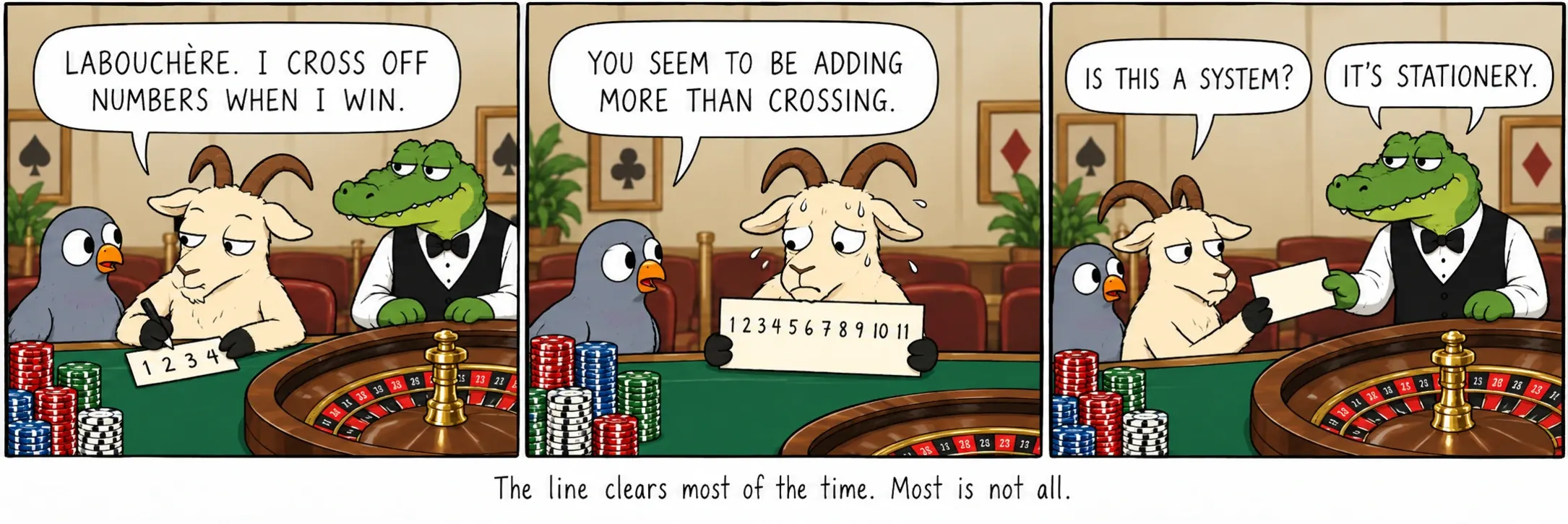
The line clears most of the time. Most is not all.
Sources
- Ethier, S. N. The Doctrine of Chances: Probabilistic Aspects of Gambling.
- Epstein, R. A. The Theory of Gambling and Statistical Logic, 2nd ed.
- Wykes, A. The Complete Illustrated Guide to Gambling.
- Leigh, N. Thirteen Against the Bank.
- Goldman, N. Great Gambling Scams.