Origin of Roulette
Several wheels, one name, a city that finally wrote it down.
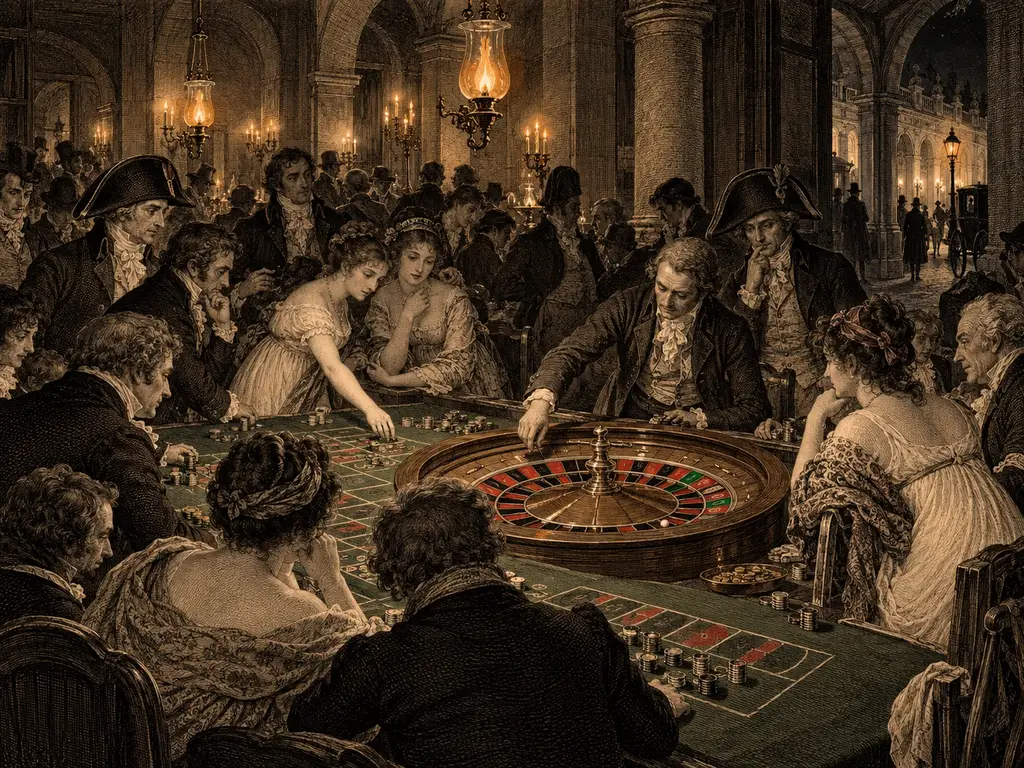
Roulette as we know it appears in Paris at the end of the 18th century, combining a spinning wheel from earlier games with a betting layout borrowed from Italian and English table games.
Ancestors
Three older games supplied the parts. English E.O. (“even-odd”) wheels of the 1740s had a spinning wheel with forty pocketsequipmentPocketOne of the 37 numbered compartments on the rotor. Also: slot, cup.Read full → marked E or O and a ballequipmentBallThe small ball launched along the track against the rotor. Modern balls are ivorine or Teflon, 18–21 mm.Read full → launched against it; they were banned in 1745 and kept being played anyway. Roly-poly, an earlier English game, was similar. The Italian lottery game biribi, said to have started in Genoa around 1750 and known in France as cavagnole, used a board of 70 numbers on which players staked and a bag from which a number was drawn; a winning number paid back 64 times the stake, the stake included (63 to 1), so the banker kept 6 of every 70 unitsmoneyUnitThe base stake a system or a player works in. Progressions are described in units so they apply at any table.Read full → staked, an edge of 8.57%. Casanova, who played it in the 1760s, called it a game for cheats, and France banned it in 1837. It contributed the idea of a layoutequipmentLayoutThe printed betting grid on the table. Also: table, felt, cloth.Read full → of numbers with a long-odds payoutmoneyPayoutWhat a winning bet returns, quoted as “X to 1” on top of the returned stake.Read full →. Hoca, played at the French court in the 1600s, had thirty numbers and a house edgemathHouse edgeThe share of each stake the casino keeps on average: 2.70% in European roulette.Read full → built on reserved slots. None of them is roulette; together they are its parents.
Hoca at the French court: thirty numbers, house slots. Banned by Louis XIV, played anyway.
Biribi in Italy and France: numbered board, number drawn from a bag, long odds.
E.O. wheels in English gaming houses: a spinning wheel, a ball, even or odd. Banned 1745.
Paris combines wheel and numbered layout. Both 0 and 00 are house pockets.
The Palais-Royal game that Lablée’s novel (1801) describes in recognizable detail.
Paris, 1796
The novel La Roulette, ou le Jour by Jaques Lablée, published in 1801, describes a wheel in the Palais-Royal in 1796 with the numbers 1 to 36, a redbetRedEven-money bet on the 18 red numbers. French: rouge.Read full → zerowheelZeroThe single green pocket that no even-money, dozen or column bet covers; the source of the house edge. Also: single zero, 0.Read full → and a blackbetBlackEven-money bet on the 18 black numbers. French: noir.Read full → double zerovariantDouble zeroThe 00 pocket of the American wheel. Its presence raises the house edge from 2.70% to 5.26%.Read full → reserved for the house, and a layout with the inside and outside betsbetOutside betA bet on the boxes surrounding the grid: dozens, columns and even-money bets.Read full → more or less as they exist today. It is the first complete description and it is already the modern game. The Palais-Royal was Paris’s gambling quarter, licensed and taxed, until the ban of 1837 pushed the game to the German spa towns.
The name
Roulette is French for “little wheel”. The word was in use for other wheel games before it settled on this one: a 1758 regulation for New France, the French colony on the St Lawrence, already banned “dice, hoca, faro and roulette”, as Shelley (1988) reports, without saying what that roulette looked like. In early English sources the game is sometimes called “roulet” or described as “the French E.O.”. By the 1820s “roulette” meant one specific game everywhere in Europe.
The two zeros
The original Paris wheels had both 0 and 00, which gave the house an edge of 5.26% on a 38-pocket wheel. The single-zero wheel was a commercial move by the Blanc brothers at Bad Homburg in 1843, designed to draw players from rival spas. The American wheel kept both zeros because the game had reached America before the change and nobody there had a competitor to undercut. Some early American wheels went further: one 19th-century layout had only the numbers 1 to 28 with 0, 00 and an eagle, paid a single number 27 for 1, an edge of 12.90%, and took 9.68% on its columnsbetColumnTwelve numbers in one vertical column of the layout, pays 2:1.Read full → and colors. It did not last.
Why it spread
Roulette needs no skill, settles every minute, and lets any number of players bet at once against a house that cannot lose in the long run. For an operator it is the ideal game: fast, simple, scalable and profitable at a known rate. For a government it is taxable. The game followed money and licenses from Paris to Homburg to Monaco to everywhere.
What has not changed
The layout, the payouts (36/n − 1), the fixed sequence of a round and the role of the dealer are the same in Lablée’s description as on a live stream today. The wheel sequence, the deflectorsequipmentDeflectorOne of the metal obstacles on the apron that scatter the falling ball. Also: canoe, diamond, pin.Read full → and the low fretsequipmentFretThe metal divider between two pockets on the wheel.Read full → are 19th-century refinements against players who had learned to watch the ball. The single zero is the only change that touched the odds, and it made them better.
Questions
He experimented with spinning wheels in the 1650s for other reasons. The attribution is traditional, not documented. See his page.
Licensed in the Palais-Royal until 1837, then banned until 1907, when casinos in spa and seaside towns were permitted again.
To alternate colors strictly and spread high/low and odd/even. The exact sequence was settled in the 19th century and has not changed.
Fun with Math
Try these yourself first. Each solution is folded; open it when you are ready.
Biribi paid back 64 for 1 on one number out of 70, the stake included: 63 to 1. What edge is that? If it had offered a bet on two numbers, what payoutmoneyPayoutWhat a winning bet returns, quoted as “X to 1” on top of the returned stake.Read full → would keep the same edge?
Show the solution
Answer The edge is 6/70, 8.57%. A two-number bet would pay 31 to 1, a whole number.
A single number wins once in 70 draws and pays 63 unitsmoneyUnitThe base stake a system or a player works in. Progressions are described in units so they apply at any table.Read full →; the other 69 draws lose 1: (63 − 69)/70 = −6/70, an edge of 8.57%. Put another way, the bank pays 64 back where a fair gamemathFair gameA game in which neither side has an edge: every bet has an expected value of zero.Read full → would pay 70.
A two-number bet at x to 1 wins twice in 70 draws: 2x units won against 68 lost, an expected valuemathExpected valueThe average result per bet over the long run. −1/37 of the stake for every standard European bet.Read full → of (2x − 68)/70. Set 2x − 68 = −6: x = 31. That is 32 back for 1, half of 64.
Biribi’s payouts follow 64/n back for 1, and 64 halves cleanly for 1, 2, 4, 8, 16 and 32 numbers, so those bets come out whole. Roulette’s 36 divides by 1, 2, 3, 4, 6, 9, 12, 18 and 36, which suits a layoutequipmentLayoutThe printed betting grid on the table. Also: table, felt, cloth.Read full → of rows of three.
Biribi’s 70 numbers, laid out in rows, left room for four three-number bets. By the rule behind the single number’s 8.57% edge, what should a three-number bet pay? What would the nearest whole payouts cost?
Show the solution
Answer 20⅓ to 1. Paying 20 to 1 would cost 10%; paying 21 to 1, 5.71%.
The rule from the puzzle above: a bet on n numbers pays 64/n back for 1. For three numbers that is 64/3 = 21⅓ back, or 20⅓ to 1, which no chipmoneyChipA token representing a fixed amount, placed on the layout to make a bet. Also: check.Read full → can pay.
A three-number bet at x to 1 wins 3 times in 70 draws and loses 67 times: an expected value of (3x − 67)/70. At 20 to 1: −7/70, 10%. At 21 to 1: −4/70, 5.71%.
Rounding down by a third of a unit costs the player almost a point and a half; rounding up gives back nearly three points. Thirty-six, with its many divisors, spares roulette that choice on every bet but the American five-number one.
The 19th-century eagle wheel had 31 pocketsequipmentPocketOne of the 37 numbered compartments on the rotor. Also: slot, cup.Read full →, 1 to 28 plus 0, 00 and an eagle, and paid 27 for 1 on a single number. Its columnbetColumnTwelve numbers in one vertical column of the layout, pays 2:1.Read full → and color bets cost 9.68%. What should a four-number bet pay, “for 1”, to cost the same?
Show the solution
Answer 7 for 1, which costs 3/31 = 9.68%.
A bet that pays X for 1 hands back X units, stake included, when it wins. A four-number bet wins 4 times in 31, so it returns 4X units for every 31 staked: an expected value of (4X − 31)/31.
At 7 for 1 that is −3/31, 9.68%, the same as the columns and colors. At 8 for 1 it would be +1/31, an edge for the player. So the eagle wheel’s rule was (28 − n)/n to 1, three house pockets out of 31.
Comic relief
English wheel, Italian layout, French name, two zeros.
Sources
- Lablée, J. La Roulette, ou le Jour.
- Kavanagh, T. M. Dice, Cards, Wheels: A Different History of French Culture.
- Schwartz, D. G. Roll the Bones: The History of Gambling.
- Bollman, M. Mathematics of the Big Four Casino Table Games: Blackjack, Baccarat, Craps, & Roulette.
- Shelley, R. Roulette Wheel Study.
- Dictionnaire de l’Académie française, 4th ed.