James Bond Strategy
A fixed spread of 20 units: 14 on 19–36, 5 on the 13–18 six line, 1 on zero.
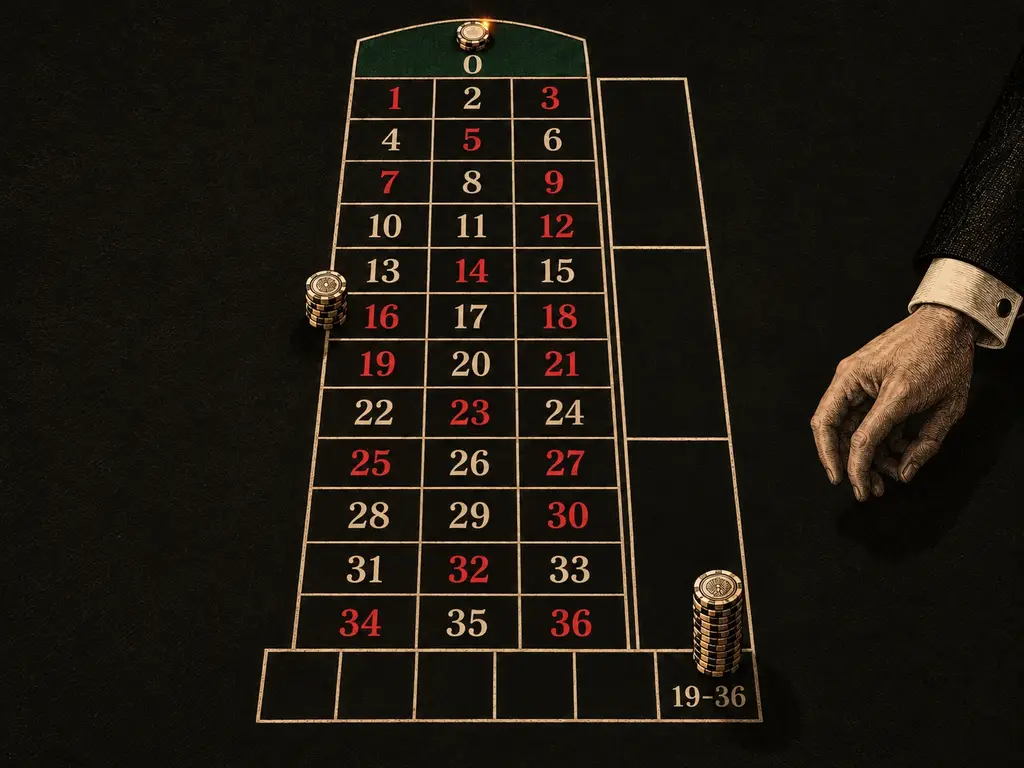
Covers 25 of 37 numbers. Wins 67.6% of spins. Loses 20 units on 1–12. Expected valuemathExpected valueThe average result per bet over the long run. −1/37 of the stake for every standard European bet.Read full →: −2.70% of 20 units, like everything else.
What is the James Bond bet?
Twenty unitsmoneyUnitThe base stake a system or a player works in. Progressions are described in units so they apply at any table.Read full → per spin, split three ways: 14 units on high (19–36), 5 units on the six linebetSix lineSix numbers in two adjacent rows, pays 5:1. French: sixain.Read full → 13–18, 1 unit straight upbetStraight upA single number, pays 35:1.Read full → on zerowheelZeroThe single green pocket that no even-money, dozen or column bet covers; the source of the house edge. Also: single zero, 0.Read full →. Twenty-five numbers are covered; the twelve numbers 1 to 12 are not. Despite the name, the spread is not in Ian Fleming’s novels: in Casino Royale (1953) Bond backs two dozensbetDozen1–12, 13–24 or 25–36, pays 2:1.Read full → at the table maximum. Who first attached Bond’s name to this spread is not known.
What does each result pay?
19–36 hits (18 numbers): high pays 14, the six line and zero lose 6, net +8. 13–18 hits (6 numbers): the six line pays 25, high and zero lose 15, net +10. Zero hits: 35 − 19 = +16. 1–12 hits (12 numbers): everything loses, −20.
What does a session look like?
Two spins in three you win 8 to 16 units; one spin in three you lose 20. Over 37 average spins: 18 × 8 + 6 × 10 + 16 = 220 won, 12 × 20 = 240 lost, net −20 on 740 wagered. It feels like winning because it mostly is, and the losing third costs more than the winning two thirds earn. It is, in payoutmoneyPayoutWhat a winning bet returns, quoted as “X to 1” on top of the returned stake.Read full → shape, a slightly lumpier version of betting two dozens.
- p10 −$500
- p25 −$500
- median −$360
- p75 +$0
- p90 +$280
What if you double it after a loss?
Some players double the whole spread after a losing spin (1–12). Twelve numbers lose 32.4% of the time, so two losses in a row happen one spin in ten and the stake reaches 80 units quickly; a table limittableTable limitMinimum and maximum bet allowed. The maximum is what stops doubling progressions.Read full → of $500 on the total stake at $1 units is hit after five losses (20, 40, 80, 160, 320, then 640). It is a MartingalestrategyMartingaleProgression that doubles the bet after each loss. See the Strategy section for what it does and does not do.Read full → with a steeper cliff, and the same −2.70%.
Why is it popular?
It gives the player a lot to watch: three bets, four outcomes, and a win on most spins. The zero chipmoneyChipA token representing a fixed amount, placed on the layout to make a bet. Also: check.Read full → in particular feels like insurance. It is also easy to remember and easy to say to a dealer. None of that is a criticism; it is a perfectly ordinary set of roulette bets with a famous name. Just know what the one-in-three costs.
Questions
Neither, as far as we can find. In Casino Royale (1953) Bond backs two dozens; the spread was named after him later.
So that every winning outcome returns a profit. Scale them (140/50/10) and the proportions hold.
Same expected lossmathExpected lossExpected value times total amount wagered; the average amount lost over a session or a period.Read full →. The payouts differ: two dozens win +1 unit 64.9% of the time and lose 2 the rest; this spread wins +8 to +16 per 20 units 67.6% of the time and loses 20 the rest.
Comic relief
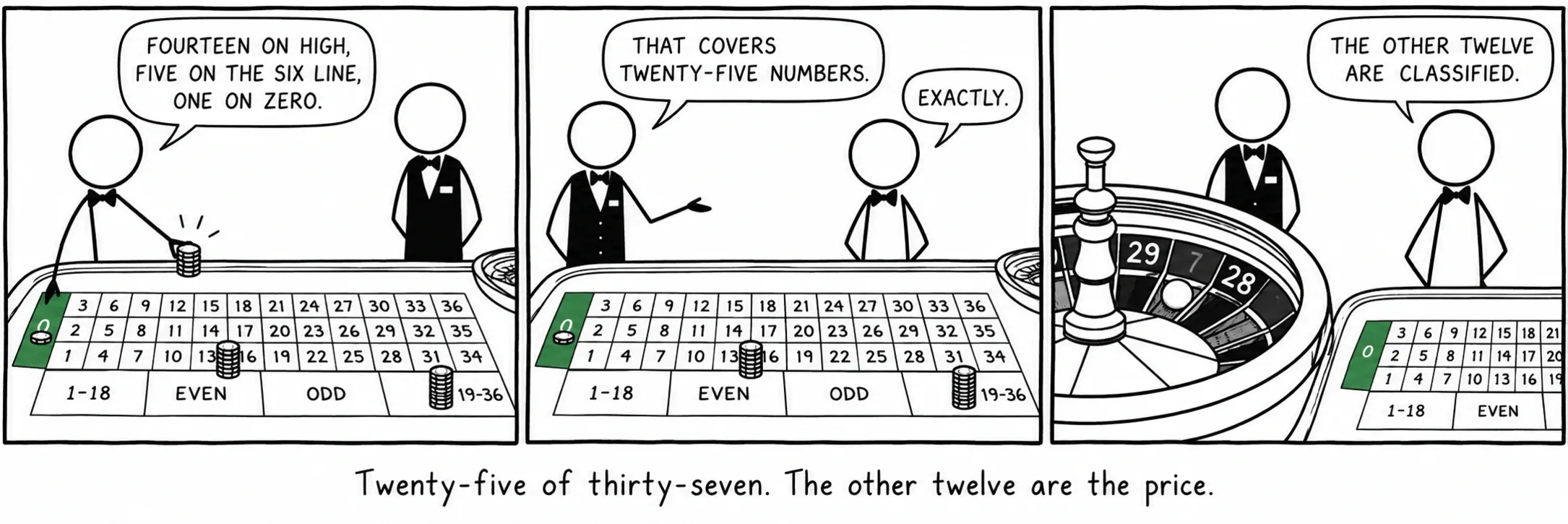
Twenty-five of thirty-seven. The other twelve are the price.
Sources
- Ethier, S. N. The Doctrine of Chances: Probabilistic Aspects of Gambling.
- Fleming, I. Casino Royale.